PreparedFaculty research, February to September 2026
The dramaturg
Faculty brought the law. I did the research on how to teach it. Open a packet to see what the studies say, in the packet’s own words with the page, and where each finding went in the course we were planning.
The packets
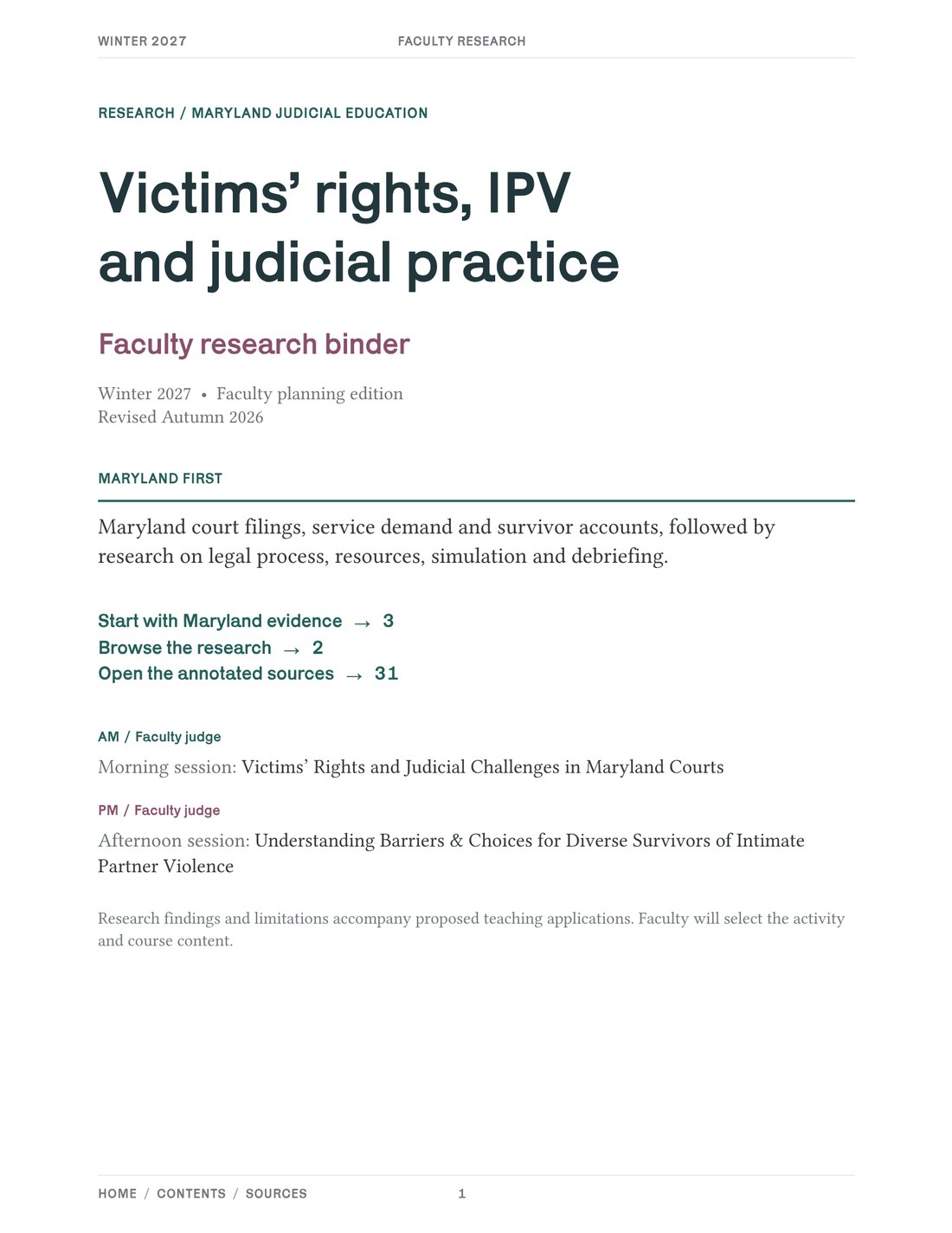 Comings and Goings course, planned for February 2027Faculty research binder: victims’ rights, IPV and judicial practice38 pages, 10 rebuilt here · 8 findings
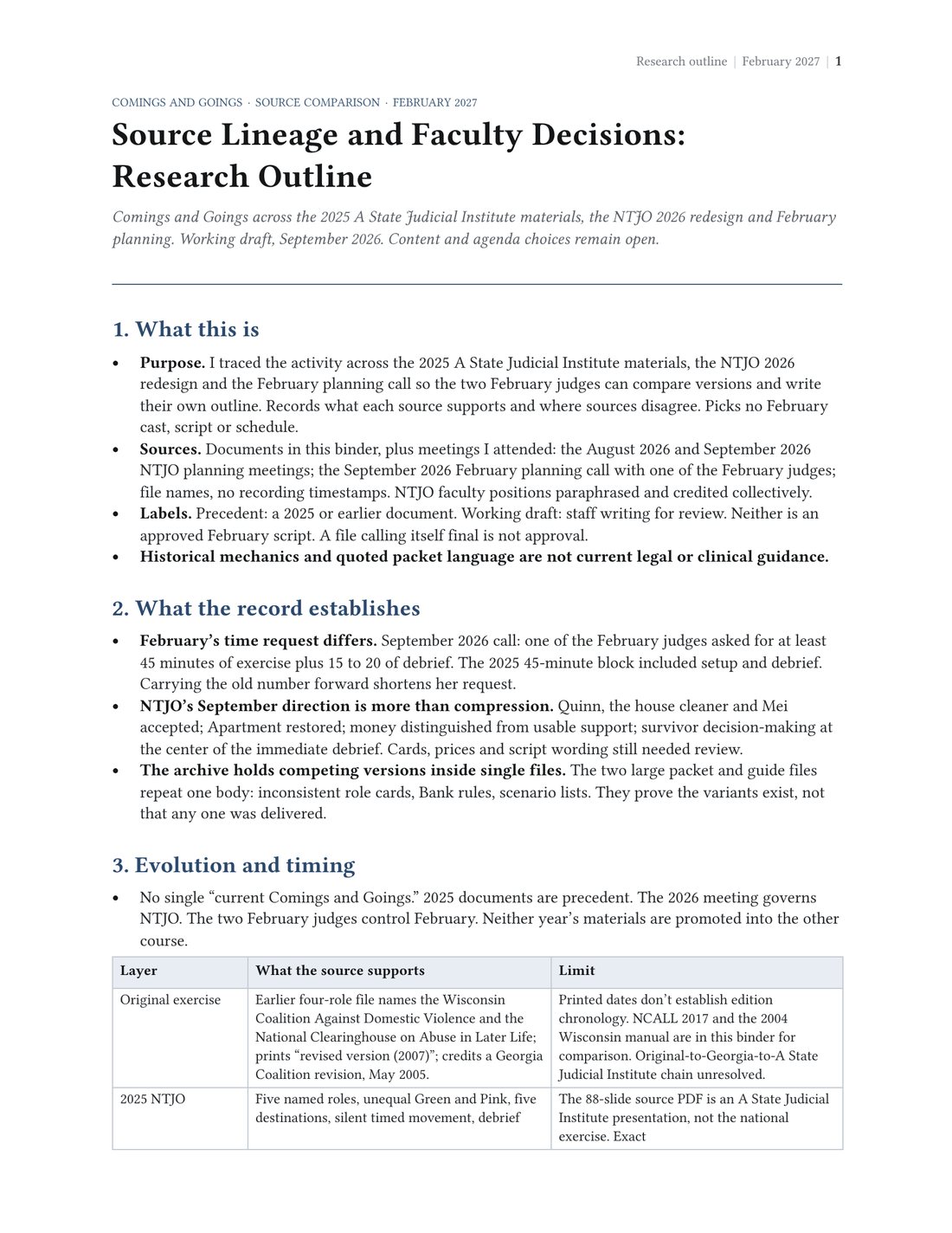 Comings and Goings course, planned for February 2027Source lineage and faculty decisions13 pages, 6 rebuilt here · 7 findings
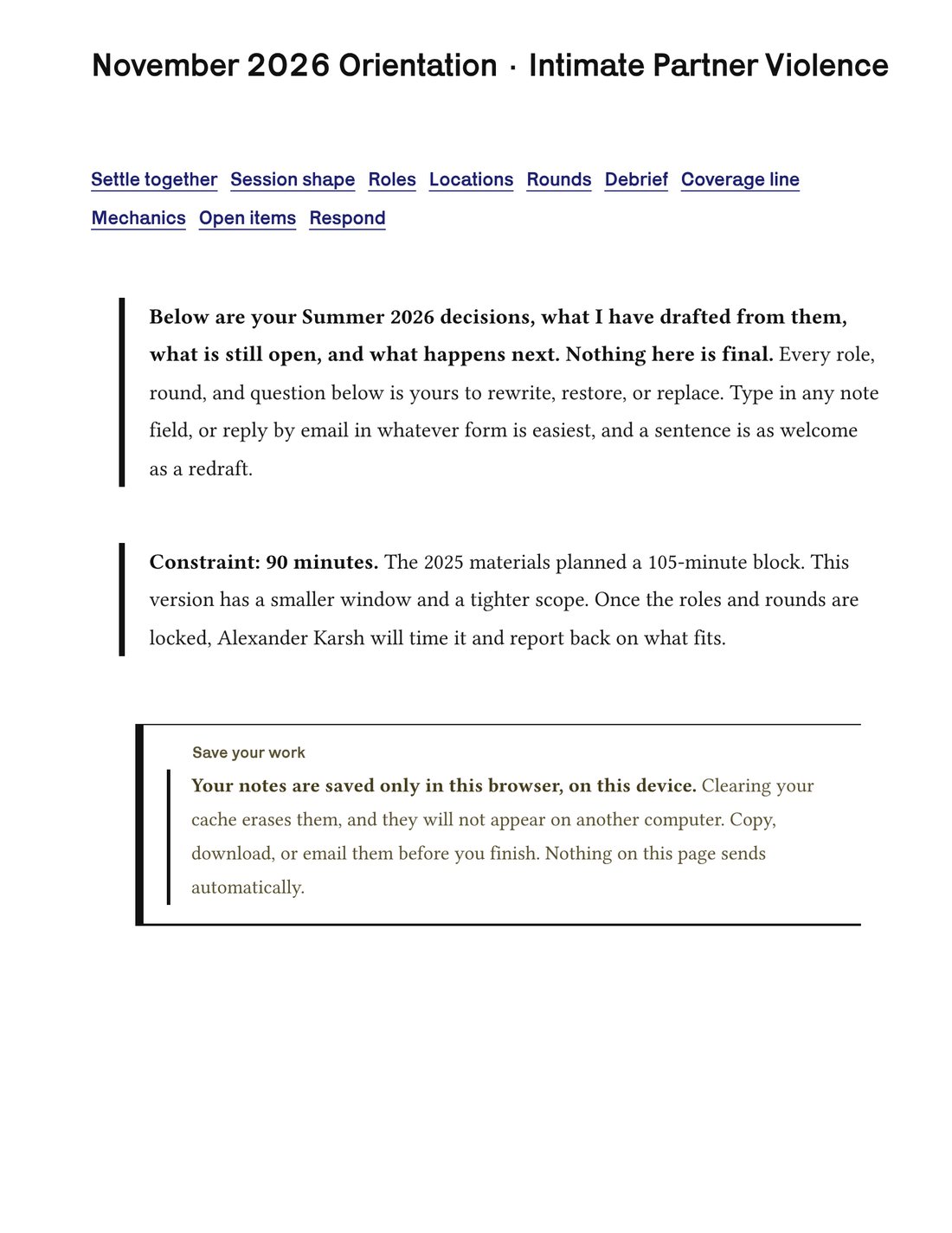 New-judge orientation simulation, November 2026Faculty working page: the intimate partner violence simulation24 pages, 6 rebuilt here · 5 findings
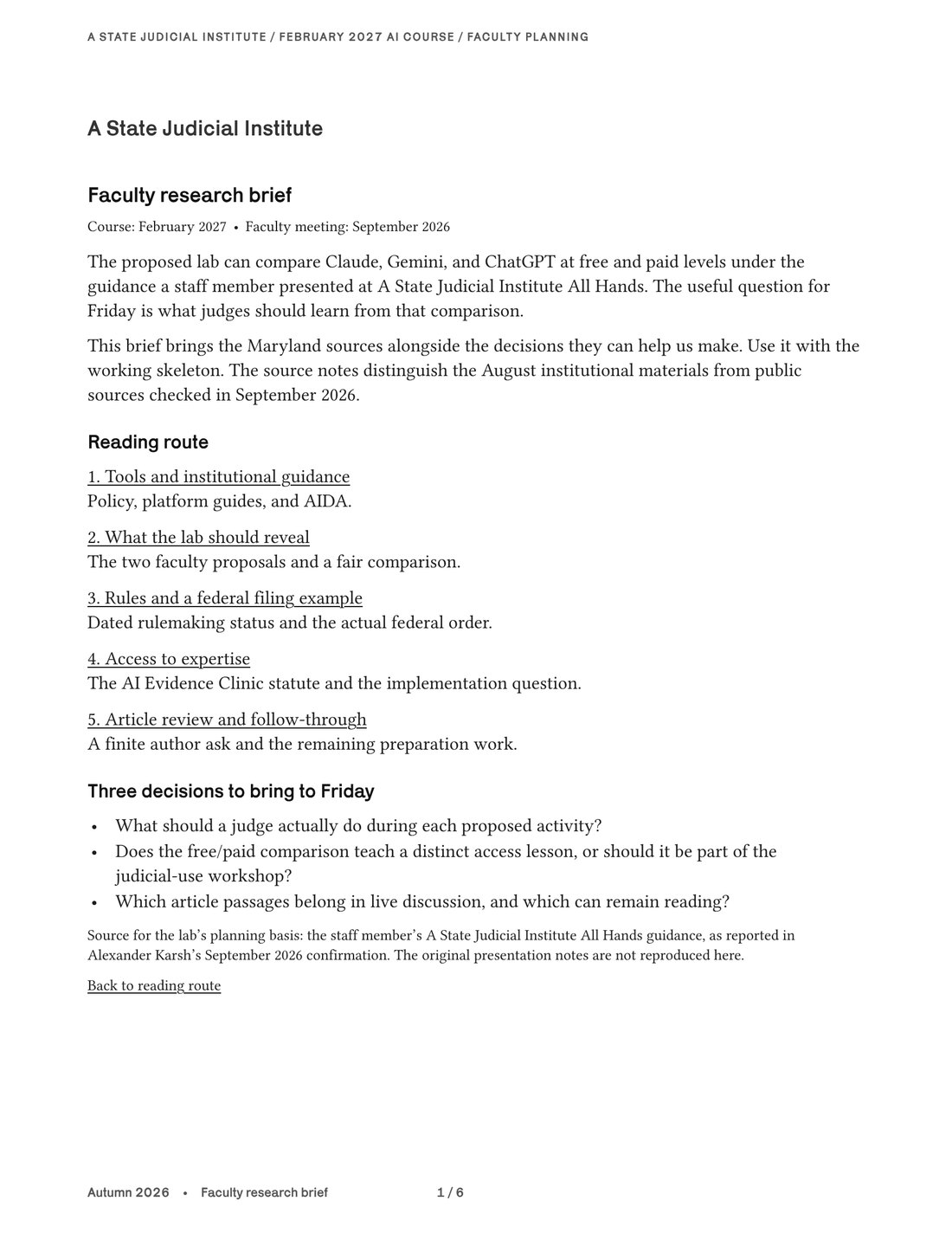 AI course for judges, planned for February 2027Faculty research brief for the AI course6 pages, all rebuilt here · 5 findings
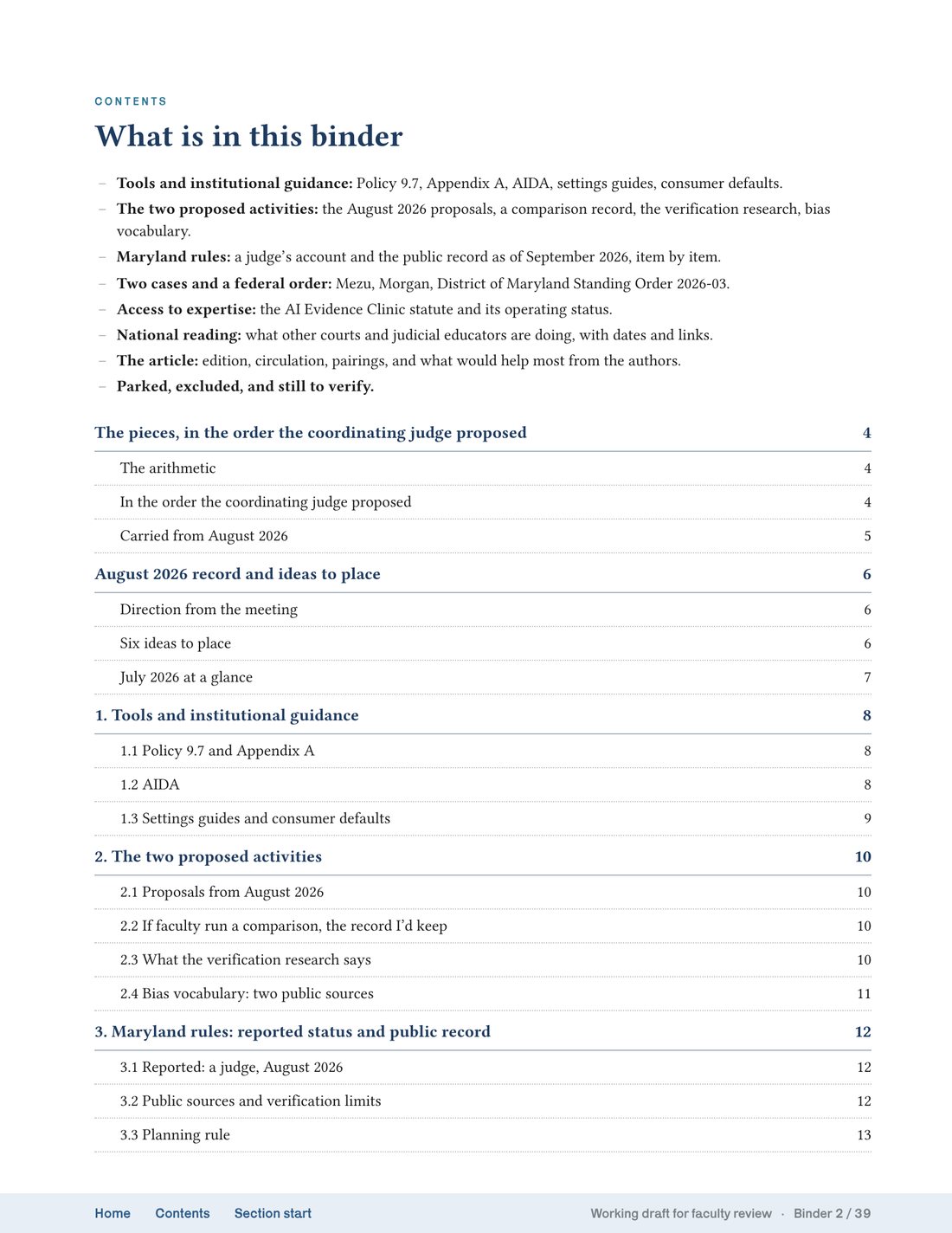 AI course for judges, planned for February 2027Faculty research binder for the AI course39 pages, 6 rebuilt here · 5 findings
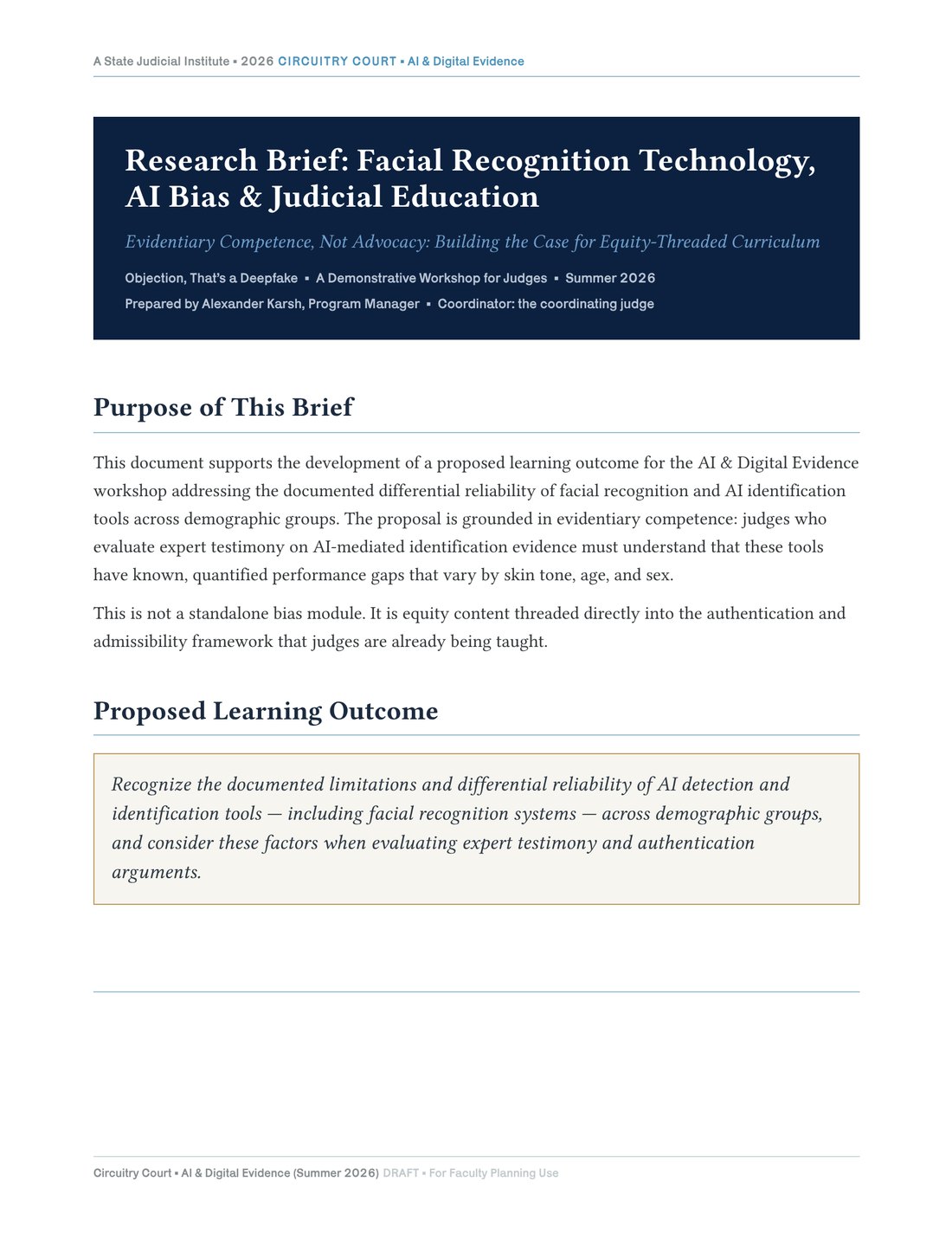 AI and digital evidence course, summer 2026Research brief: facial recognition, AI bias and judicial education4 pages, all rebuilt here · 4 findings
Where the title comes from
The word was mine. After the summer AI course, before planning started on the February one, I met one on one with the retired judge who led our AI courses. I'd told her the field was changing fast and that I could keep faculty current on AI policy. She told me research was what I was good at, and that it should be my job with this group: I'd send them the current events and the research, and they'd make the agenda. I asked her if she knew what a dramaturg does in a theater. She didn't, so I told her, and we ended up talking about plays, because she loves theater. She said yes, exactly like that.
Why I did the research
Faculty brought the law. They weren't necessarily trained educators, and they didn't have time to research teaching methods alongside their work on the bench and in practice. One of the most useful things I could offer was doing that research for them.
What I built
- Comings and Goings: an editable agenda and the 38-page research binder, sent four days after the first planning call. It covers Maryland court filings and survivor accounts, research on survivors' experience of the legal process, the evidence on simulations and on what transfers to practice, debriefing and participation, and the activity's design, with 45 annotated sources.
- The February 2027 AI course: a six-page brief in early autumn, then the 39-page binder five days later, with the court system's AI policy, two cases, a federal standing order and the national reading.
- The summer AI and digital evidence course: a February brief proposing one learning outcome, that judges recognize the documented demographic differences in how facial recognition and AI identification tools perform, and weigh those differences when evaluating expert testimony.
- The intimate partner violence simulation at the November 2026 orientation: a faculty working page, sent in late summer.
The faculty decided what went in the course. In email, the test I kept putting to them was what judges would take away: I wanted the course and its binder to be something judges actually use, on the bench or back in chambers.
What happened
Prepared. The summer course ran, and the facial recognition brief went to the coordinating judge for her decision. She was excited by it and said she might talk about it, but she gave only the opening and closing, and I don't know whether it reached the room. The other three courses were still in planning when I left in October 2026. The working page for the orientation simulation worked well: I had the judges' responses before our next planning meeting. One of the faculty on the Comings and Goings course thanked me for the binder and was grateful for the work. The AI course agenda was a working draft under faculty review. What became of either binder after I left, I don't know.
Where the words and ideas came from
I drafted the master script for Comings and Goings, the simulation for a new-judge orientation, with Perplexity, working from the transcripts of our planning meetings and the drafts that came out of them. Wherever I could, I used the words of the two judges and the clinical respondent, and where I couldn’t, I kept their idea. I took leeway too, and I’ve marked it below. I highlight them. I’m not them.
| In the planning meeting | In the script | What I did | Whose |
|---|---|---|---|
| “[…] just use your worksheet. Your worksheet is your friend. If you go through your worksheet, that is your guide for […] the law that you have to apply, the standards you have to apply […].”A faculty judge, summer 2026 | “Use the Judges Worksheet. Let it carry the legal sequence so attention remains available for the people and evidence in front of the court. […]” | The instruction is the judge’s, nearly word for word, and the reason that follows is mine. | Their words |
| “[…] they can’t completely recount to you, or they don’t tell you everything that they put on their petition that maybe they filed 90 days ago or 2 months ago. […] that’s why it’s important. […]”A faculty judge, summer 2026 | “Why might a survivor’s account emerge in pieces, change in detail, or sound less organized at a later hearing?” | I’d brought up memory, and I turned the judge’s courtroom example into a question for the clinical respondent, who’s the one to explain why an account changes. | Their idea |
| “Can you add in either Maria or [Mei], that they don’t speak English? Speak or read English.”A faculty judge, summer 2026 | “You do not speak or read English. […] Your partner handles forms and appointments.” | The judge’s words are on Maria’s card, and I added that her partner handles the forms. After the judge proposed the language barrier, I called it another form of control, and the judge agreed. | Their words |
| “[…] sometimes, you know, people can get caught up thinking this is about something that it’s not. Sometimes it’s just they’re not making decisions because there are real consequences. They don’t have anywhere to live. They have nowhere else to live.”A faculty judge, summer 2026 | “Staff tell you that your time at this Shelter has ended. You have reached the maximum stay allowed in this fictional placement. You must leave today.” | When the Shelter scene was close to being cut, the judges kept it for this reason, and in the script the narrator reads that scene only to people at the Shelter, as a faculty judge asked in the autumn. | Their idea |
| “Can we not do [Mei] and make John older? […] Because in John, we can get in the disability, we can get in the age, we can get in the pet.”A faculty judge, summer 2026“[…] I’m fine with the way you consolidated.”The same judge, autumn 2026 | “Mei owns the house and uses a wheelchair. Her partner controls household accounts and withholds help with transfers, bathing, transportation, and medication.” “Quinn has a car and an elderly cat.” | The judges wanted John, a man from the 2025 cast, to absorb Mei, and I went the other way: I kept the older woman, gave the pet to Quinn so each character carried a different barrier, and told the judges in the autumn. | My leeway |
| “I don’t even know if I would give a time frame, a specific time frame. I think I would just say some time has passed, or something.”A faculty judge, autumn 2026 | “Some time has passed.” | I used the judge’s sentence to open Rounds 2 through 6 in place of the summer draft’s “Months later” and “three days,” and I didn’t give a time frame in any round. | Their words |
| “[…] what I just love is the struggle. […] that I’m between a rock and a hard place […].”The clinical respondent, autumn 2026 | “It is the struggle: the moment when a person knows there is danger and still has to protect children, a pet, bodily care, housing, income, privacy, community, identity, and the part of the relationship that once felt like home.” | The clinical respondent said “the struggle” about the rounds as drafted, and I made it the emotional center of the whole script. | Their words |
| “Right, if nobody cares about you, go back home […]”A faculty judge, autumn 2026“Or you’ve exhausted it. […] Your best friend’s husband doesn’t want you at the house anymore.”The other faculty judge, autumn 2026 | “MONEY and SUPPORT cannot replace one another. If one reaches zero, keep the other. Zero in one resource does not send you Home. It only closes options that require what you no longer have.” | The judges wanted running out of Support to send a person Home, and I kept Money and Support separate and sent the call back to the judges, because someone with people and no money still has help, and someone with money and no people can still get a hotel room. | My leeway |
I’ve quoted faculty from the meeting transcripts, cut where marked, and used roles in place of names and seasons in place of dates. The master script is on the simulation page.