Active workflowVerification & review architecture, Maryland judicial education
How I work with AI
I use Gemini, Perplexity and Claude for research, drafting and review. I write the instructions, check the sources and outputs, and decide what goes to faculty. I also test course mechanics and audit decks against faculty decisions.
I also ran a multi-agent editing pass on my own research, with every agent cast as a class from Pathfinder: the party, the gates and where it broke.
I wrote the instructions for Slide Forge, an AI-assisted slide builder for the course decks: colors and type set in one place and checked on every build, faculty content held as labeled placeholders, and a machine-written receipt before a deck counted as done. It raised rough faculty decks to one standard for color, type and accessibility. On one faculty deck that was already well designed it flattened the design, and that deck went back to its own slides with only the colors and type matched.
The fabricated case
Early in my adoption of AI, I turned in a binder for a Fourth and Sixth Amendment course, and there was a completely fabricated case in it. A judge on the faculty had referenced cases that did A, B and C, and I asked the AI for them. The AI found A and B but didn't find C, and since it knew it was supposed to find three, it fabricated a third. The case snuck by me, and I turned the binder in to my faculty.
What I built
- A hard non-fabrication rule (BLANK IS SACRED): When a case citation, statute, procedural step, or speaker attribution cannot be verified against a primary source, the system must leave a visible placeholder (such as PENDING FACULTY INPUT or a blank field) rather than guessing.
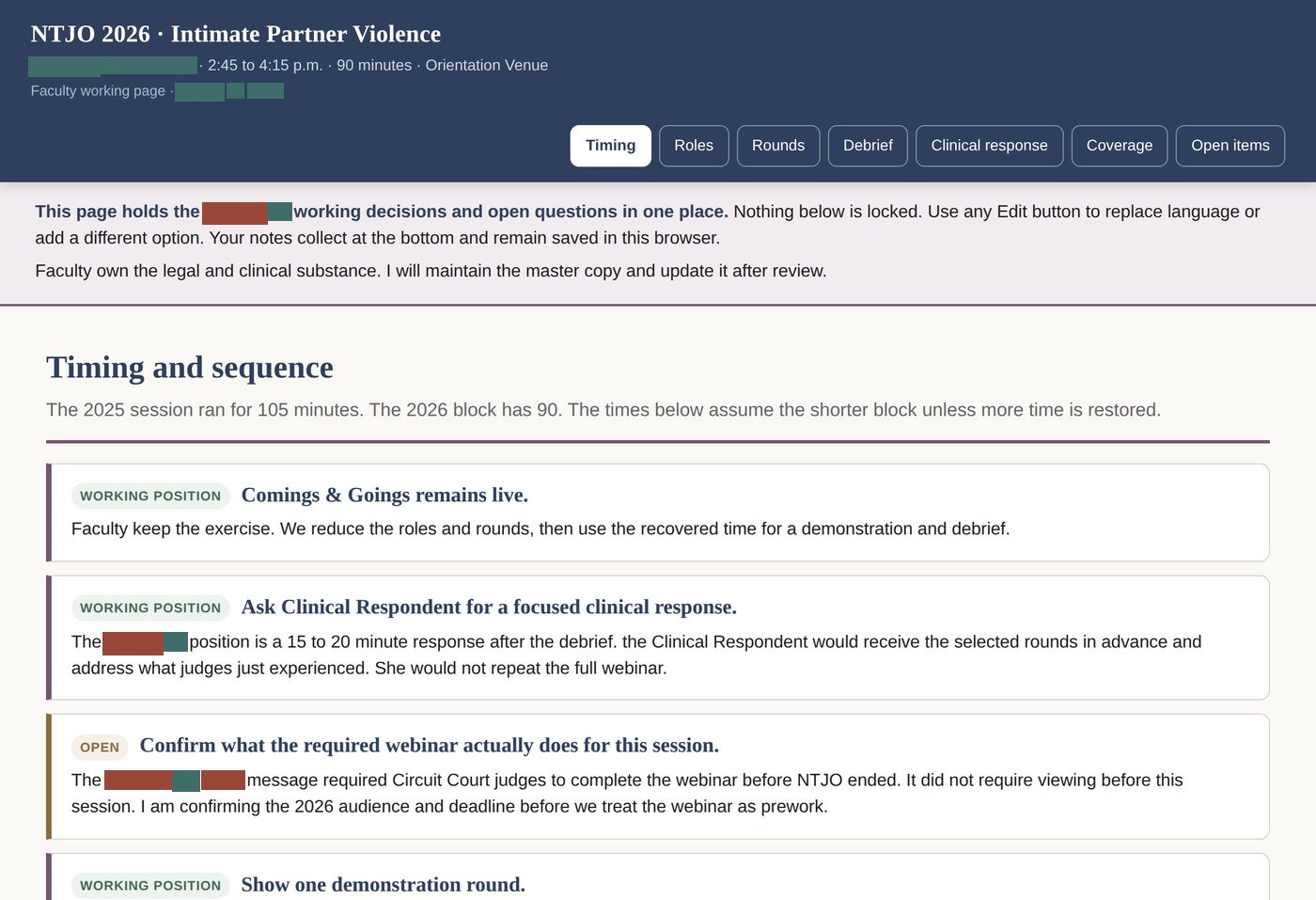
- A bilateral 5-to-7 business day review window: My rough drafts go to faculty five to seven business days before print lock, on the same schedule their drafts come to me, with working positions and open decisions tagged in one browser view.
- Adversarial prompting (Friction is the deliverable): Every AI system I use operates under a standing instruction: 'Do not blindly accept my input. Question. Verify. Challenge my thinking. Push back. Friction is the deliverable. Agreement is not.'
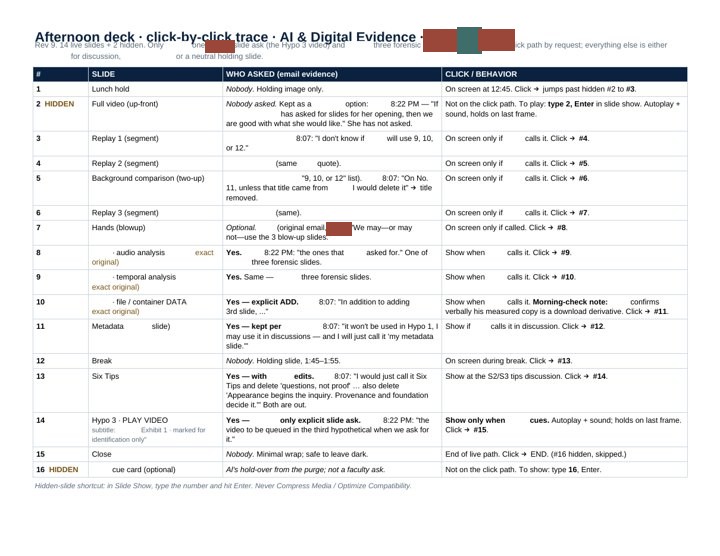
- Source-traceable synthesis across three workflows: I used this architecture to (1) audit deck builds click-by-click against faculty email requests (above), (2) compile source-checked research briefs and 39-page faculty binders with error logs (see The dramaturg), and (3) run multi-engine adversarial coding checks across 52 jurisdictions (see An Architecture of Absence).
One course first, then the rest
In August I had transcripts from a run of courses and wanted a recap of each: what was decided, who owned what, what was still open. I did not set it running across all of them. I asked for one, checked it myself, and only then released the batch.
“please produce an export per course essentially of ‘heres what yall talked about’ with any decision highlighted action items etc for each of the transcripts. cina first, i check ur work, then u do the rest once i approve”
My instruction, August 13, 2026“perfect now all the rest!”
After I had read the first oneThe recap it produced separated decisions from working agreements, named an owner for each, and kept a list of what nobody had settled. What this shows is the gate, not the output: one item, a human read, then the rest. It does not show that every later recap was right, and none of these recaps went to faculty.
Two checks that caught something
For an AI-ethics planning meeting, I sent the same research questions to Gemini, Perplexity and Claude and kept a claim-by-claim ledger of the returns and the primary-source checks. One report misdated a standing order and attributed amendments to an order that didn't contain them. I kept that report, marked void, beside the correction.
In a June deck rebuild, my automated title check missed problems visible on the rendered slides. The other corrections concerned transparency, color embedded in images and preserving faculty-supplied content. Those findings became instructions for the next pass.
My role and the tools
The faculty owned the legal content. The court system had an in-house AI, and I was encouraged to use it. My number one source was always faculty. When I made a reference tool, I pulled faculty language from their slide decks and handouts first, then searched doctrine and statutes in the in-house AI.
Other records
The faculty send kit, prepared for the summer course, separated each person's materials and marked which decisions belonged to faculty. Open the kit, seven of eight pages.