DeliveredAssessment resultsNinth-grade English, fall 2017
Friends, Romans, Ninth Graders
Master of Arts in Teaching, secondary English · Johns Hopkins University · 2018
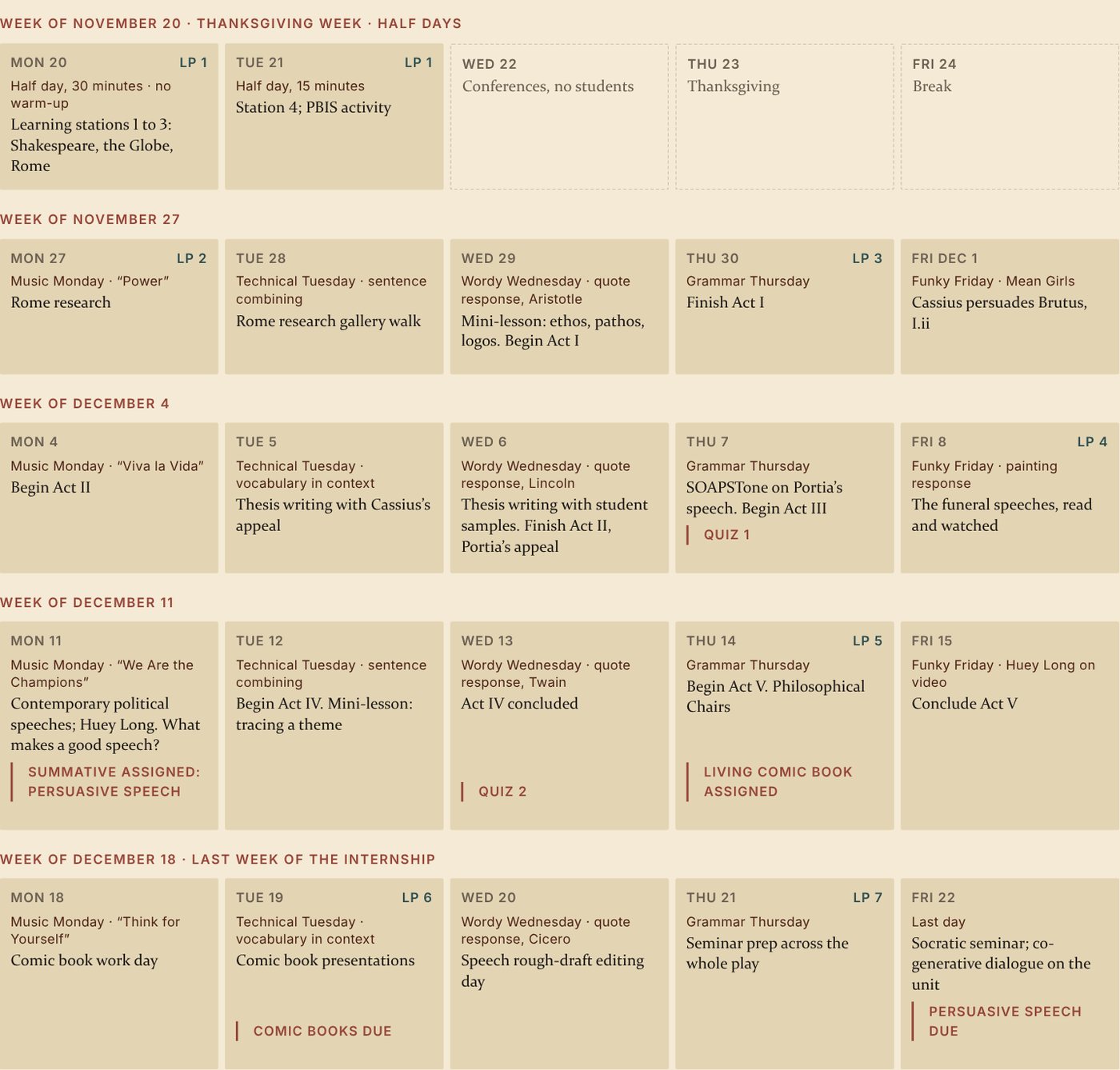
I planned and taught a Julius Caesar unit for 48 ninth graders over 22 classes, as lead teacher during my internship. The final assignment was a persuasive essay and a recorded speech.
The mini-lesson
On a pre-assessment sheet, the students had to identify persuasive appeals as ethos, pathos or logos. I used the evaluation data to construct a mini-lesson on rhetoric through alternative modalities. We watched commercials and looked at magazine ads. The ad with Superman drinking milk was ethos. The horribly manipulative advertisement with the sad dog eyes was pathos. I put a heavier focus on ethos because it was the weak point. Then I reassessed the students with a fun assignment: I was their parent, and they really wanted to go to a party Saturday night, but I wasn't letting them because we had plans to go see Ladysmith Black Mambazo. The students had to use all three tools to convince me why they needed to go.
What happened
Delivered, fall 2017, with my own assessment results. From my unit reflection, Section 5, quoted as written:
The class average on the persuasive essay was an 84% - higher than any of their formal writing assignments so far. I found, in general, a very solid understanding of ethos, pathos, and logos.
With respect to the post-assessment: I know that I will, in the future, introduce writing assignments of this magnitude earlier in the quarter.
My role
I planned the unit, taught it and wrote the reflection, as lead teacher in my mentor teacher's classes and under her oversight.
One lesson plan, written out
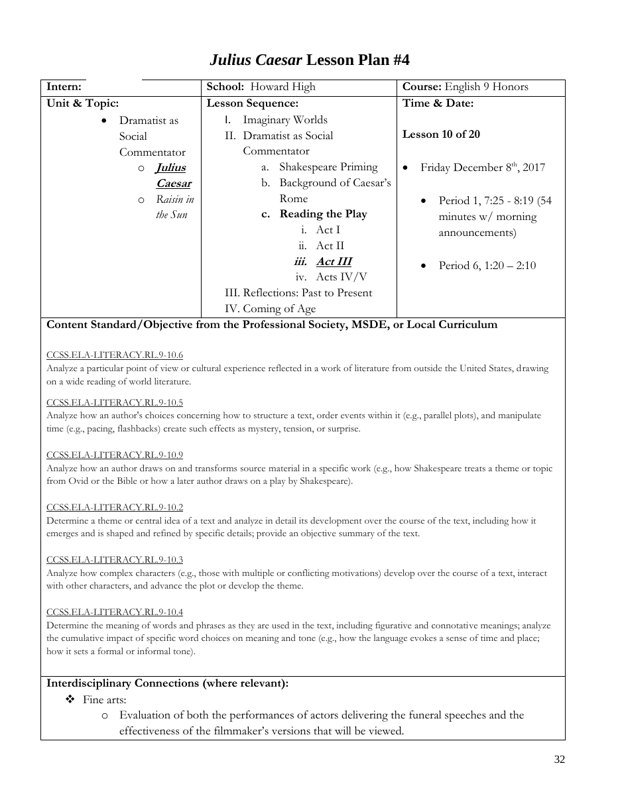
Lesson 4, minute by minute
| Time | What the plan called for |
|---|---|
| 8 minutes | Warm-up. A painting response: students were to name the mood, theme and subject of an image of Vercingetorix laying down his arms at Caesar's feet, and connect it to the text. |
| 12 minutes | Mini lesson, writing folders. Students were to rewrite the thesis from their latest essay. |
| 14 minutes | Reading the speeches. I planned to read Marc Antony, stopping the class at the most intense moments of rhetoric, and to encourage students to beat the teacher to the strong arguments. |
| 12 minutes | Watching the speeches. Students were to name Shakespearean staging conventions first, then watch a film of The Globe's production with those conventions in mind. |
| 4 minutes | Closure. The class was to compare reading the play with watching it performed. |
| Homework | Canvas journal post. Two paragraphs at most, persuading me whose speech was more effective, Antony's or Brutus's. |