Prepared2026 redesign, New Trial Judge Orientation
Comings and Goings
It's a ninety-minute simulation for new judges. Each plays one fictional person who decides, round by round, whether to stay with an abusive partner or go.
“And I think they can learn from each other when they all have different roles. They might remember. They may be empathetic and remember one of their new colleagues in one of these rooms.”
Why I redesigned it
I'd managed a domestic-violence course, and what really stuck with me was one presenter's idea: what happens when the source of a person's abuse is also the source of their happiness and sense of safety. I wanted judges to have more empathy and understanding for why a victim may repeatedly show up in court and, by the second or fourth visit, be living with the abuser again. What judges see in court, what's on the record, rarely reflects the struggles of the victims at large.
“[…] this goes to why victims stay, right? Why they stay in the home, why they go back, why there's this repeated kind of cycle.”
What I decided, and what faculty decided
- The 2025 version I was given to build from had five characters, and that year I didn't make many changes. I intentionally made one of the five a trans man, because there was no LGBT representation. That was something I authored, and it was accepted.
- At the first planning meeting for 2026, I proposed cutting the cast from five characters to three, and the judges agreed. Three roles became the working cast.
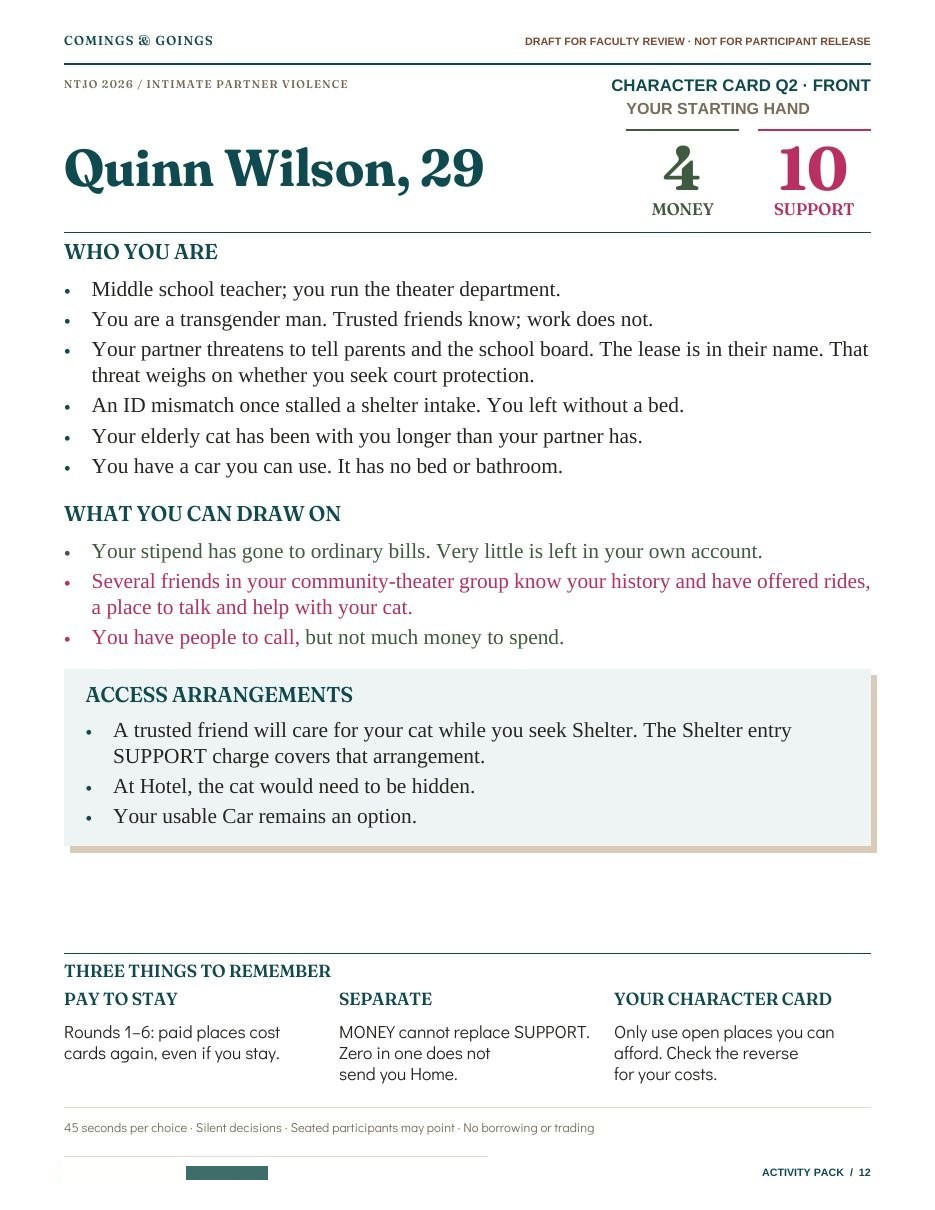
- At the second meeting, I brought up starting resources. One of the judges felt strongly that people should see that someone with no money but a lot of community goodwill might have more options than someone with a lot of money. We talked about whether one of the three characters should start rich, one medium and one poor. What I designed and then gave to faculty as a choice was to keep three characters and vary each character's starting quantities. That way we can see that a person with a lot of money is going to have different options than a person with no money but a lot of friends from work.
“I think you’ve done a great job. I think it is a really hard task to try and fit in one, the roles and fit in fact patterns that are applied to three different scenarios.”
A rule I tested and sent back
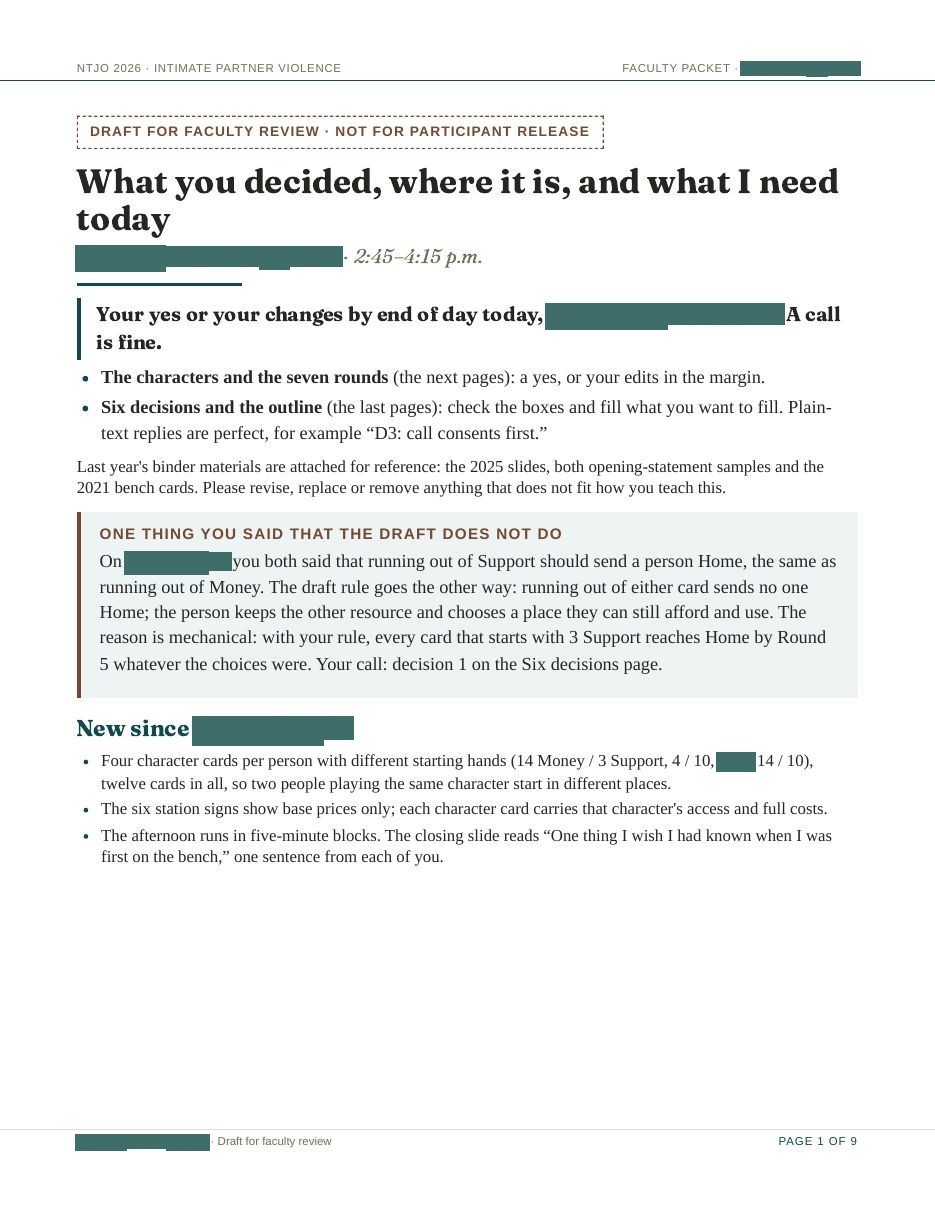
In the autumn the judges proposed that running out of Support should send a person Home, the same as running out of Money. They felt strongly that goodwill should count as much as money, and I understood the logic. But we'd already agreed on a game with no banker and no way to get money by selling drugs or sex work, and with that setup their rule couldn't work. I ran it against every starting hand, with an AI's help: every card that starts with three Support reaches Home by Round 5, whatever the player chooses. They didn't have time to sit and run the numbers. I did.
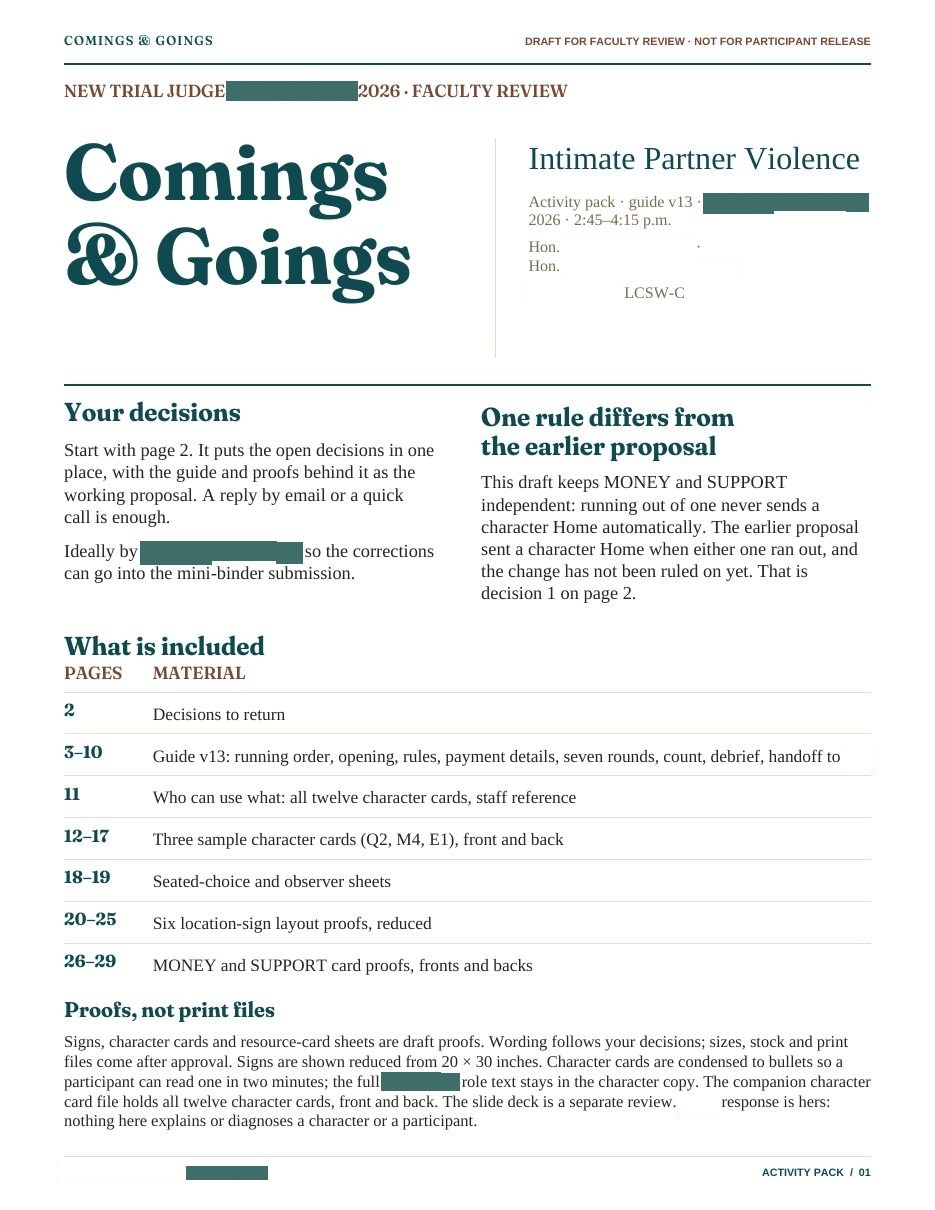
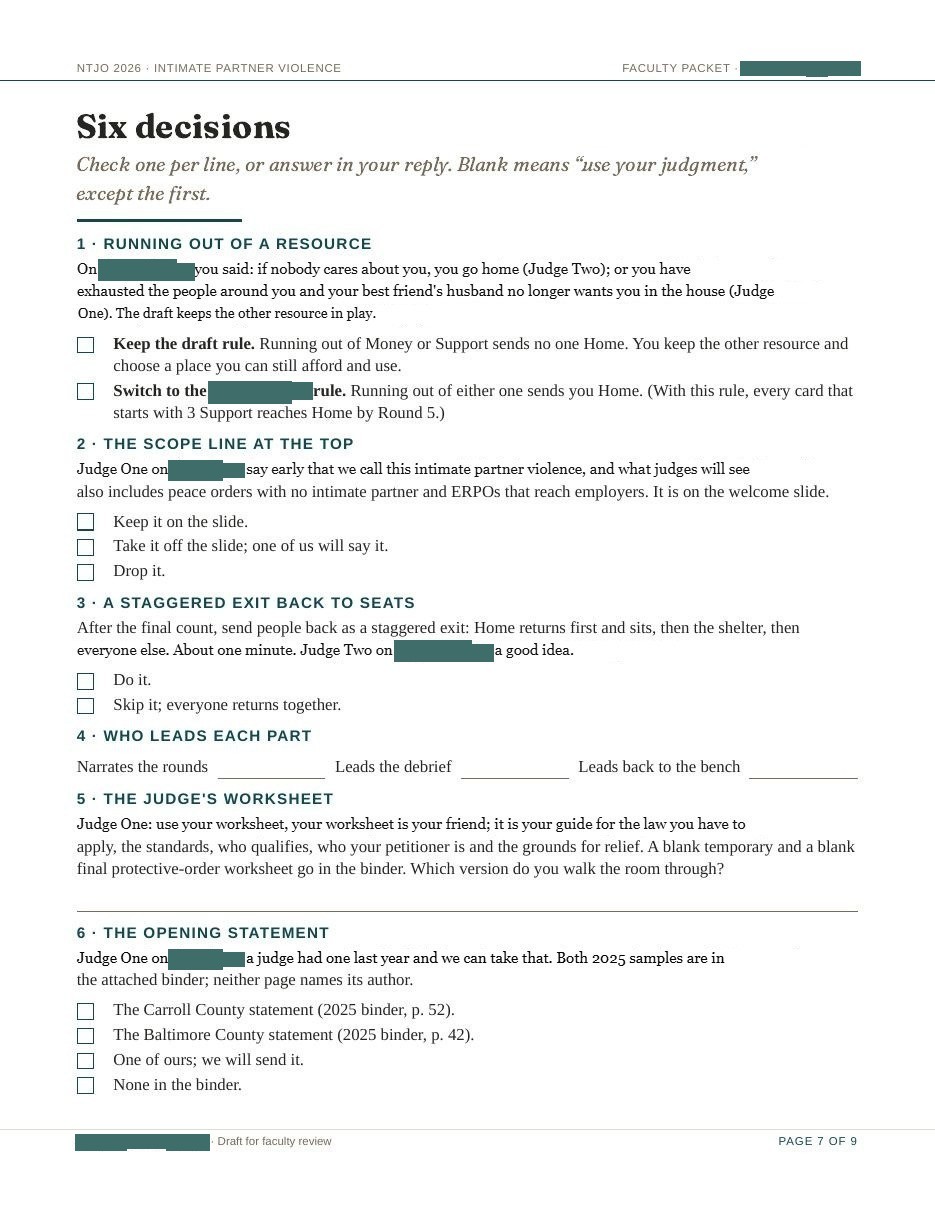
So I kept the draft rule, which leaves the two resources separate, and put what Support means onto the cards instead: if you have no money but people on your side, you can stay at your sister's house, and if you have money but nobody, you can still stay at a hotel. That went against what the judges wanted, so I didn't decide it for them. The arithmetic went on the first page of the review packet, and the call went back to faculty as the first of six decisions, bracketed: here's what you said you wanted, and here's what I found when I ran it, with a box to overrule me.
The faculty review packet
The mechanics
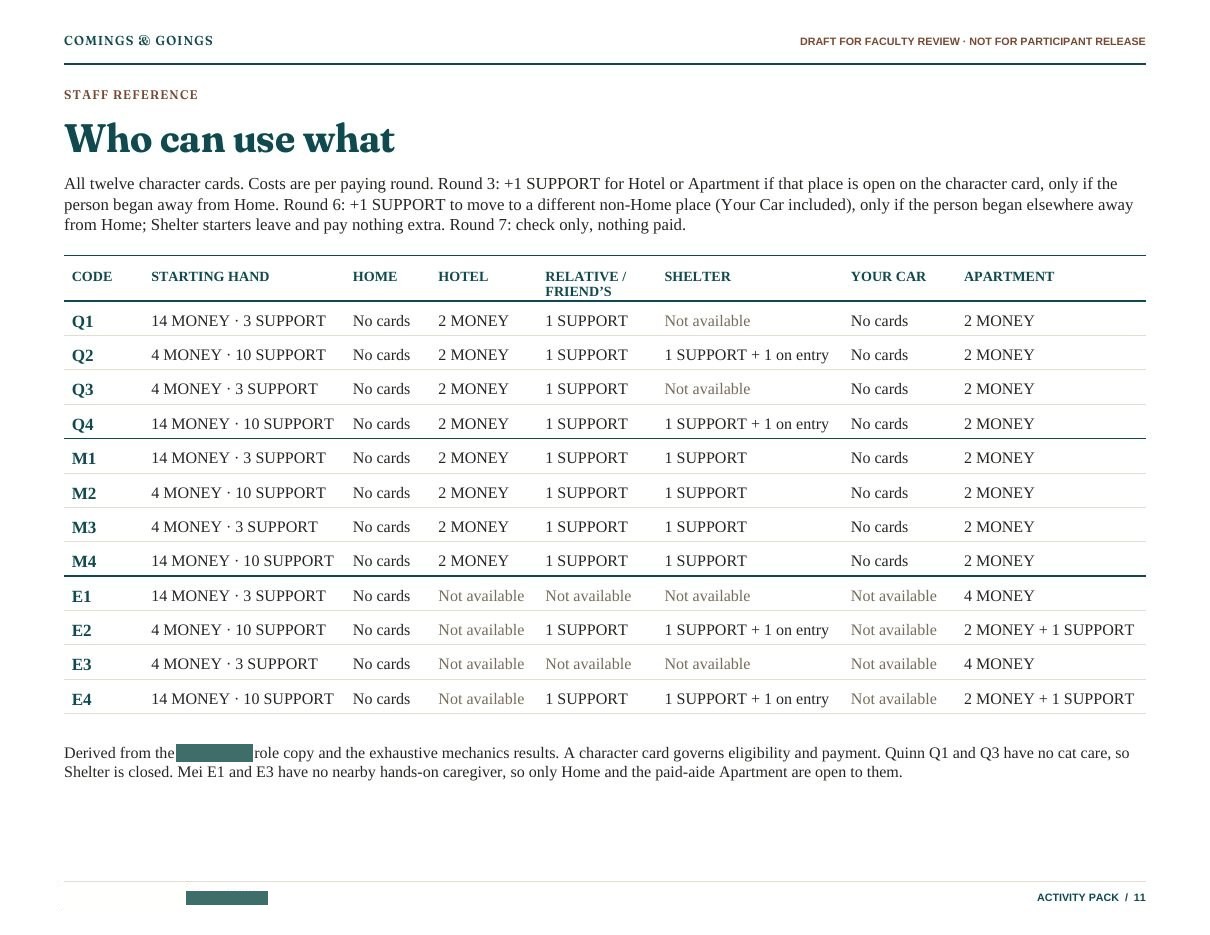
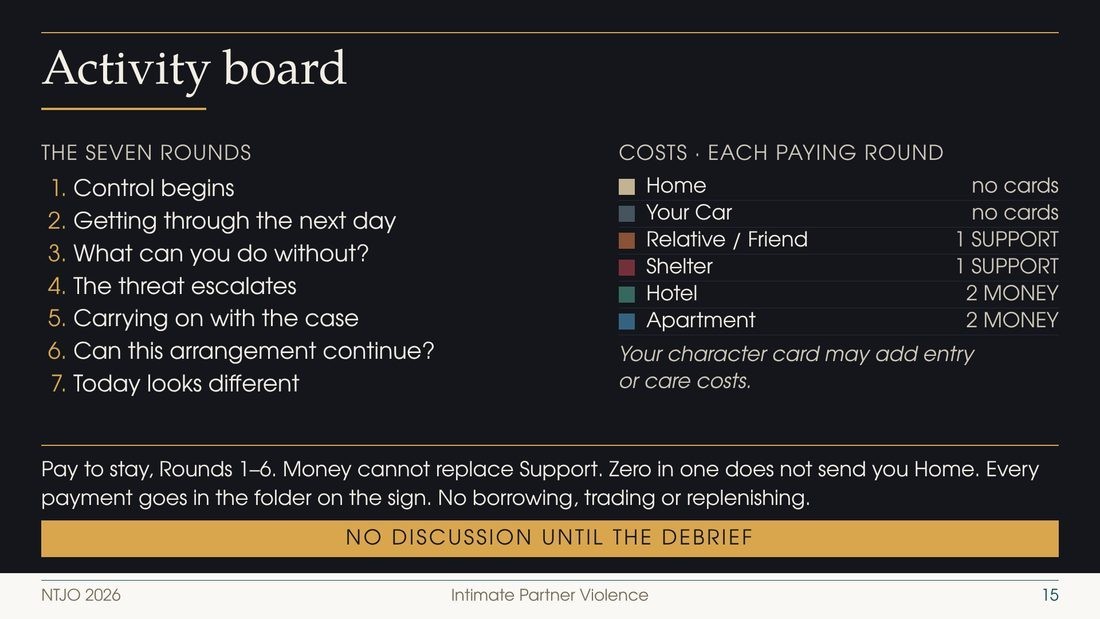
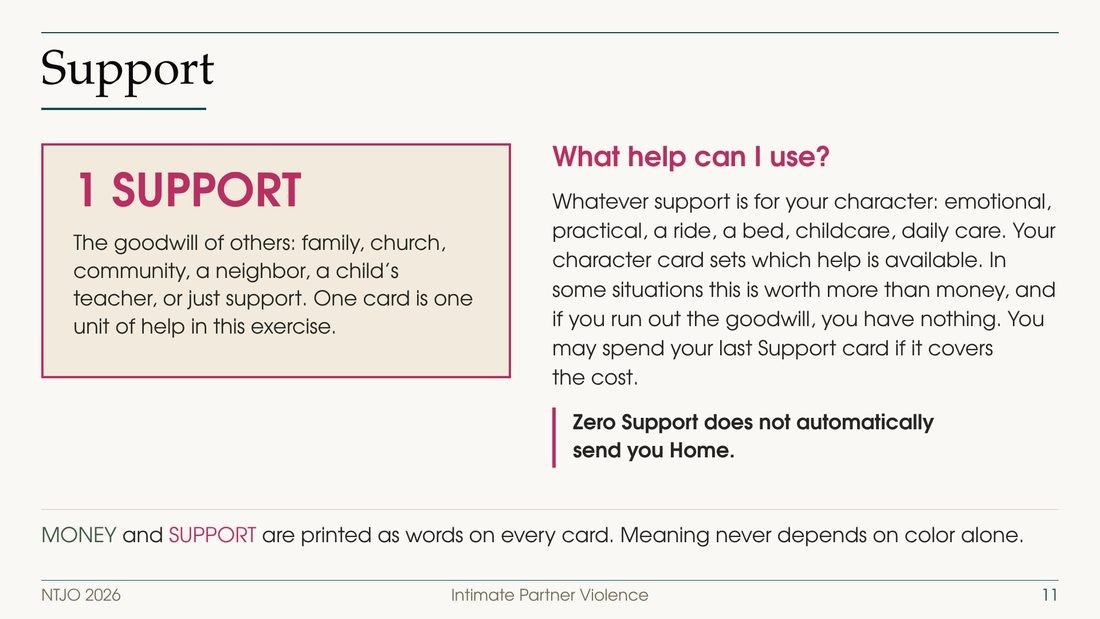
“So yeah, this is a little different. It makes sense to me, but it's a little different how I've done… comings and goings before, but I like it.”
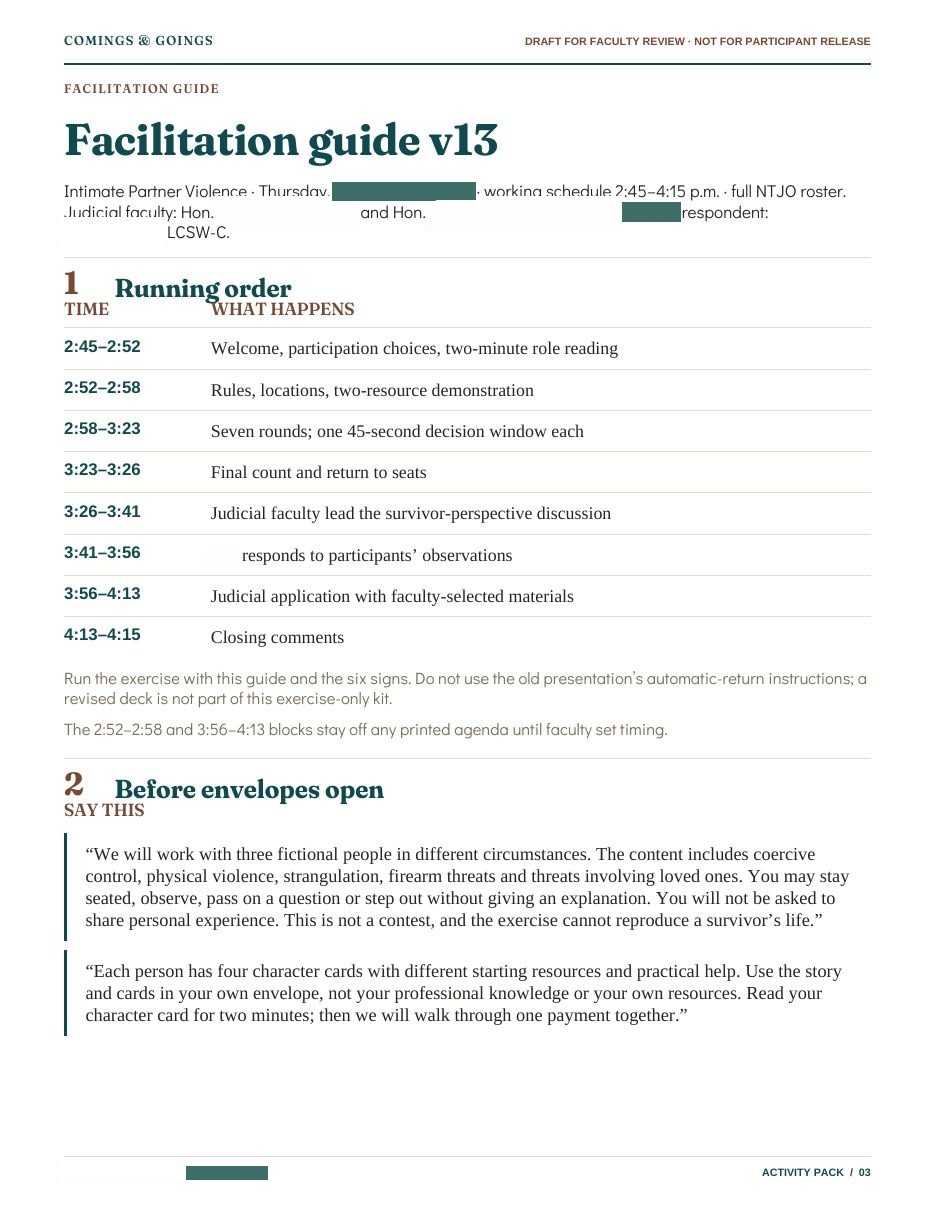
The master script
Content note: the rounds in this script include coercive control, physical violence, strangulation, firearm threats, stalking and threats involving loved ones.
After the autumn review set, I pulled the directions I'd chosen into one master script for the ninety minutes, from the opening to the closing slide: what's said and done in the room, and all twelve versions of Quinn, Maria and Mei. The script's costs are the pack's. I drafted the script with Perplexity, and wherever I could, the wording is the judges' own, taken from the transcripts of our planning meetings. The script's status line reads: “Internal creative and production master for faculty review. This is not faculty approval, participant-release authority, legal validation […].”
Whoever opens the exercise sets out its purpose before anyone opens an envelope:
“The purpose is not to reproduce a survivor's life. No exercise can do that. The purpose is to notice what becomes invisible when we see only the final decision: that someone stayed, returned, withdrew, changed a story, missed a hearing, or appeared unable to explain a choice.”
I built the rounds around where each person is when a round begins. Everyone hears the same scene only in the first and last rounds. In Rounds 2 through 6, the narrator reads each scene only to the people it fits, by where they start the round, and reads every scene before anyone moves. Nobody who's already left Home hears a scene set in the house, and in some rounds some people don't hear a scene at all. The staff note on Round 4 reads: “Use actual starting locations. Do not narratively move anyone Home.”
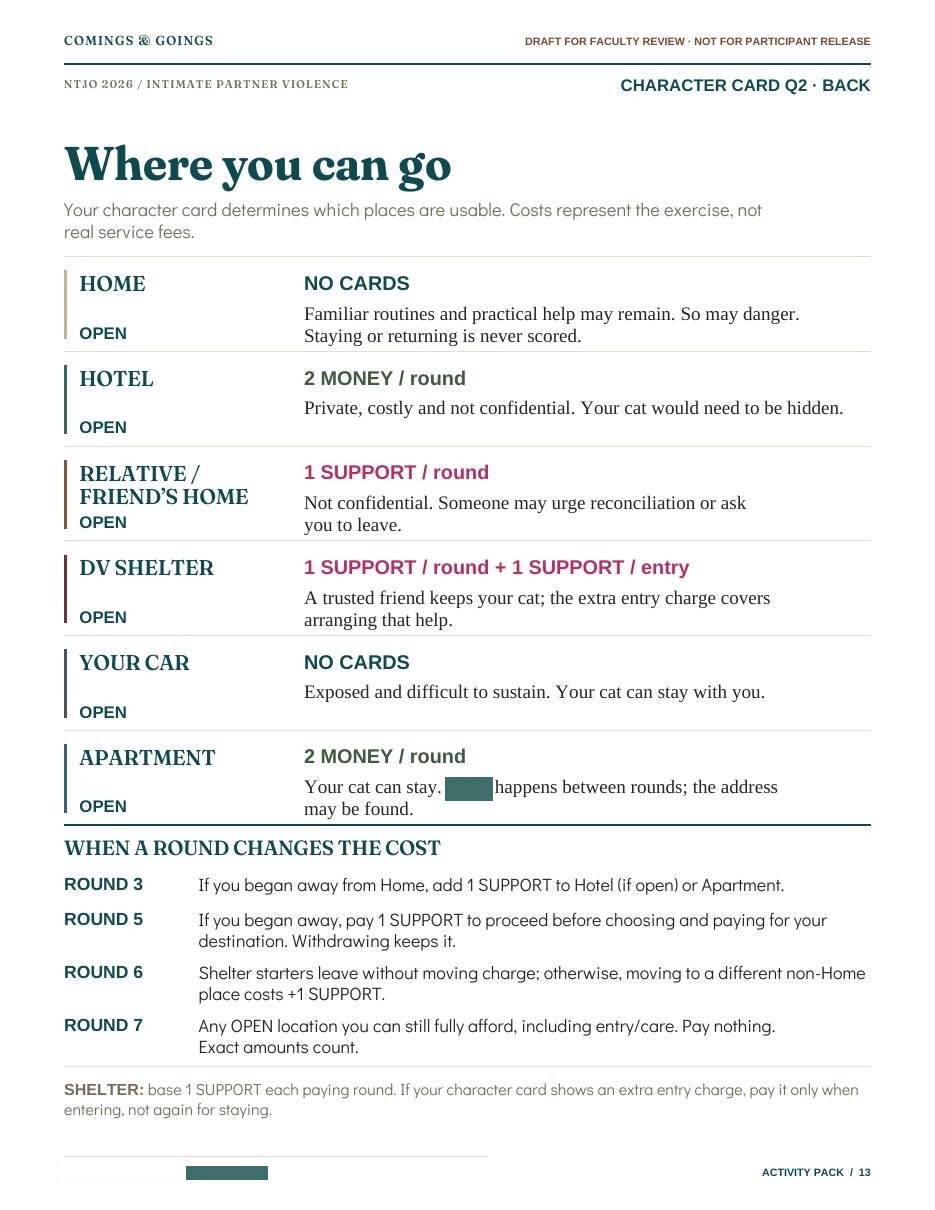
| Round | Who hears a scene | What the round changes |
|---|---|---|
| 1 · Control begins | Everyone | Everyone pays the posted cost, even to stay |
| 2 · Getting through the next day | Only people who started at Home | Everyone pays the posted cost |
| 3 · What can you do without? | One scene for people at Home, another for people away | Anyone who started away pays 1 Support more for Hotel or Apartment |
| 4 · The threat escalates | One scene for people at Home, another for people away | Everyone pays the posted cost. No extra charge |
| 5 · Carrying on with the case | Only people who started away | To go on with the case, a player pays 1 Support where they started. Withdrawing keeps it. A player with no Support can't go on, and that doesn't send them Home |
| 6 · Can this arrangement continue? | One scene for people at the Shelter, another for people elsewhere away. People at Home hear neither | Shelter starters must leave and don't pay the moving charge. Anyone else away who moves to another place away from Home pays 1 Support more |
| 7 · Today looks different | Everyone, with one line changed for people at Home | Nobody pays. A player still has to hold the full cost and meet every access condition, and an exact amount is enough |
The staff note on Round 5, the court round, reads: “Court is not portrayed as futile. It is portrayed as a process that consumes time, coordination, explanation, and help […].”
In the script, whoever explains the rules defines Support out loud before the first round. The definition is nearly word for word what one of the faculty wanted: “SUPPORT is usable help and the work of asking for it: a ride, a call, childcare, daily care, a place to stay, a changed routine, another disclosure, or another favor from someone whose help may not be unlimited. SUPPORT is not resilience. It is not credibility. It is not a measure of how loved someone is.”
Staff demonstrate the rules on a sample hand that doesn't belong to anyone in the room, and once play starts, staff stay out of the decisions: “Retrieve every demonstration card before Round 1. During live play, staff never announce that a participant has depleted a resource, reveal remaining balances, recommend a destination, or direct someone Home.” Staff can explain a posted rule, confirm a cost or collect a payment from someone who's seated. Staff can't recommend a place, send anyone Home, invent a caregiver or a bed that a card doesn't give, waive a cost because an outcome feels too harsh, or praise or criticize a choice. The silence rule has a limit: “Silence applies to participant decisions, not to clarification, mobility support, or access needs. […] Do not let speed become a second punishment.”
I drafted the debrief for the judges to lead, and it stays with the characters before anyone turns to the bench. In the script the judges ask “What made that choice available?” instead of “Why did you choose that?”, which can sound like cross-examination. These are three of the debrief's questions:
- “Which location looked available on the room map but was not actually usable to your character?”
- “Compare two versions of the same character. What could MONEY solve? What could it not solve? […]”
- “What would someone who saw only the final location misunderstand?”
The second question is where the twelve hands matter: two people who've played the same character with different resources compare what money could and couldn't fix, which is what one of the judges wanted the room to see. If someone says the model is unrealistic, the judges ask that person what would change their character's choices: “Criticism of the model is legitimate. […] Do not diagnose disagreement as a failure of empathy.”
“Basically, we're not gonna say it, but remember that when they come before you. Be empathetic, because you felt what they felt for even a millisecond.”
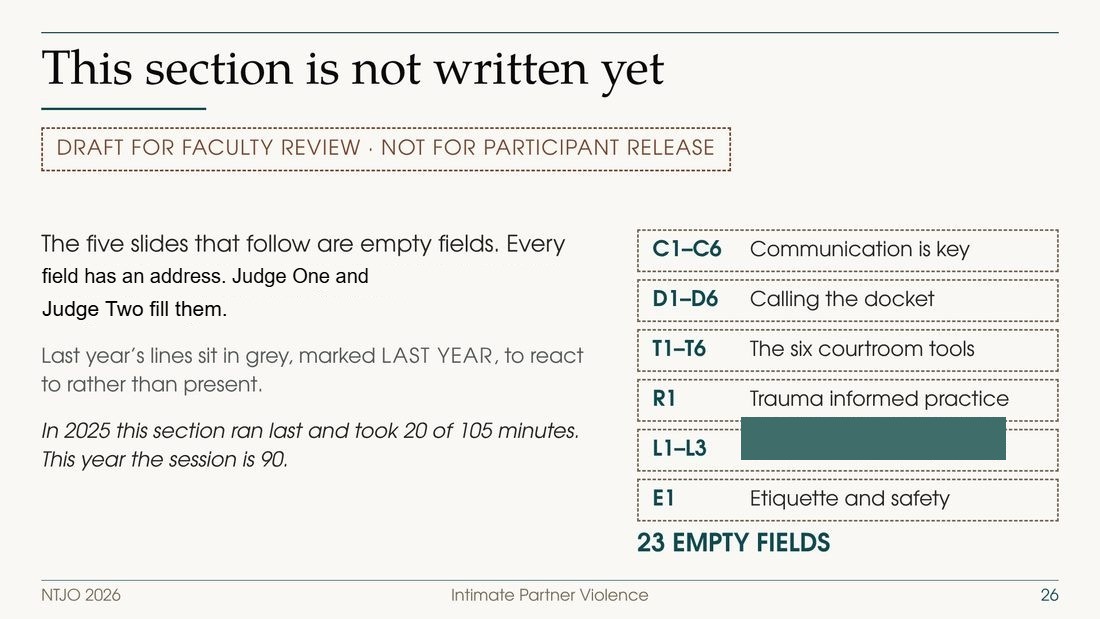
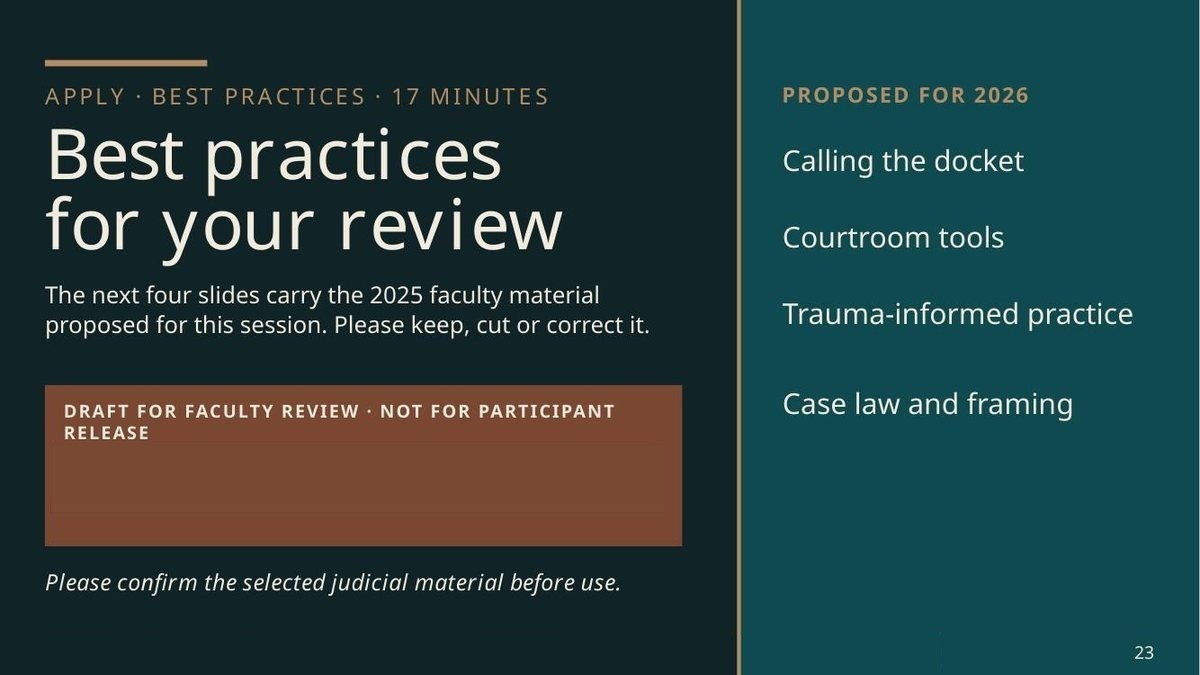
The script has a draft for every part of the afternoon, so the people who own each part can keep, cut or correct what's written for it. The parts that belong to the judges and the clinical respondent aren't shown here.
| Part of the afternoon | Whose it is | In the script |
|---|---|---|
| The opening, the rules, the demonstration, the seven rounds and the staff rules | Mine | Drafted in full |
| The debrief questions | Mine, for the judges to lead | Drafted for them to keep, cut or correct |
| The clinical response | The clinical respondent's | A handoff, an anchor question and four optional prompts, all for the clinical respondent to revise. The clinical explanation isn't scripted |
| The bench scenario and the practices for Monday morning | The two judges' | Drafted for them to keep, cut or correct. Not shown here |
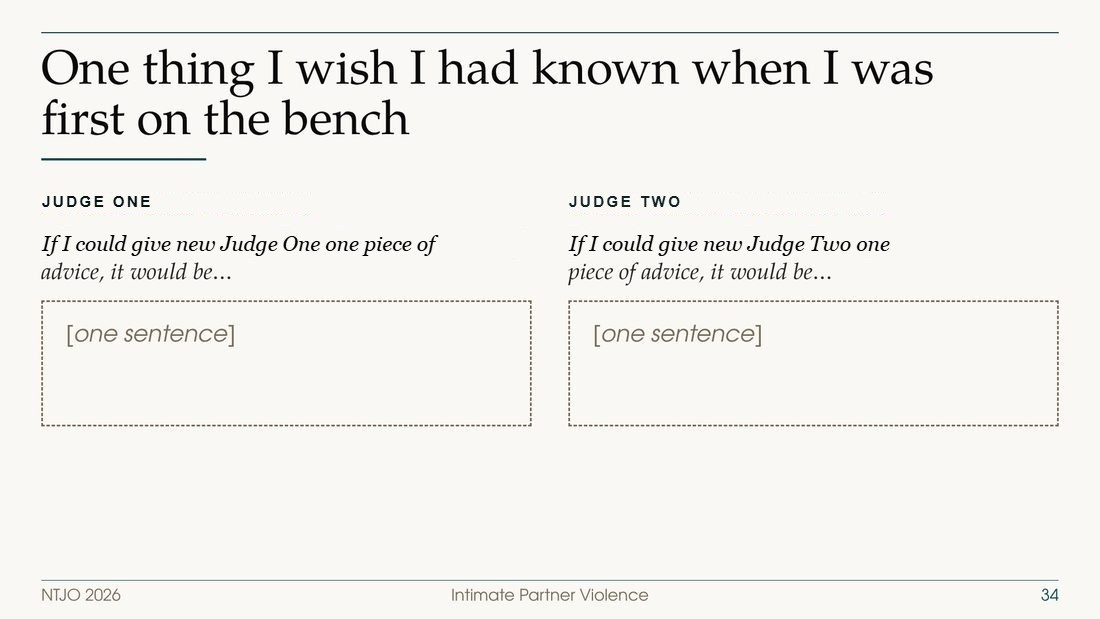
| The closing slide | Each judge's | Left blank for one sentence from each judge |
| The order of the afternoon and the length of the clinical response | The two judges', decided in planning | Fifteen minutes, as a working figure |
The handoff to the clinical respondent ends with this staff note: “[The clinical respondent] owns the clinical explanation, terminology, examples, and closing language. The facilitator should not diagnose characters or participants […].”
I listed fourteen cases a physical rehearsal has to check, because reading the script can't show whether the branches and the order of payment work. The cases include a player holding 2 Money and no Support, an exact payment that leaves zero, the Round 5 charge paid where the player began before they pay for where they're going, and a seated player paying the same costs as everyone else with no public explanation. The script ends with a release gate. Before anything's printed, the judges have to approve the roles, the rounds, the debrief prompts, the judicial materials and the timing. The clinical respondent has to confirm the slot and the handoff, and a full timed rehearsal has to leave the debrief, the clinical response and the bench segment intact.
Status: drafted, autumn 2026, for faculty review. The rehearsal cases and the release gate are specified, and the costs are the pack's.
How this was made, and the rest of the pack
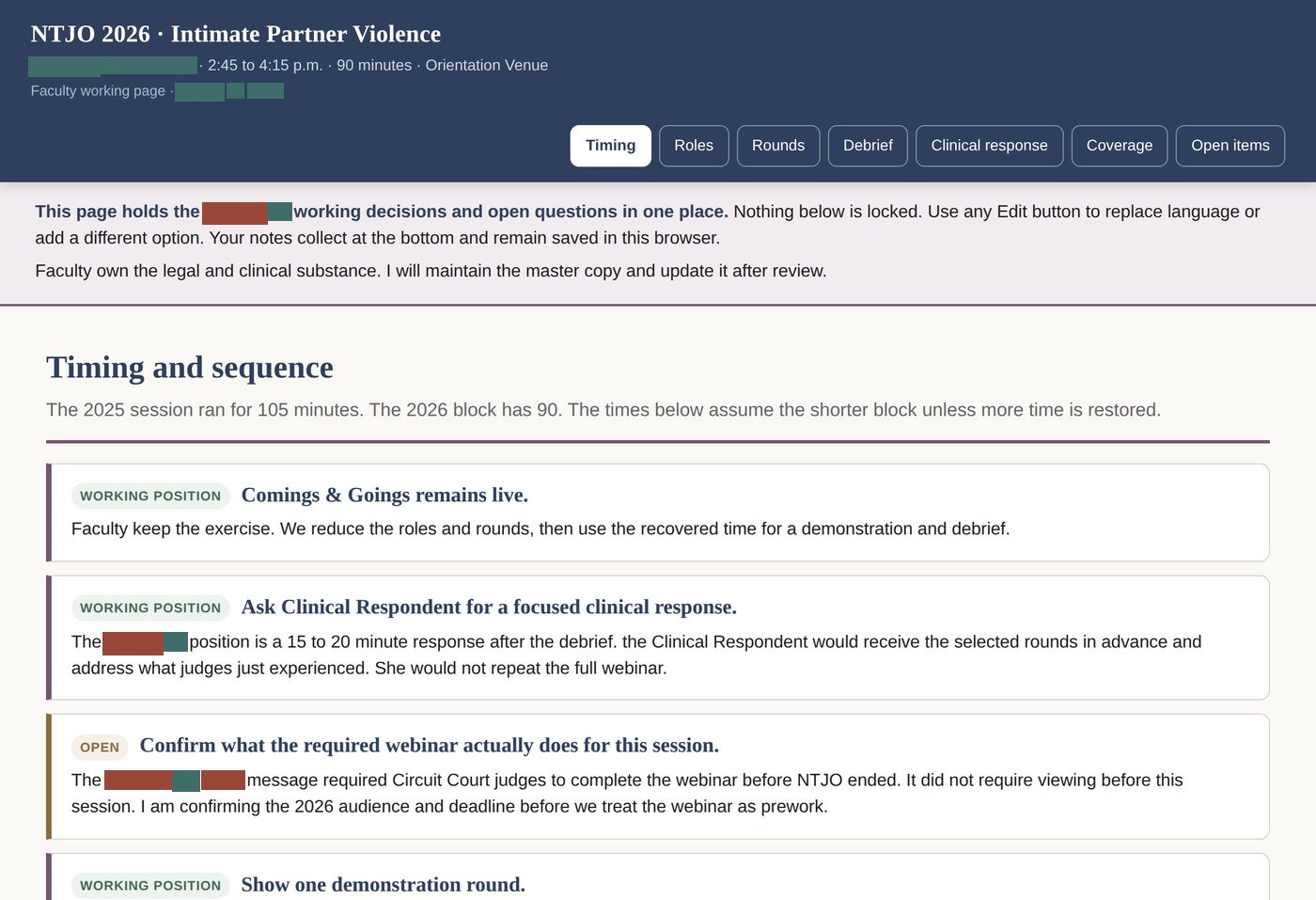
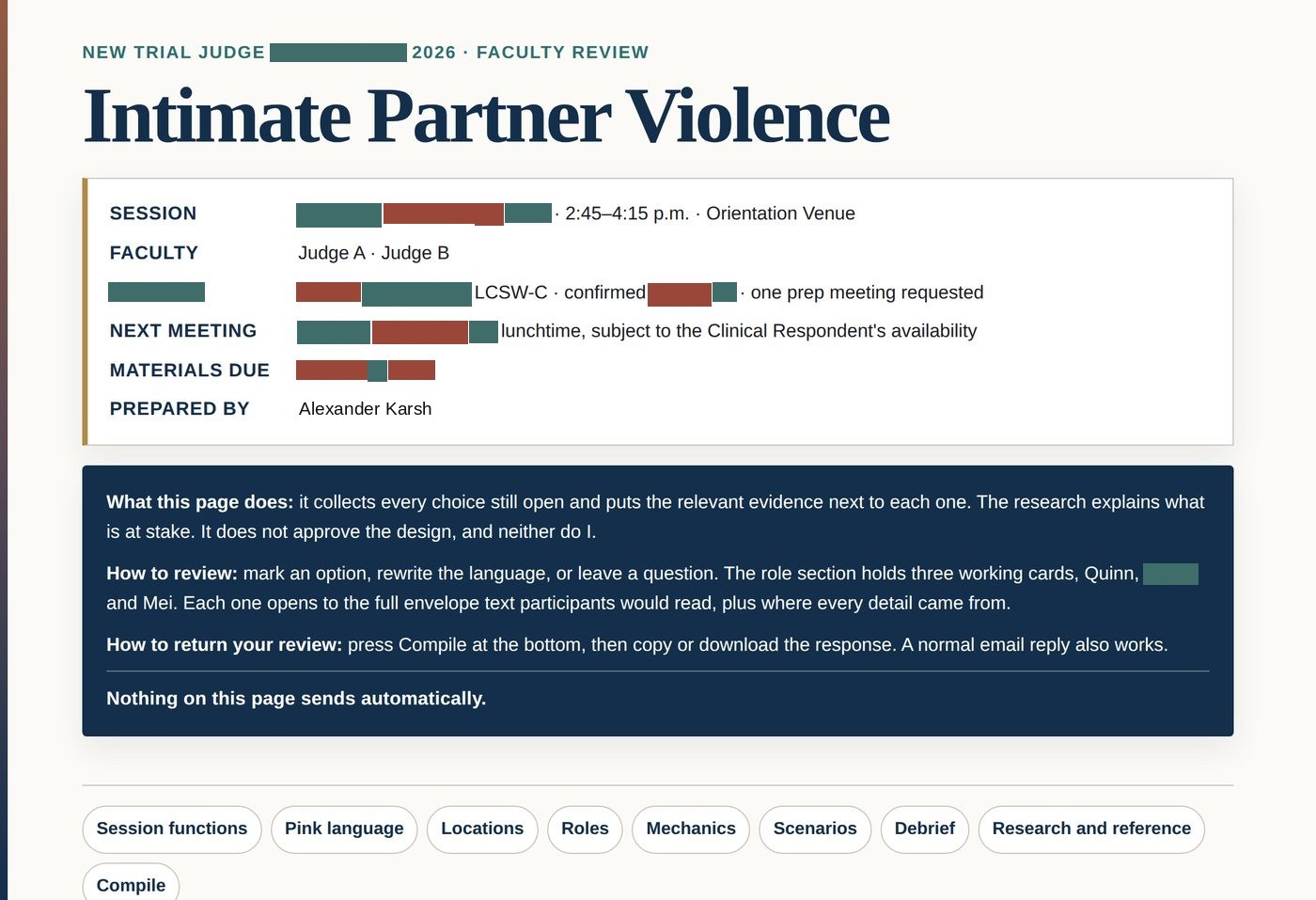
I asked too much of faculty with my first review tool: a question and a row of radio buttons for every open item. I replaced the tool with one working page that separated settled decisions from proposals and open questions, kept each reviewer's notes in their own browser and sent nothing automatically.