PreparedBuilt at a coordinating judge's request
Objection, That’s a Deepfake*
*Renamed AI and digital evidence course
Seven pages of bench cards, one reference guide
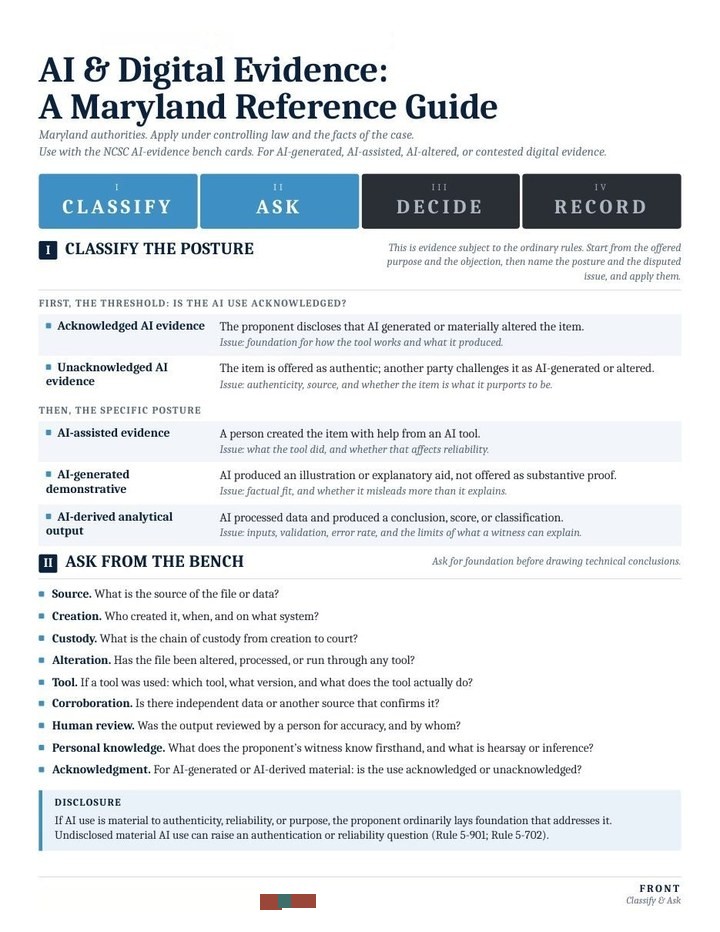
The coordinating judge for an AI and digital evidence course asked me for a cheat sheet: judges would be seeing AI-generated evidence without knowing what to do with it. I started from the NCSC's two national bench cards, added Maryland law and the faculty's materials, and built one sheet, front and back. Its four moves are classify the posture, ask the foundation questions, decide under Maryland law and make the record, and I designed a day of practice around them. The Maryland law faculty confirmed the law.
Prepared through faculty-review drafts. June 8 version, reconstructed for this portfolio. Not legal guidance.
- Prepared
- Approved
- Delivered
- Measured
The four rungs this portfolio uses for every piece. This one stops at the first.
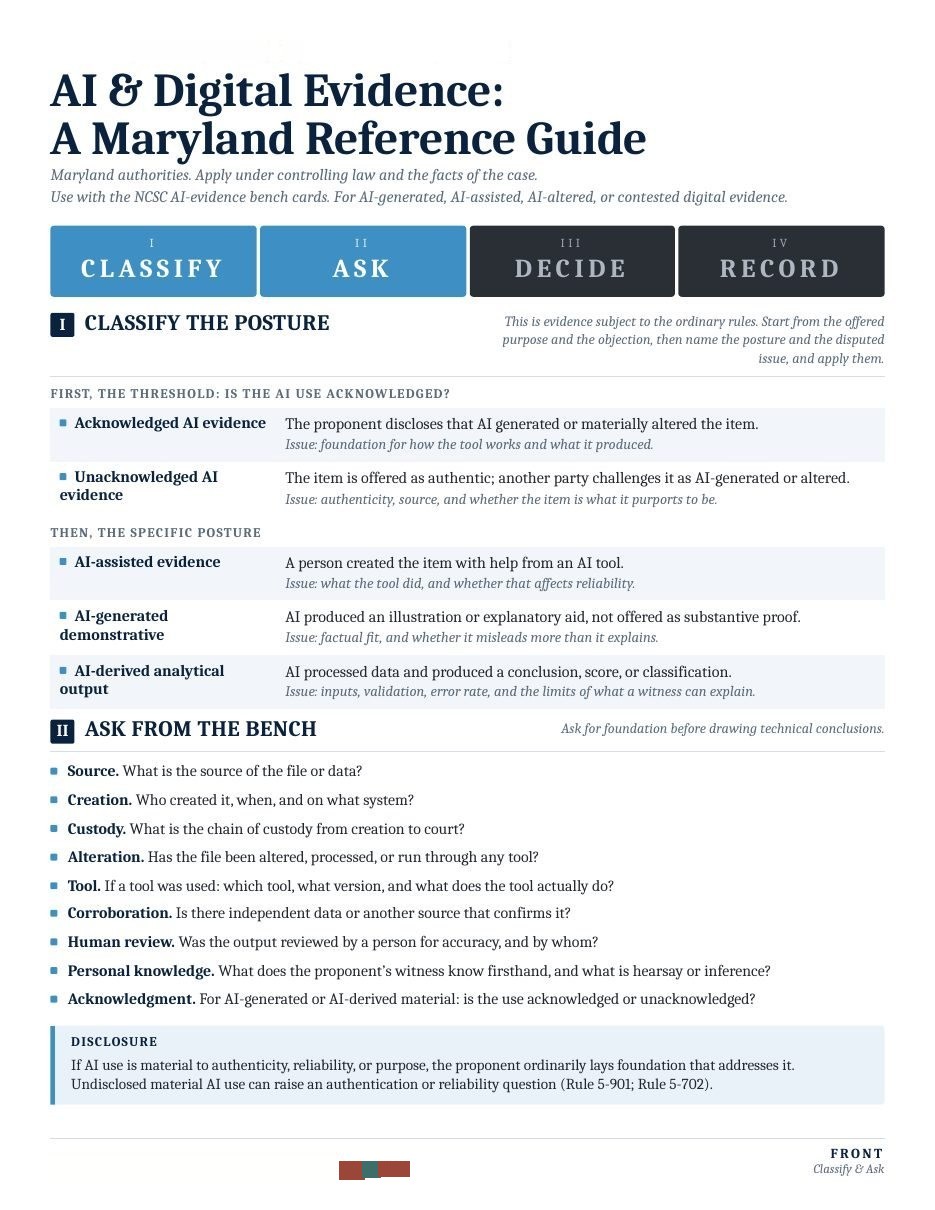
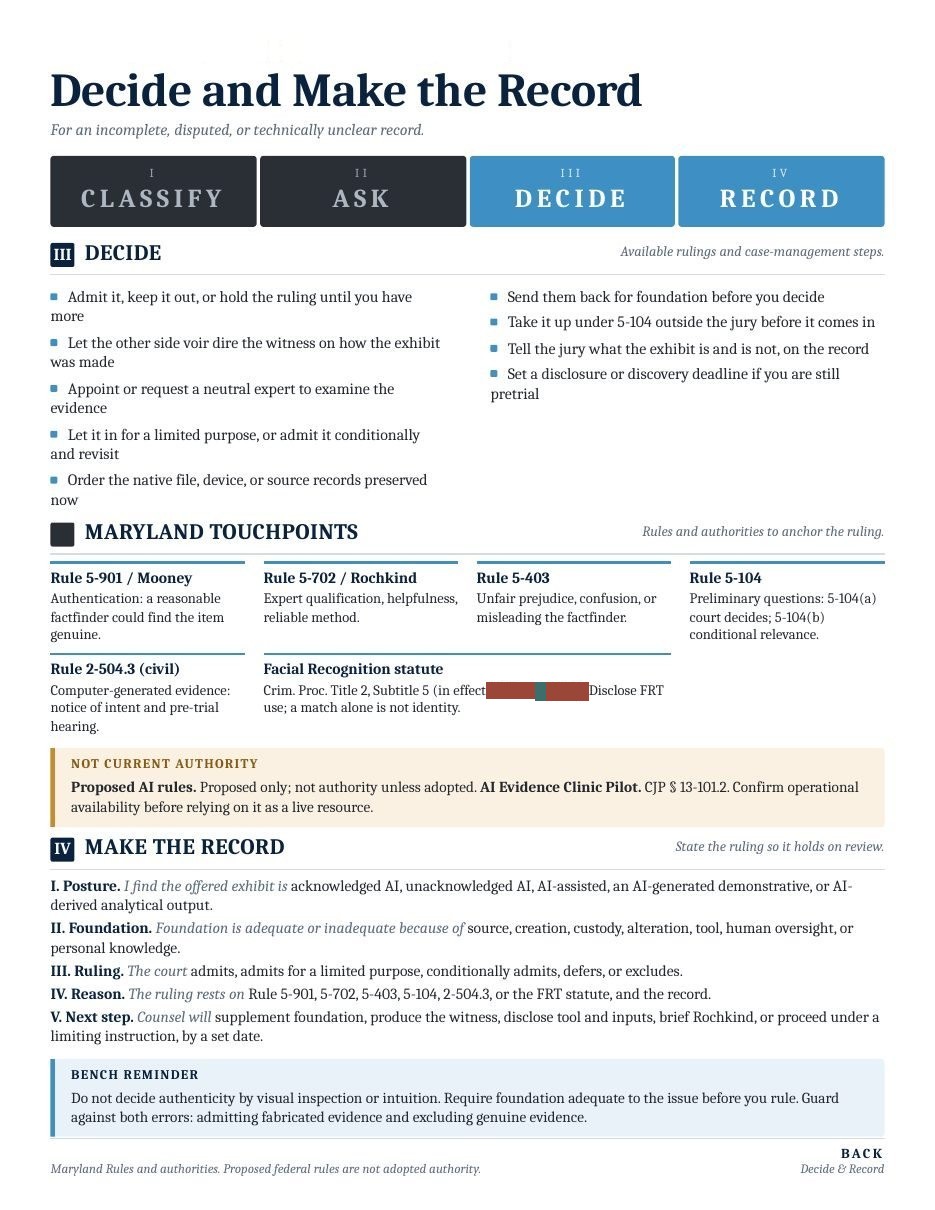
For readers outside law: the guide walks a judge through deciding whether an exhibit is what it claims to be, whether an expert's method is reliable enough to hear, and how to say the ruling on the record.
The two-page guide, June 8 version, prepared through faculty-review drafts. Reconstructed for this portfolio; institution, seal, faculty and course dates removed. Not legal guidance. Open the guide at full size.
Where the guide came from
Behind it sat the NCSC's two national bench cards: seven pages and fourteen numbered questions, seven on each card, with a guidance paragraph under every question. The national cards leave the legal standard to each state, so the guide supplies six Maryland touchpoints, each flagged for the Maryland law faculty to verify.
Before drafting, I commissioned research from AI research engines on how judges use reference tools and where the national cards fell short, and checked what mattered against the primary sources. Its gap list for the national cards: no jurisdiction-specific law, no record language, guidance paragraphs useful for study and unwieldy in the middle of a hearing, no decision path. The table answers that list.
| In the NCSC cards | What I did | Guide move |
|---|---|---|
| Separate cards for acknowledged and unacknowledged AI-generated evidence | Made that the first question: one threshold question, then three postures, rebuilt around Dr. Grossman's edits | Classify |
| Fourteen numbered questions, seven on each card, each followed by a guidance paragraph | Merged the overlapping questions into nine, each led by a keyword a judge can scan | Ask |
| Judicial actions described in guidance prose | Nine options written as courtroom verbs | Decide |
| A note that legal standards vary by jurisdiction | Six Maryland touchpoints, each flagged for the Maryland law faculty to verify; proposed rules and the AI Evidence Clinic Pilot kept in a separate "not current authority" box | Decide |
| Direction to document the rationale | Five fill-in sentence stems that produce the record itself | Record |
How the guide took shape
My first draft ran four pages and read like a form: 84 checkboxes, and the same foundation questions asked in three places. The guide is one sheet, front and back, with no checkboxes. Thirty overlapping questions became nine, each led by a keyword a judge can scan. A nine-item "before you rule" checklist became five fill-in stems that produce the record itself; I adapted them from the sentence stems I used teaching rhetorical writing.
The day as designed
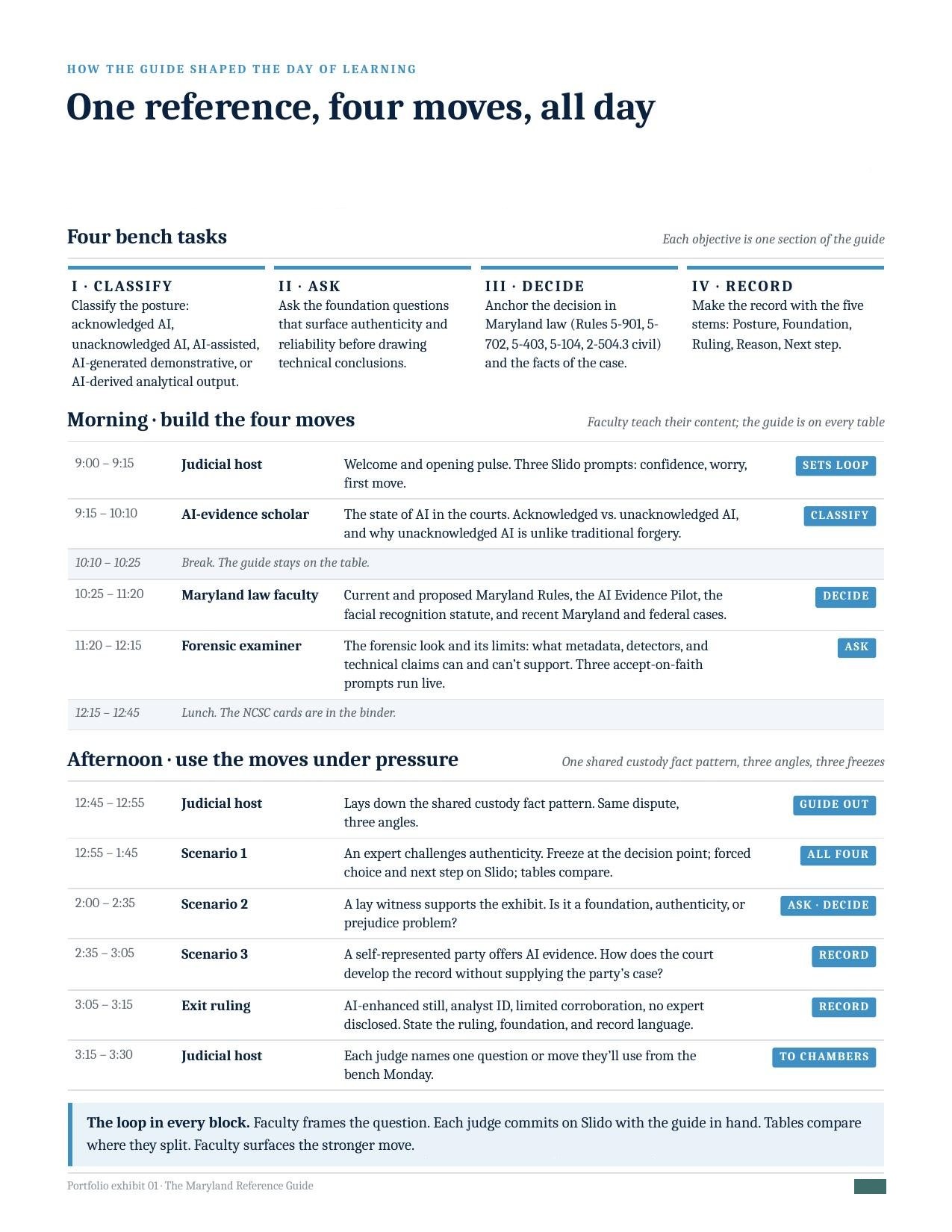
The day was built around four bench tasks, one for each section of the guide: classify the posture, ask the foundation questions, decide under Maryland law, make the record. I designed it backward from an afternoon spent on a contested exhibit, guide in hand, so the morning was built to teach the four moves and the afternoon to put them under pressure. I built every block on five beats: frame, commit, share, name, apply.
The close is the exit ruling. The prompt: "A party offers an AI-enhanced still image and an analyst's identification. Limited corroboration, no expert disclosed. State your ruling or next step, the foundation you'd require, and what you'd say on the record." One to three sentences, all four moves, none of the guide's prompts in front of them.
The close is a transfer check, which is the point of Kolb's cycle: one more pass on material nobody has seen. The climb from classifying an exhibit to ruling on it follows the revised Bloom's taxonomy, and every problem is one a judge meets on the bench, which is what andragogy asks of a course for experts. A confidence survey would have told faculty how judges felt; I wanted to see what they could do.
How I worked with the faculty
My first draft treated acknowledged and unacknowledged AI as two of five parallel pathways. Dr. Maura R. Grossman, whose scholarship with Judge Paul W. Grimm defined that distinction, read the draft and gave me her edits on the first move's wording, and I rebuilt the first move around them: one threshold question, then three postures. I had opened by asking her one thing: am I representing your work correctly?
Grossman & Grimm, "Judicial Approaches to Acknowledged and Unacknowledged AI-Generated Evidence," 26 Colum. Sci. & Tech. L. Rev. 110 (2025).
Each review packet held only that reviewer's slides, guide section and questions. The Maryland law faculty were asked to check the legal wording and the status of each authority; the technical faculty member, the technical language; the coordinating judge, the opening frame, the fact pattern, the decision points and the close.
Every page of the faculty companion was marked "Suggestive, not binding." It asked faculty to keep two things, the four moves and the five record stems, and said everything else was theirs to rewrite, replace or cut. I built the package so each faculty member could teach their block their own way. Faculty needed the building, not the scaffolding.
Before any copy could go to participants, I handed the faculty a short list of what I couldn't confirm myself: a case citation I couldn't verify, which I cut from the guide until they could source it; the operative provision of the facial recognition statute; and whether the AI Evidence Clinic Pilot was in effect. I drafted the guide's disclosure line, softened it because my first version read closer to a rule than a reference guide should, and sent it to the Maryland law faculty to rewrite in their own words.
In an earlier course, early in AI adoption, a fabricated case got into a faculty binder. Since then I've worked to a rule I call Blank is Sacred: a required detail nobody has verified stays visibly blank instead of being filled with something plausible, and rough drafts go to faculty well before the materials deadline so review runs in both directions. I drafted with AIDA, the Judiciary's internal AI assistant, and sent the legal points to faculty to confirm.
Around the guide I built the faculty package: a learning design memo for the coordinating judge, a one-page day-of flow naming five faculty lanes, the day map, the faculty companion, the live-polling run of show keyed to guide sections, and a companion to a short training video on deepfakes showing how each block could use it.
More, if you want it
The working draft: my four pages beside the two
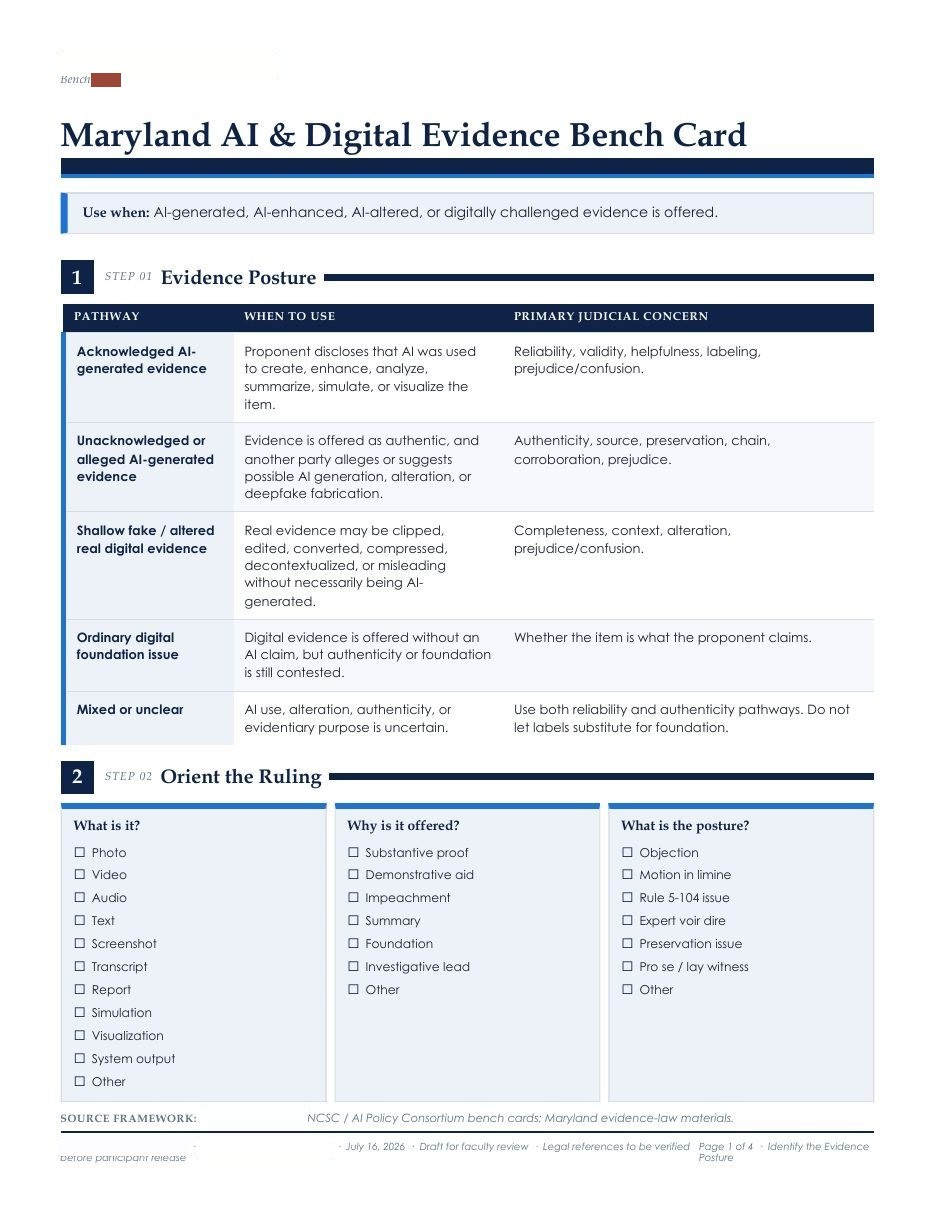
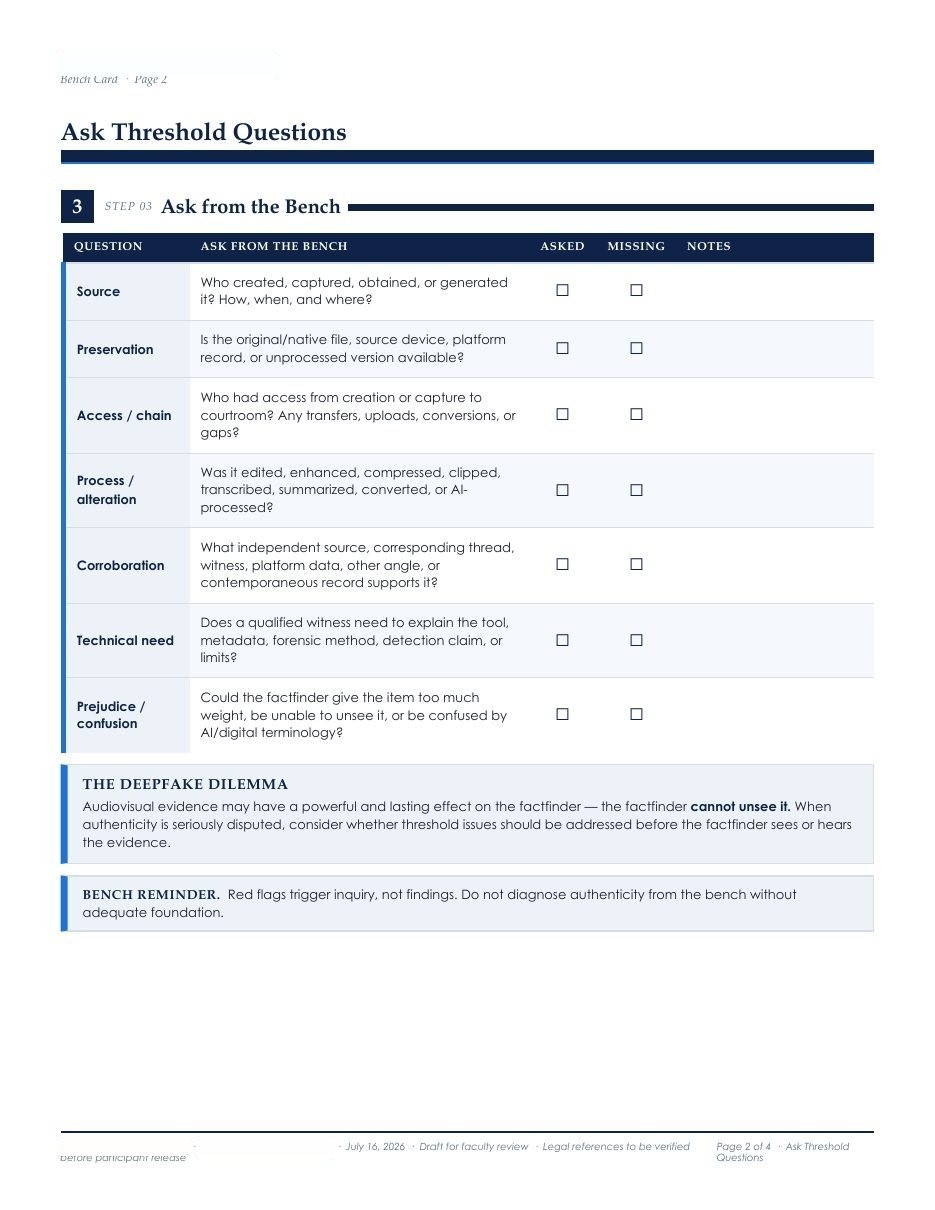
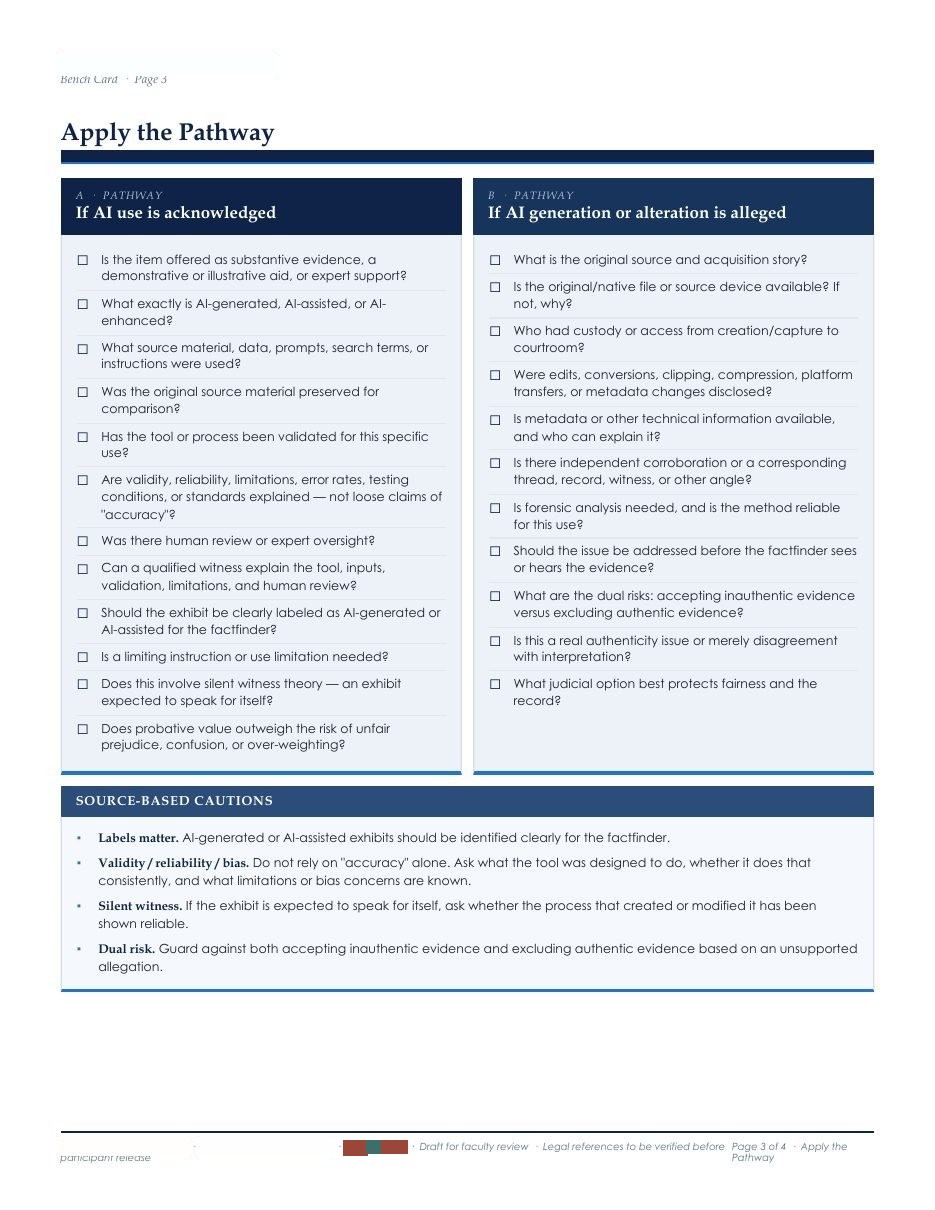
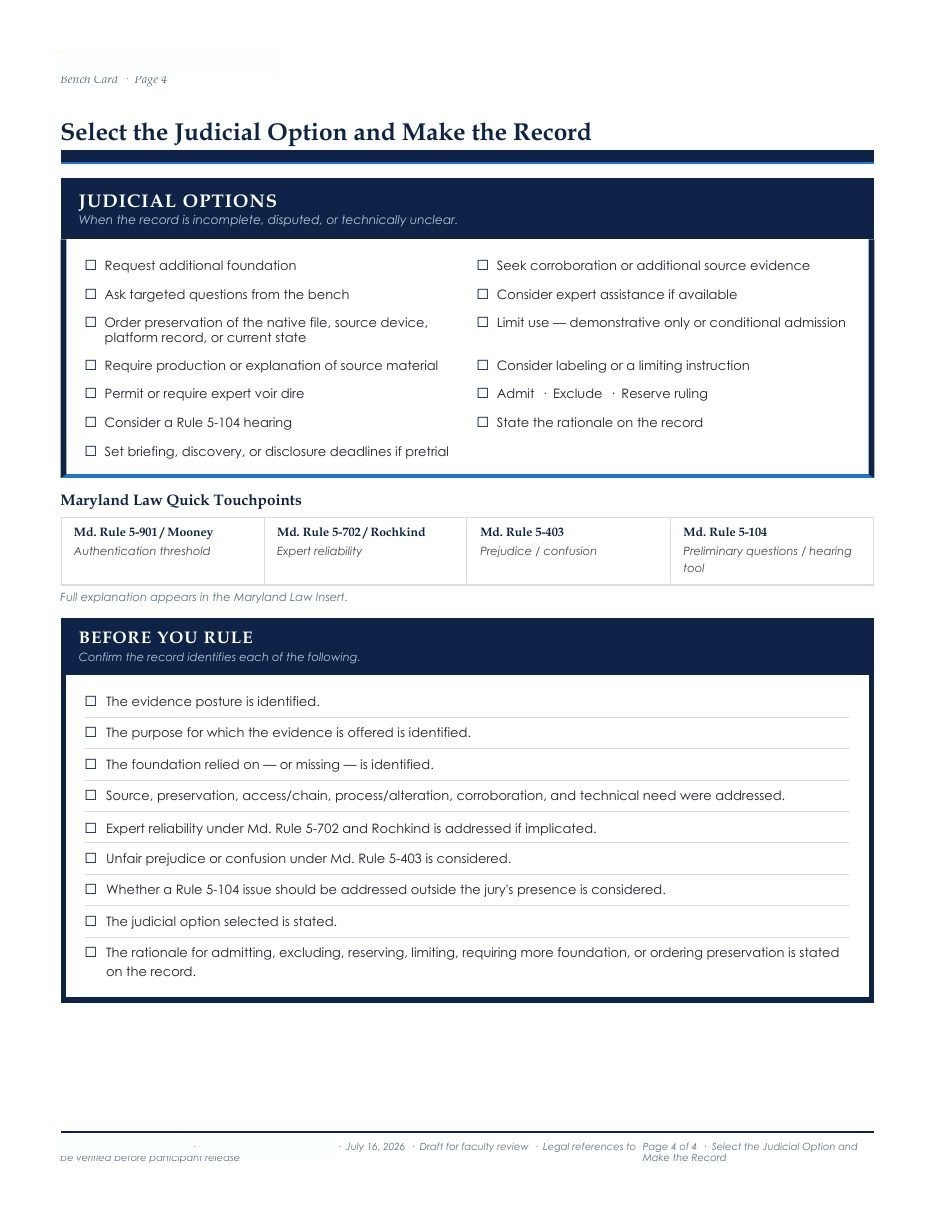
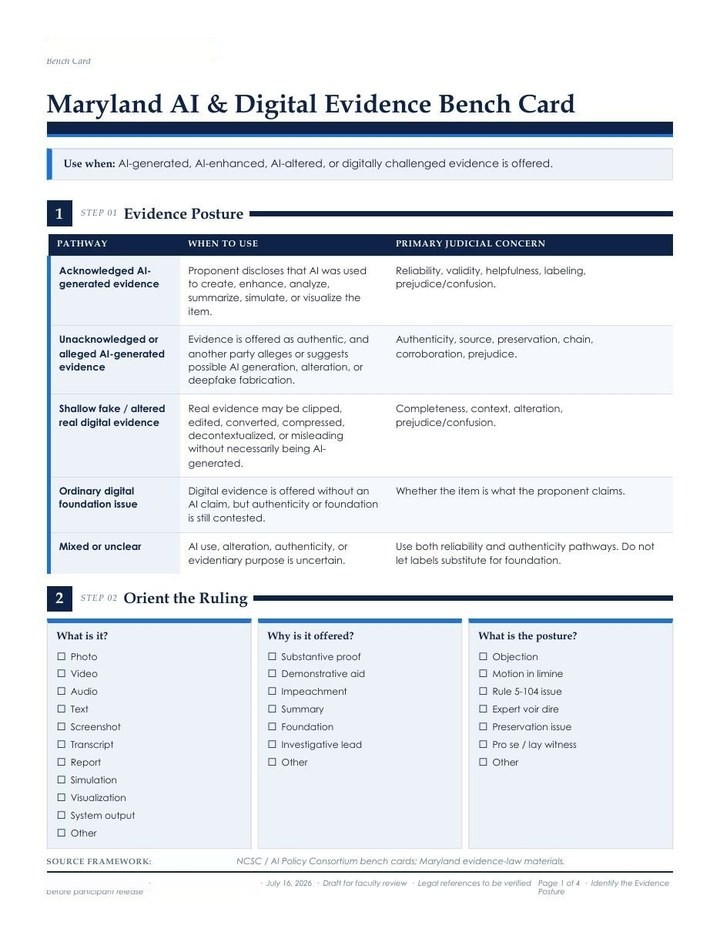 Four-page draft, PDF
 Two-page guide, June 8, PDF
Five design decisions
- Classify, Ask, Decide, Record organized the guide, the faculty companion and the audience prompts: one spine for the guide and the day's practice.
- Five parallel pathways became one threshold question and three postures.
- Three overlapping question sets became nine questions, each led by a keyword.
- A nine-item checklist became five stems that produce the record itself.
- Proposed rules and the AI Evidence Clinic Pilot sit in a separate box so nothing still in motion reads as controlling law.
The other reference tools · How I support faculty · The design rules