Alexander Karsh.

Poster acceptedAmerican Society of Criminology annual meeting, Chicago, autumn 2026

An Architecture of Absence

I mapped mandatory judicial training on bias, fairness and impartiality in 52 jurisdictions: the 50 states, the District of Columbia and the federal judiciary.
What it isA policy surveillance study: each jurisdiction coded from its own binding instruments
InstrumentsA typology of how a jurisdiction reaches zero, and a 0 to 6 index for the mandates that exist
StatusPoster accepted; working paper in preparation; not peer reviewed
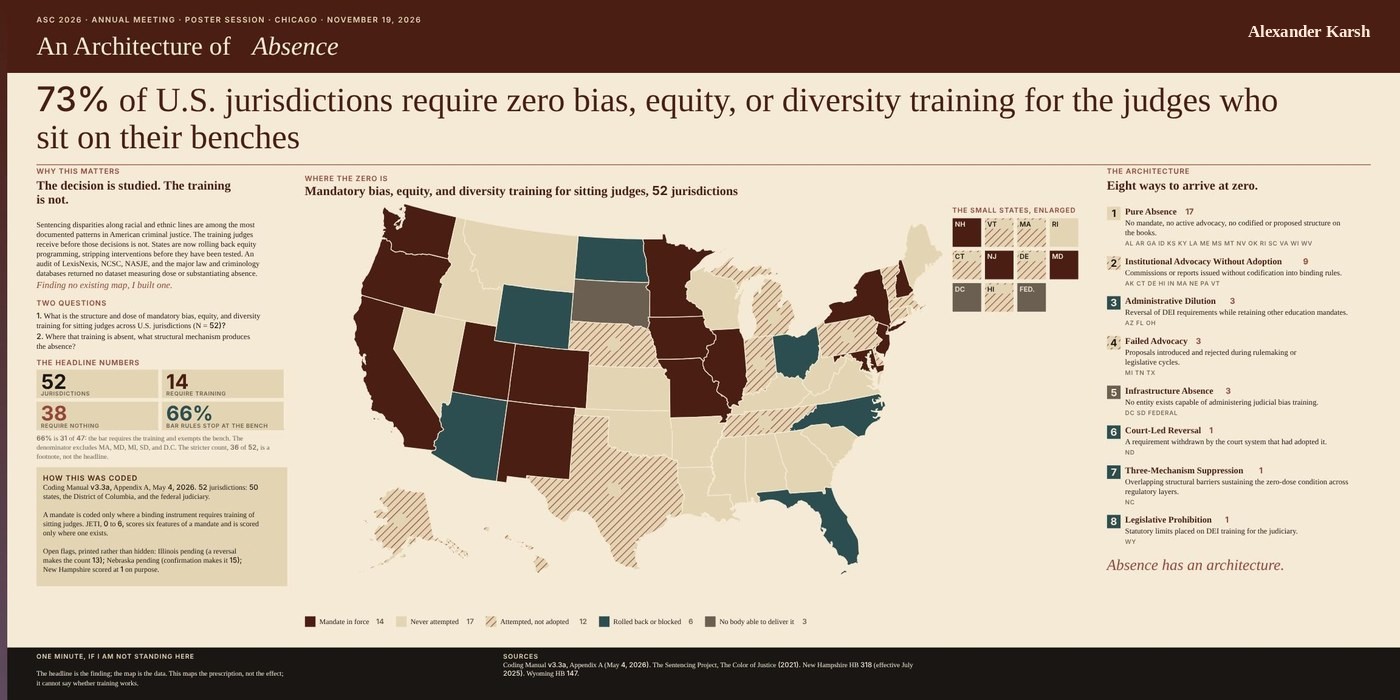
An Architecture of Absence poster: the 73 percent headline, a map of the 52 jurisdictions, the headline numbers, the coding box and the ways a jurisdiction arrives at zero
The poster for ASC 2026. It shows the headline, the map of the 52 jurisdictions and the headline numbers, from the spring 2026 coding, with the open codings printed as flags. The poster prints 14 and 73 percent, and the figures below count 13 and 75 percent from version 3.1 of the dataset. New Hampshire is the difference. For this site, the contact line, a dedication, the per-state scores, the empty QR tile and the names of two state contacts are removed.

Where the question started

I began by thinking about International Baccalaureate (IB) schools and how we thread literacy through social studies and through problems in math. I was working on a DEI course that was just a day of DEI modules. My initial thought was to call this project From Eyerolls to Evidence. I went looking for the states taking the IB threaded-curriculum formula into DEI.

There were none, and I didn't anticipate finding all the zeros. Because I didn't find what I was looking for, I almost gave up the research entirely. Then I realized there was something here.

The study

Thirteen of 52 jurisdictions require the training; 75 percent require none. Thirty-nine jurisdictions have no mandate, but they didn't reach zero the same way. One never had a mandate on the books, in another people tried for one and lost, and another lost the one it had. A jurisdiction that repealed a mandate presents a different policy question from one that never adopted one. If legislators want a mandate, they have to know why their own state doesn't have one, because that's the path to getting one.
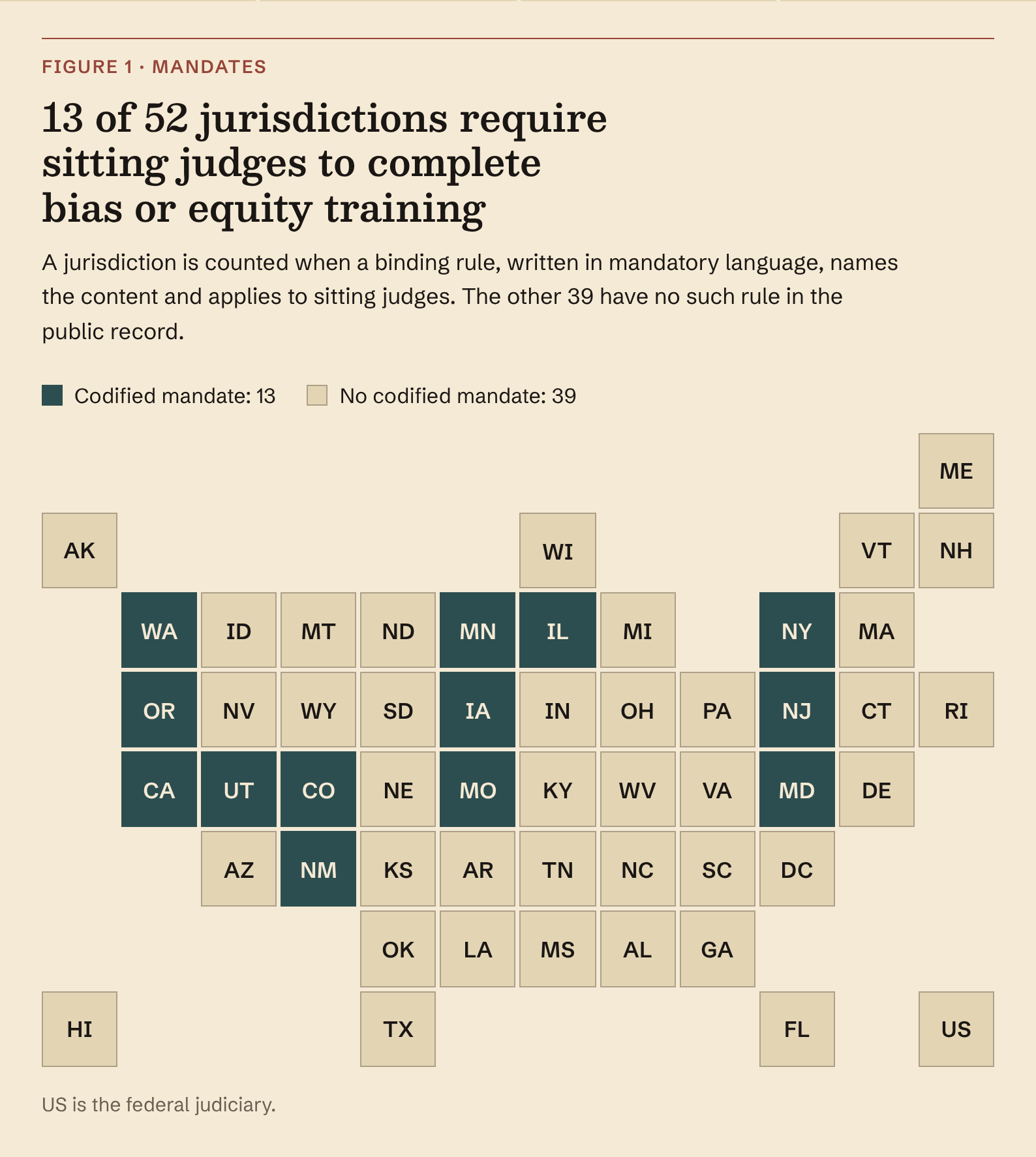
Figure 1, a tile map of 52 jurisdictions. Thirteen have a codified mandate that sitting judges complete bias or equity training: California, Colorado, Illinois, Iowa, Maryland, Minnesota, Missouri, New Jersey, New Mexico, New York, Oregon, Utah and Washington. The other 39, including the federal judiciary, have no such rule in the public record.
Figure 1. Mandates. A jurisdiction is counted when a binding rule, written in mandatory language, names the content and applies to sitting judges. Source: Judicial DEI Training Architecture Dataset v3.1, coded 16 March to 14 April 2026. One coder.
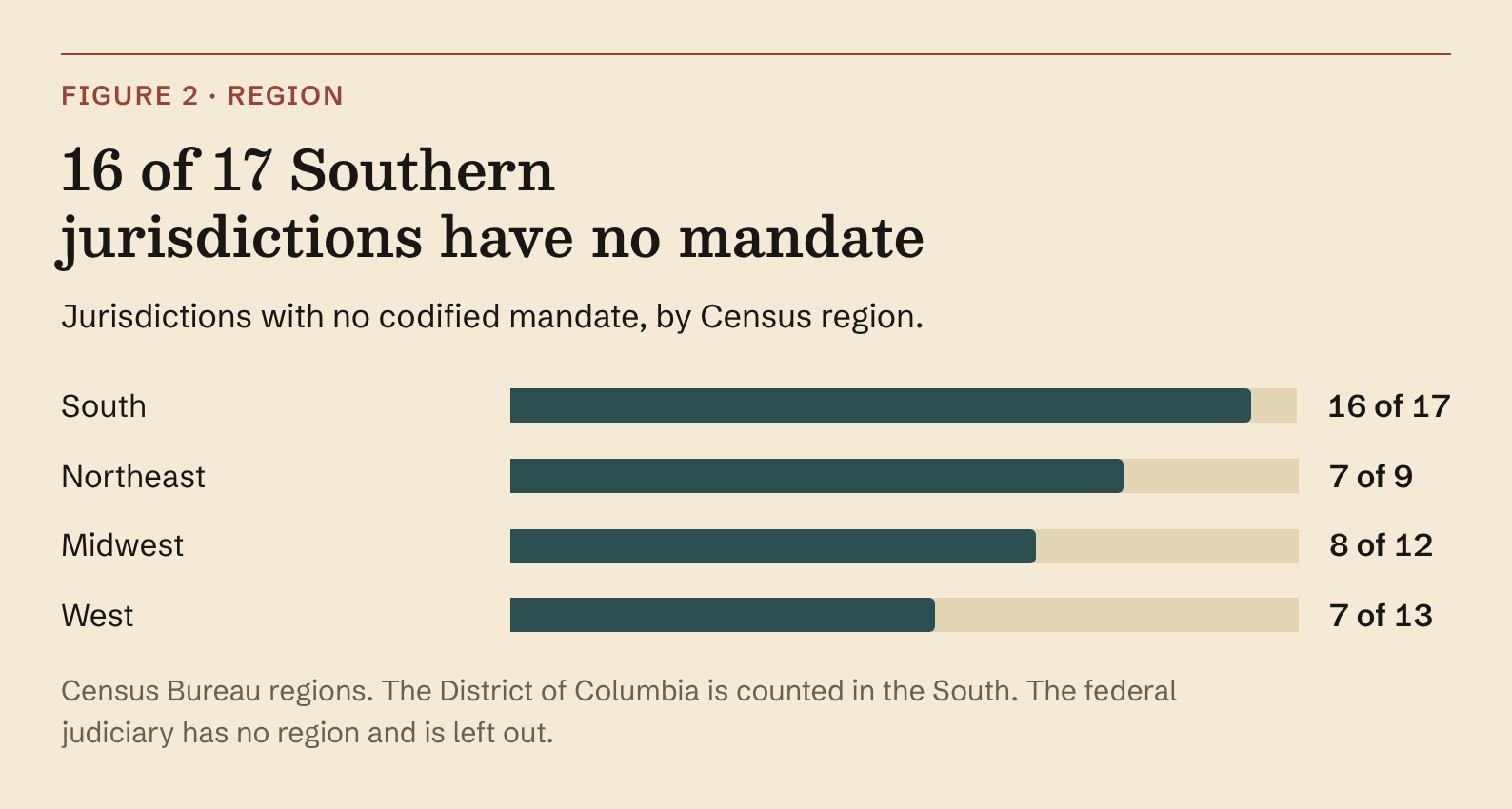
Figure 2, bars by Census region showing jurisdictions with no codified mandate: South 16 of 17, Northeast 7 of 9, Midwest 8 of 12, West 7 of 13.
Figure 2. Region. Jurisdictions with no codified mandate, by Census region. Source: Judicial DEI Training Architecture Dataset v3.1, coded 16 March to 14 April 2026. One coder.
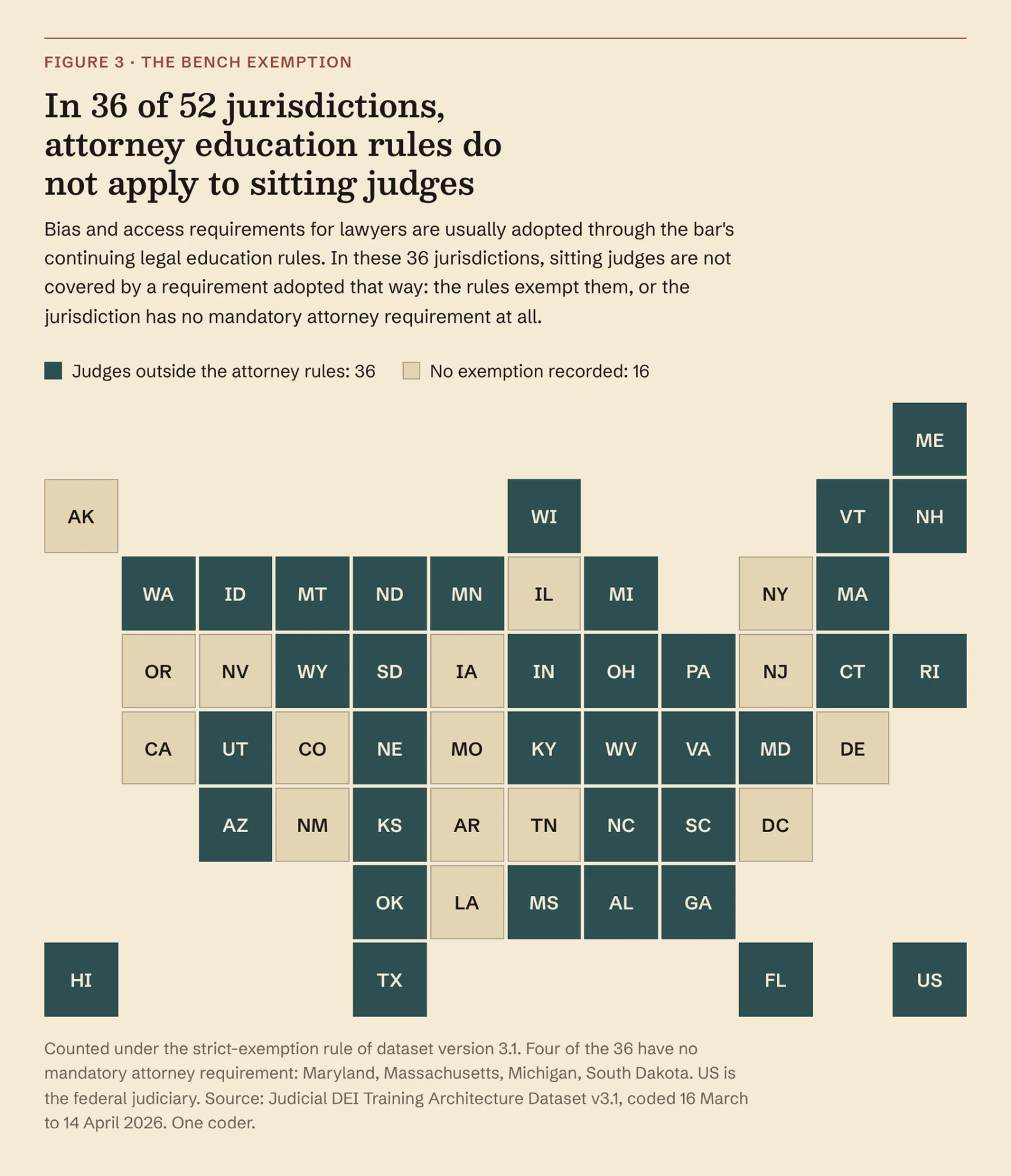
Figure 3, a tile map of 52 jurisdictions. In 36, sitting judges are outside the attorney education rules: Maine, Wisconsin, Vermont, New Hampshire, Washington, Idaho, Montana, North Dakota, Minnesota, Michigan, Massachusetts, Wyoming, South Dakota, Indiana, Ohio, Pennsylvania, Connecticut, Rhode Island, Utah, Nebraska, Kentucky, West Virginia, Virginia, Maryland, Arizona, Kansas, North Carolina, South Carolina, Oklahoma, Mississippi, Alabama, Georgia, Hawaii, Texas, Florida and the federal judiciary. No exemption is recorded in 16: Alaska, Illinois, New York, Oregon, Nevada, Iowa, New Jersey, California, Colorado, Missouri, Delaware, New Mexico, Arkansas, Tennessee, the District of Columbia and Louisiana.
Figure 3. The bench exemption. Bias and access requirements for lawyers are usually adopted through the bar's continuing legal education rules. In 36 of 52 jurisdictions, sitting judges are not covered by a requirement adopted that way: the rules exempt them, or the jurisdiction has no mandatory attorney requirement at all. Four of the 36 have no mandatory attorney requirement: Maryland, Massachusetts, Michigan and South Dakota. Counted under the strict-exemption rule. Source: Judicial DEI Training Architecture Dataset v3.1, coded 16 March to 14 April 2026. One coder.

The map shows what jurisdictions require; it can't show whether the training works.

The question still open

We don't know if threaded DEI makes a real difference, and we can't know until we actually study threaded DEI. There's not a blanket way to implement DEI training, because there's not a blanket reason why it isn't there.

Role and status

My question, my method, my coding and the poster design. Numbers are as of October 2026. The coding manual isn't posted anywhere yet, and the working paper is still in preparation.

PreviousThe dramaturgNextFriends, Romans, Ninth Graders