PreparedAI course for judges, planned for February 2027
Faculty research brief for the AI course
A brief I prepared in the autumn for the faculty planning the February 2027 AI course, to read beside the working skeleton before a faculty meeting. It sets the court system’s AI policy, a federal standing order, a Maryland statute and a bias reference against the two proposed activities, and puts three decisions to faculty.
The packet
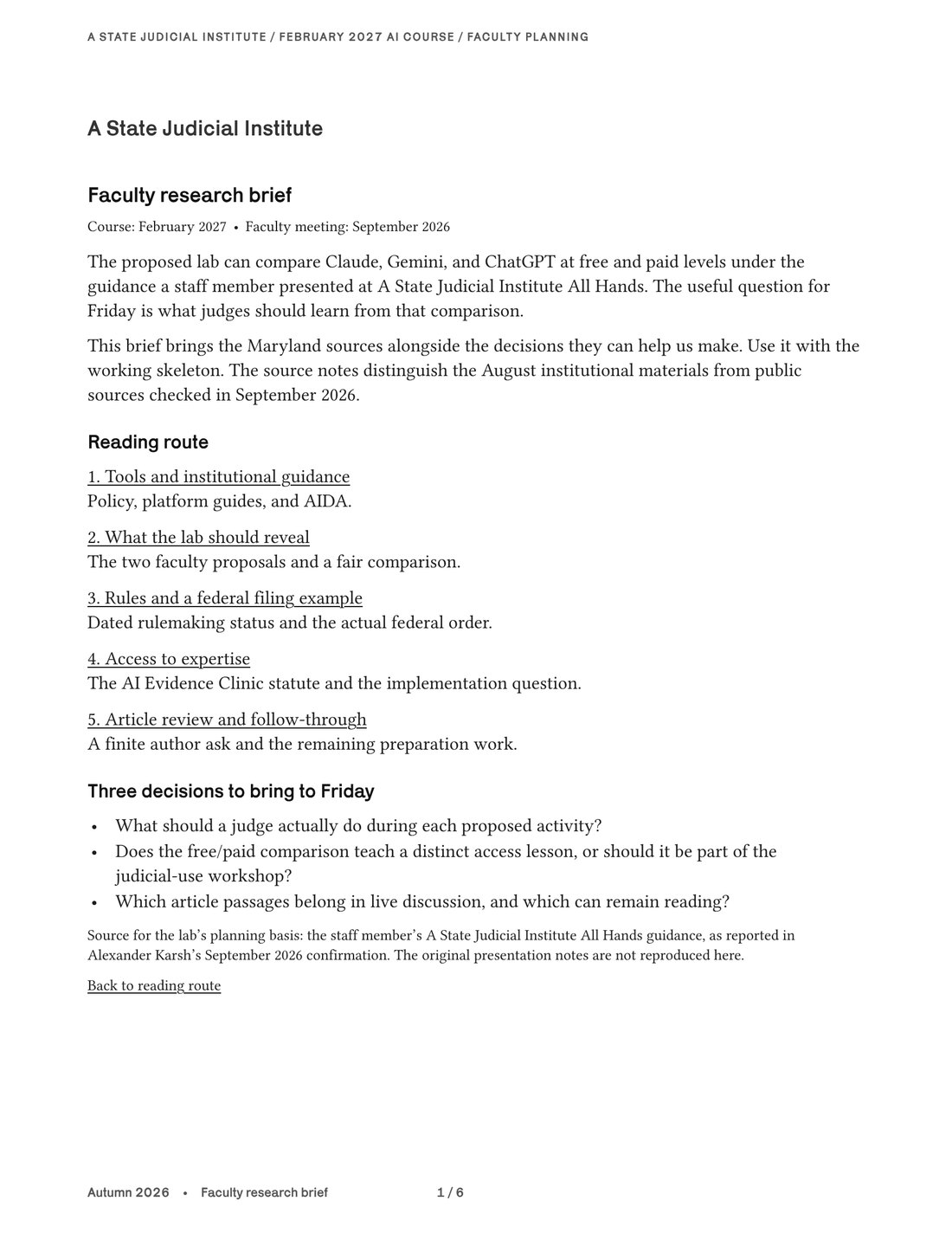 Page 1
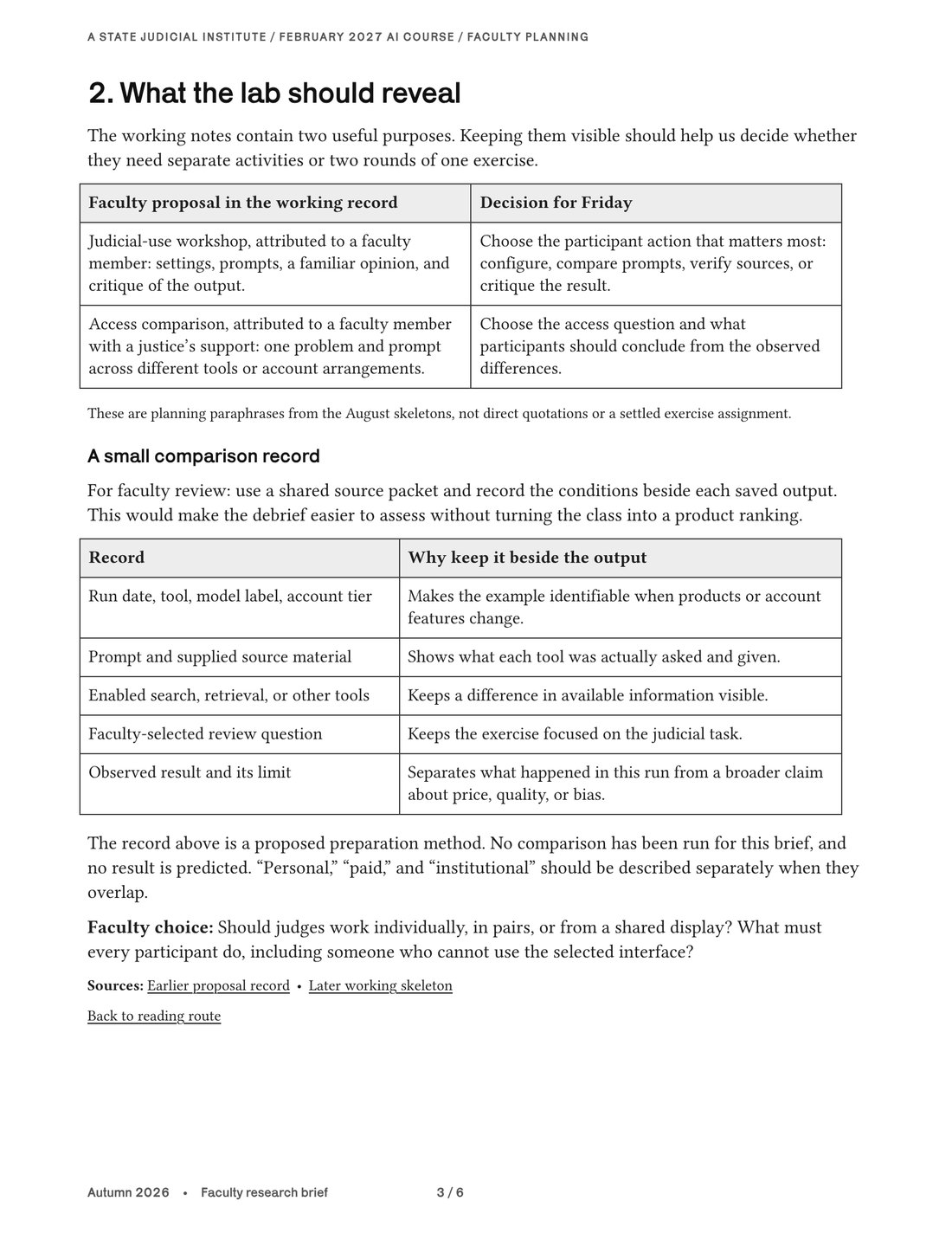 Page 3
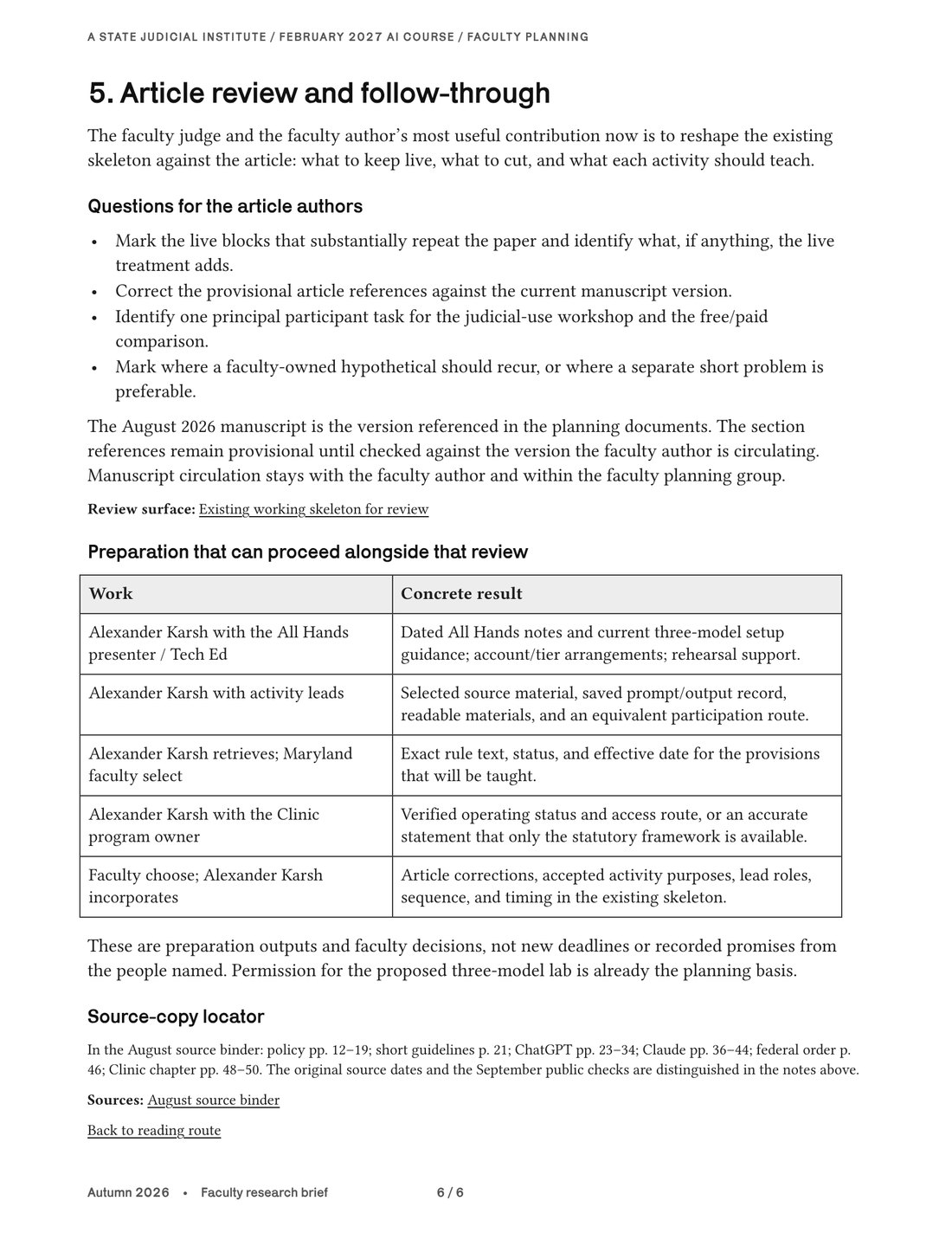 Page 6
Open the whole packet. Rebuilt for this portfolio from the packet as sent. The words are the packet’s own: roles stand in for names, A State Judicial Institute for the college, and seasons for exact dates.
What the research says, and where it went
- Guidance
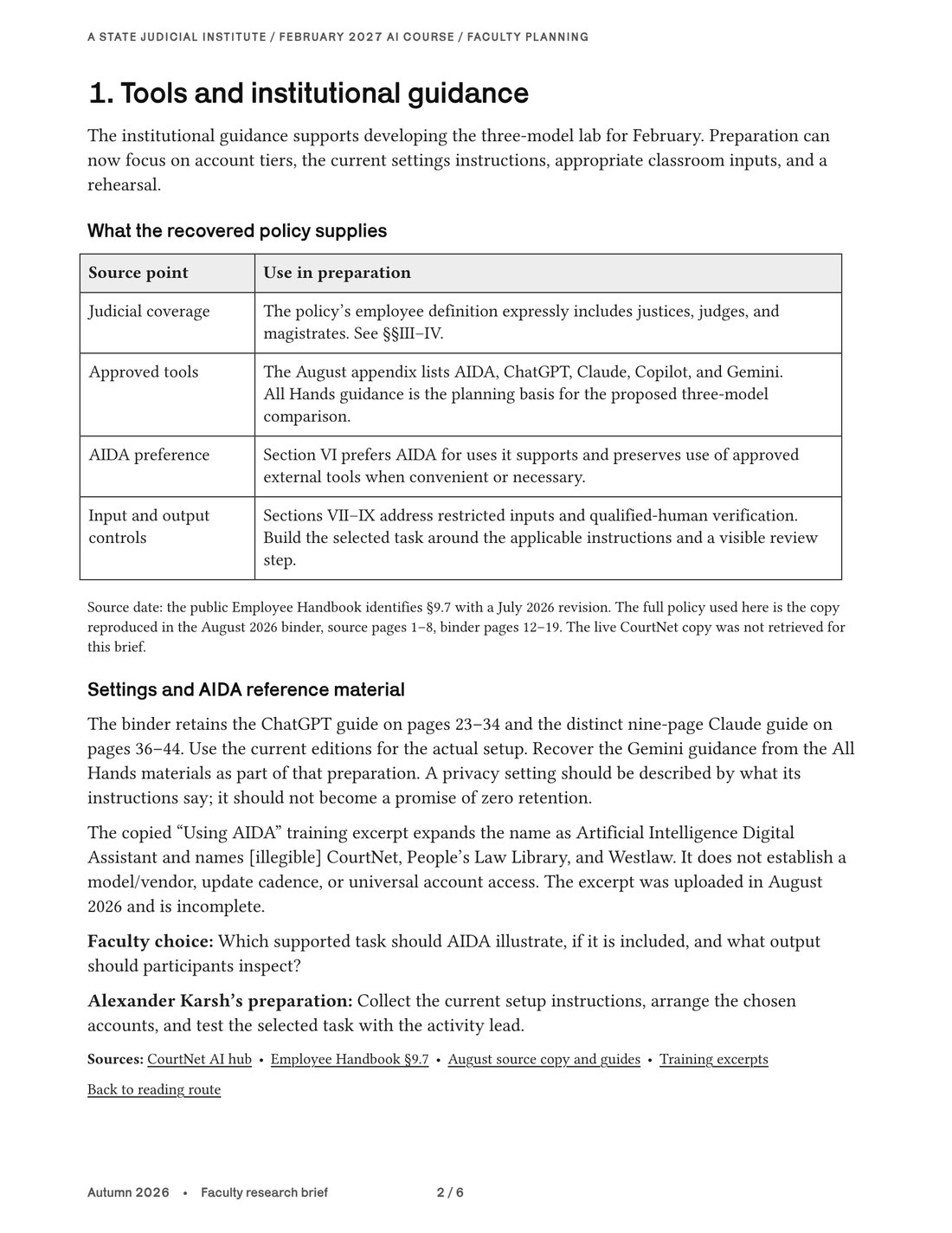
The court system’s AI policy covers judges and lists the tools the lab would compare
“The policy’s employee definition expressly includes justices, judges, and magistrates. See §§III–IV. [...] The August appendix lists AIDA, ChatGPT, Claude, Copilot, and Gemini. All Hands guidance is the planning basis for the proposed three-model comparison.”
Page 2 · The Judiciary’s employee AI policy, Employee Handbook §9.7, sections III and IV
Where it shows upThe brief’s proposed access comparison“Choose the access question and what participants should conclude from the observed differences.”
 Page 2
- Guidance
The policy calls for a qualified person to verify output, so the task needs a visible review step
“Sections VII–IX address restricted inputs and qualified-human verification. Build the selected task around the applicable instructions and a visible review step.”
Page 2 · Employee Handbook §9.7, sections VII to IX
Where it shows upThe binder’s proposed judicial-use workshop and comparison record“Which participant action matters most: configuring, comparing prompts, verifying sources, or critiquing the result?”
Page 2 - The law
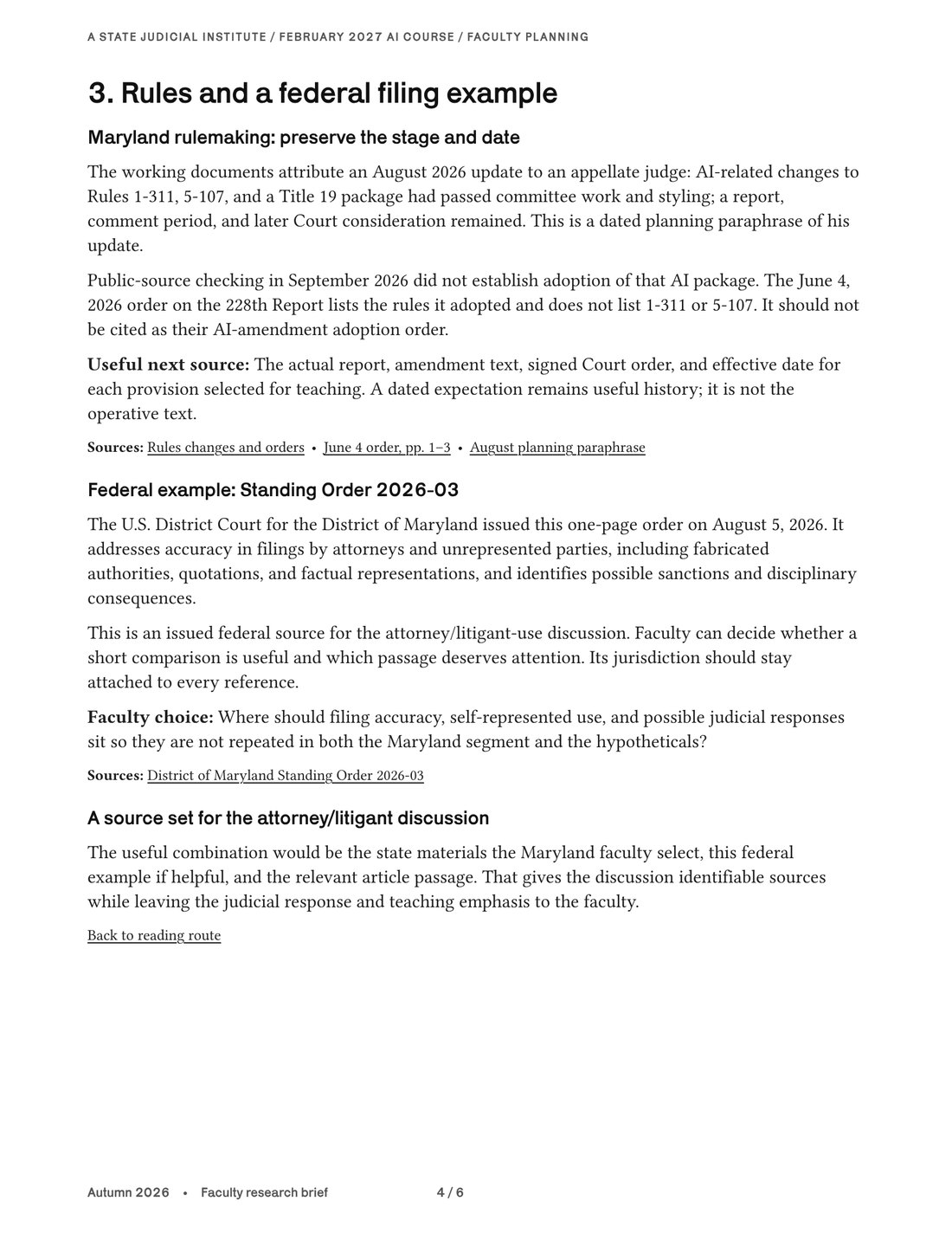
A federal court order addresses fabricated authorities in filings
“The U.S. District Court for the District of Maryland issued this one-page order on [...] It addresses accuracy in filings by attorneys and unrepresented parties, including fabricated authorities, quotations, and factual representations, and identifies possible sanctions and disciplinary consequences.”
Page 4 · U.S. District Court for the District of Maryland, Standing Order 2026-03
Where it shows upThe brief’s source set for the attorney and litigant discussion“This is an issued federal source for the attorney/litigant-use discussion.”
 Page 4
- The law
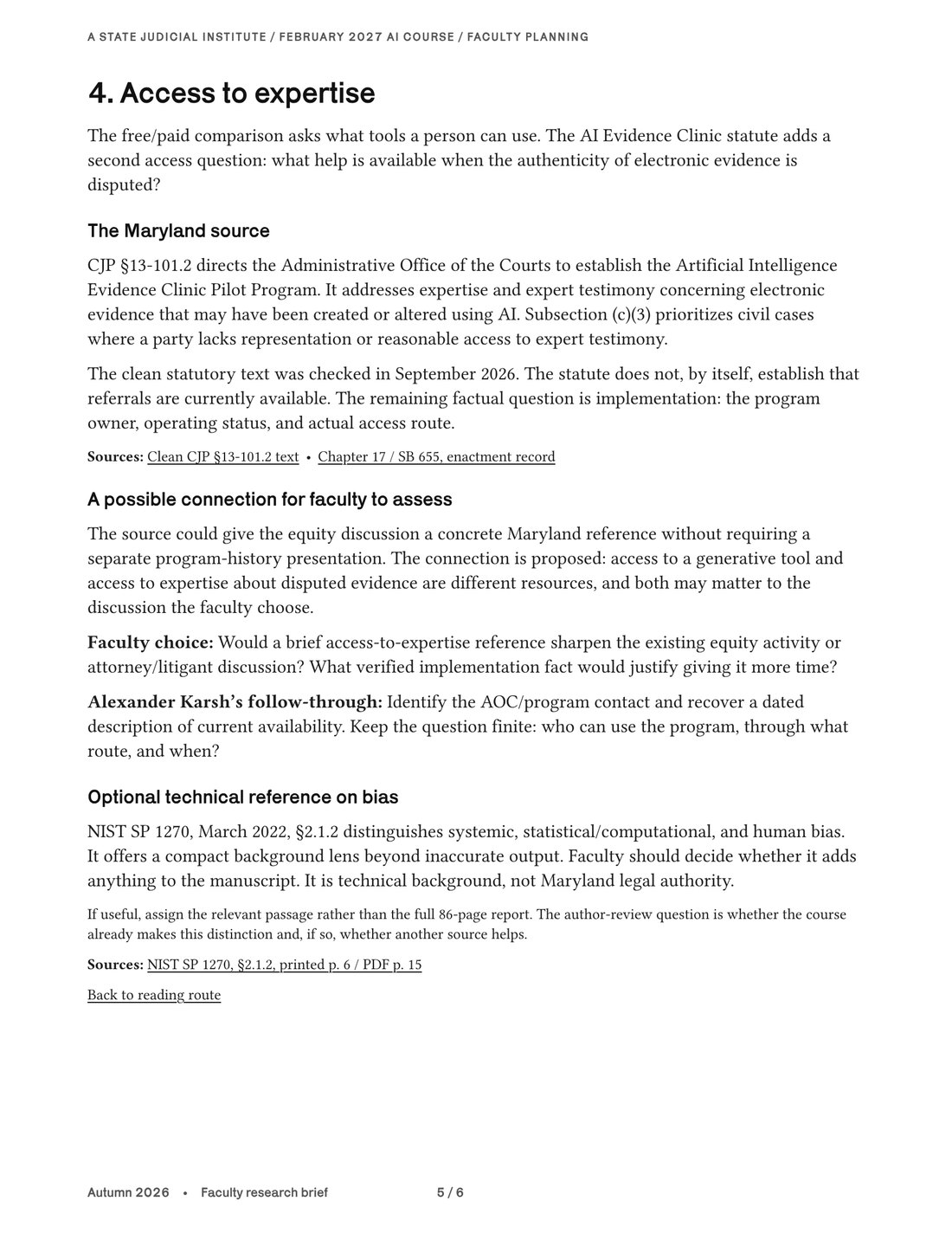
Maryland law calls for a pilot AI Evidence Clinic, with priority for parties who lack a lawyer or an expert
“CJP §13-101.2 directs the Administrative Office of the Courts to establish the Artificial Intelligence Evidence Clinic Pilot Program. [...] Subsection (c)(3) prioritizes civil cases where a party lacks representation or reasonable access to expert testimony. [...] The statute does not, by itself, establish that referrals are currently available.”
Page 5 · Courts and Judicial Proceedings §13-101.2 (Chapter 17, Senate Bill 655)
Where it shows upA possible connection, put to faculty to assess“The connection is proposed: access to a generative tool and access to expertise about disputed evidence are different resources, and both may matter to the discussion the faculty choose.”
 Page 5
- Guidance
NIST sorts AI bias into systemic, statistical and human
“NIST SP 1270, March 2022, §2.1.2 distinguishes systemic, statistical/computational, and human bias. It offers a compact background lens beyond inaccurate output. Faculty should decide whether it adds anything to the manuscript. It is technical background, not Maryland legal authority.”
Page 5 · NIST SP 1270 (March 2022), Towards a Standard for Identifying and Managing Bias in Artificial Intelligence, §2.1.2
Where it shows upThe binder’s bias vocabulary, offered for the proposed critique activity“For the authors: is either one something participants should use in the critique activity?”
Page 5