PreparedAI course for judges, planned for February 2027
Faculty research binder for the AI course
A working-draft binder for the same course: the court system’s AI policy, the two activities faculty proposed, two cases, a federal standing order, the AI Evidence Clinic statute and the national reading. Faculty decided what went in.
The packet
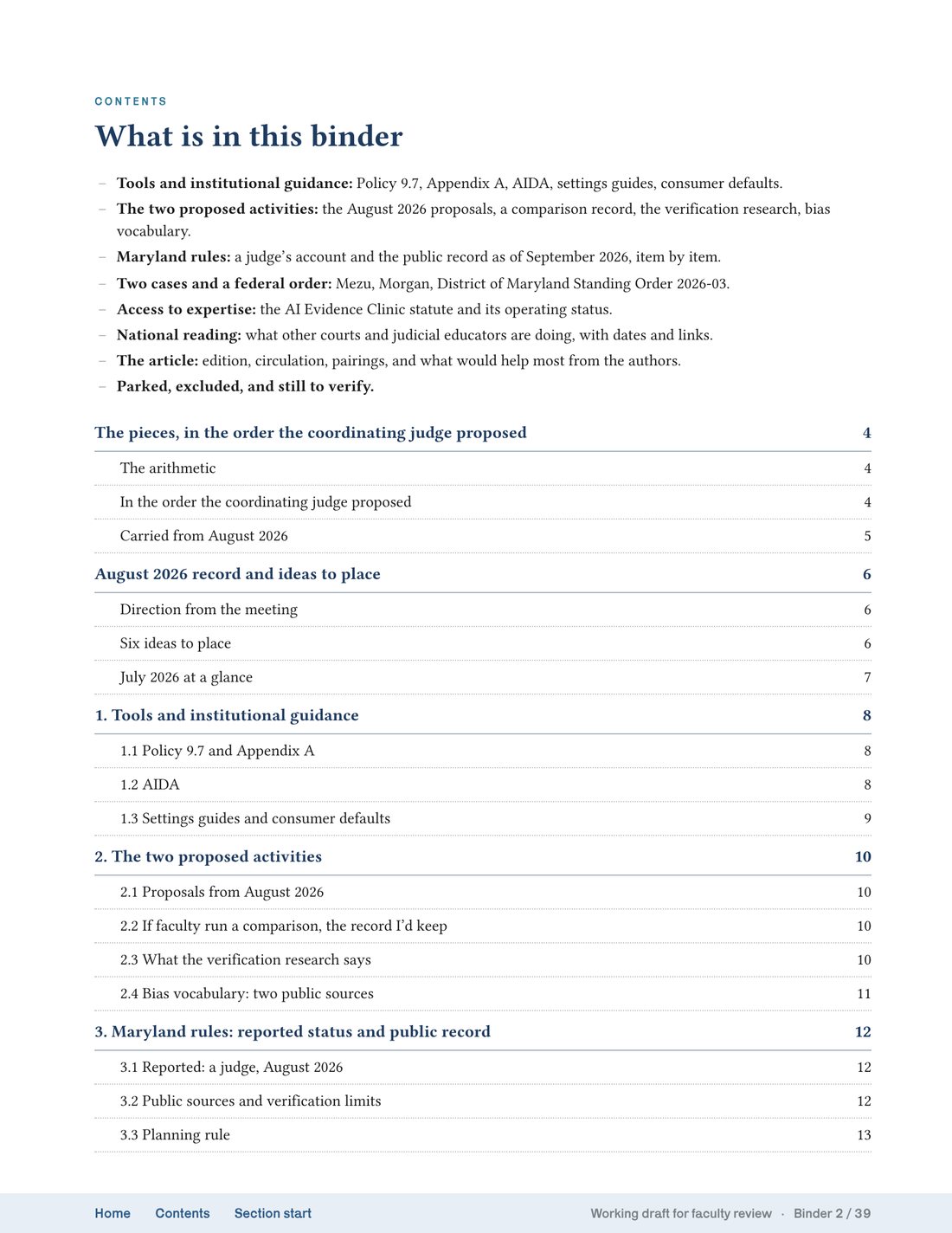 Page 2
Rebuilt for this portfolio from the packet as sent. The words are the packet’s own: roles stand in for names, A State Judicial Institute for the college, and seasons for exact dates.
What the research says, and where it went
- Studies show
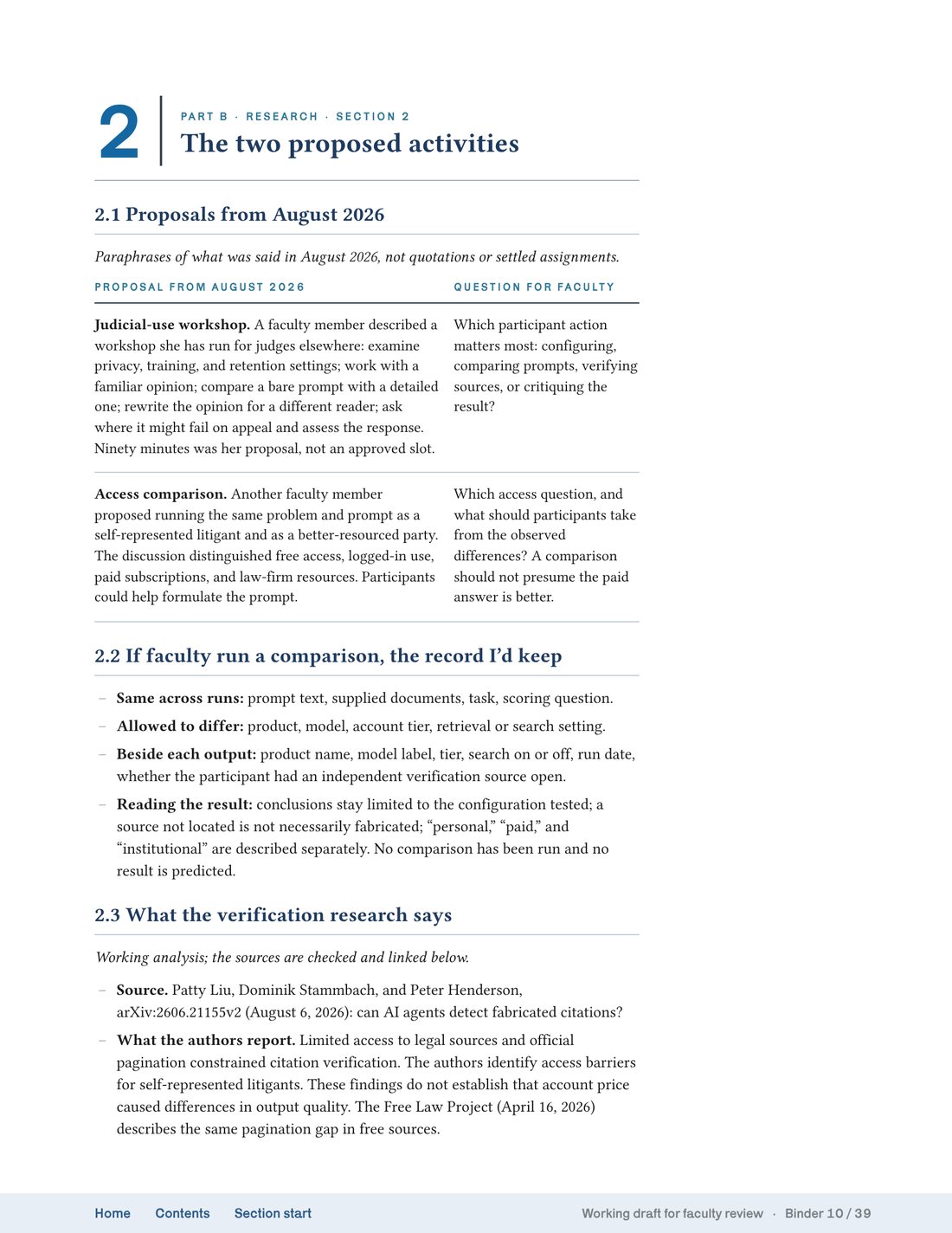
Limited access to legal sources held back AI citation checking
“What the authors report. Limited access to legal sources and official pagination constrained citation verification. The authors identify access barriers for self-represented litigants. These findings do not establish that account price caused differences in output quality. The Free Law Project (April 16, 2026) describes the same pagination gap in free sources.”
Page 6 · Liu, Stammbach & Henderson (arXiv, 2026), on whether AI agents can detect fabricated citations, and the Free Law Project (2026)
Where it shows upThe binder’s proposed access comparison“A comparison should not presume the paid answer is better.”
 Page 6
- Guidance
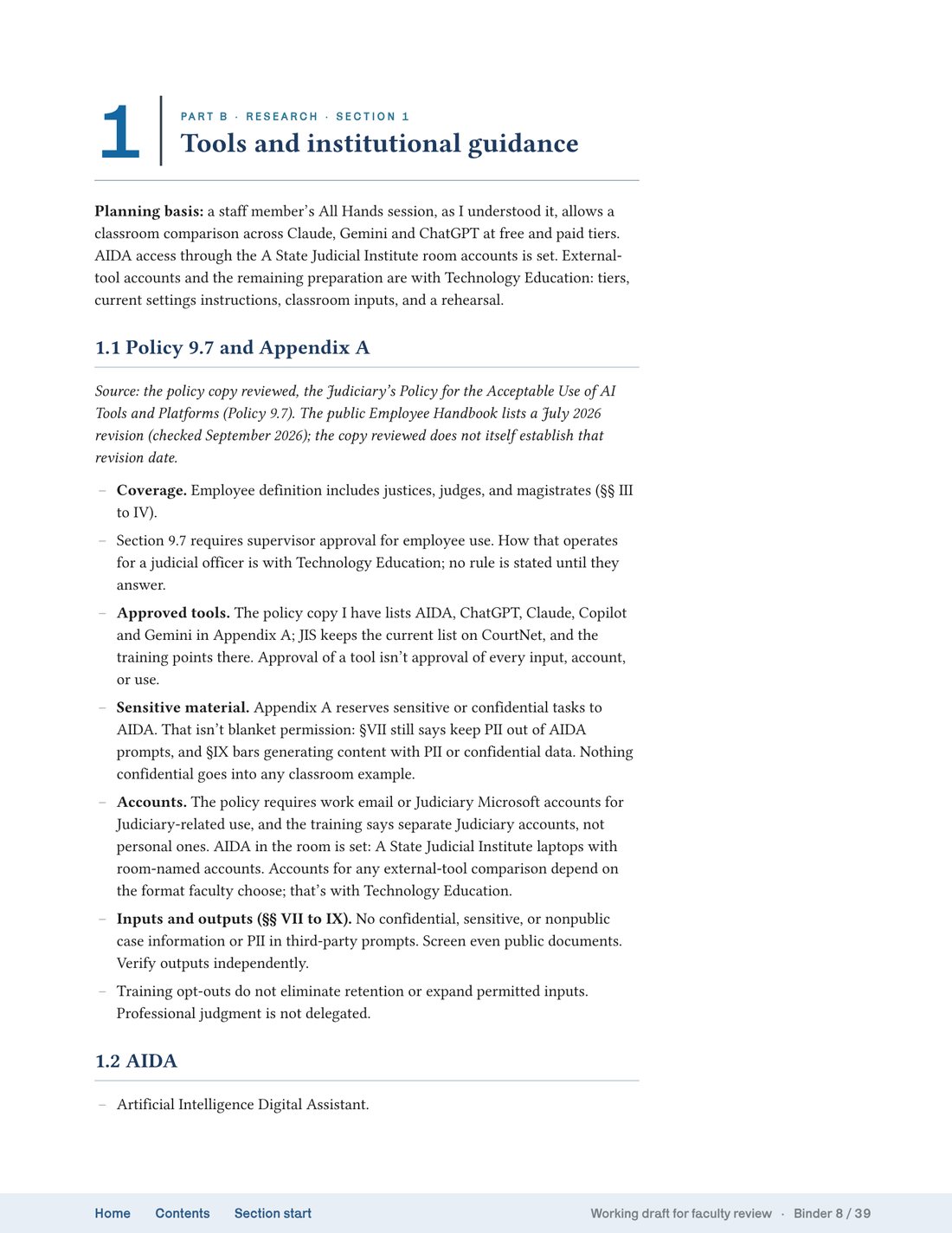
Approving a tool doesn’t approve every input, and the output still gets checked
“Approval of a tool isn’t approval of every input, account, or use. [...] Inputs and outputs (§§ VII to IX). No confidential, sensitive, or nonpublic case information or PII in third-party prompts. Screen even public documents. Verify outputs independently.”
Page 4 · The Judiciary’s Policy for the Acceptable Use of AI Tools and Platforms (Policy 9.7) and its Appendix A
Where it shows upThe brief’s preparation table, input and output controls“Build the selected task around the applicable instructions and a visible review step.”
 Page 4
- Guidance
The court’s training asks for output free of bias, and the research talks about managing it
“Bias. Video 9, Understanding AI Limitations and Flaws (transcript in the appendix), tells employees to verify that content is “completely free from unintended or undesirable bias.” The Judicature primer and NIST sources in §2.4 discuss identifying and managing bias. Is that gap something participants should notice in the critique activity?”
Page 12 · The Judiciary’s AI training, Video 9, Understanding AI Limitations and Flaws, with NIST SP 1270 and a Judicature primer
Where it shows upBackground for faculty. It isn’t tied to one part of the activity.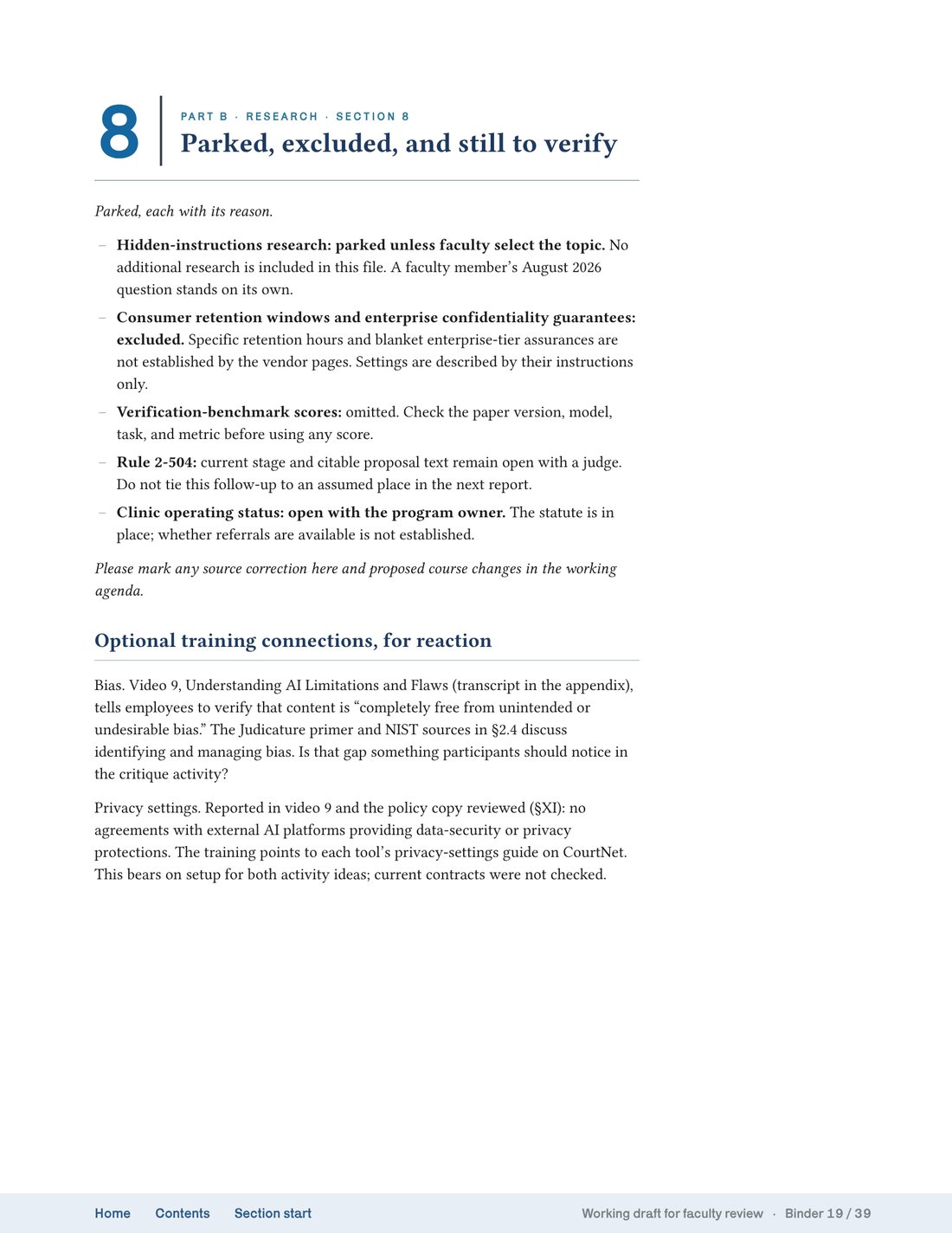 Page 12
- The law
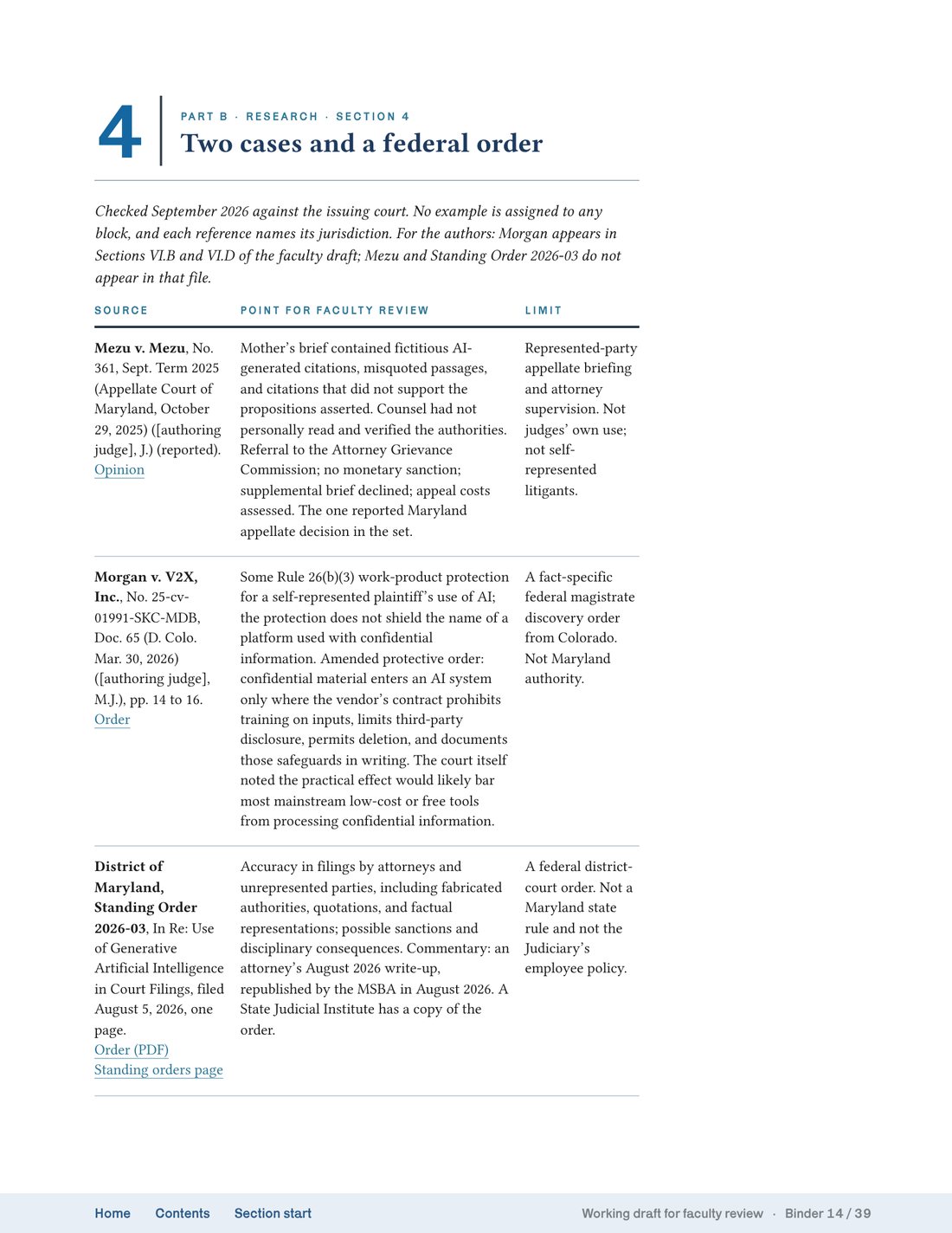
Maryland’s federal district court issued a standing order on AI in court filings
“District of Maryland, Standing Order 2026-03, In Re: Use of Generative Artificial Intelligence in Court Filings, filed August 5, 2026, one page. [...] Accuracy in filings by attorneys and unrepresented parties, including fabricated authorities, quotations, and factual representations; possible sanctions and disciplinary consequences. [...] A federal district-court order. Not a Maryland state rule and not the Judiciary’s employee policy.”
Page 8 · U.S. District Court for the District of Maryland, Standing Order 2026-03, In Re: Use of Generative Artificial Intelligence in Court Filings
Where it shows upThe brief’s source set for the attorney and litigant discussion“Faculty can decide whether a short comparison is useful and which passage deserves attention.”
 Page 8
- The law
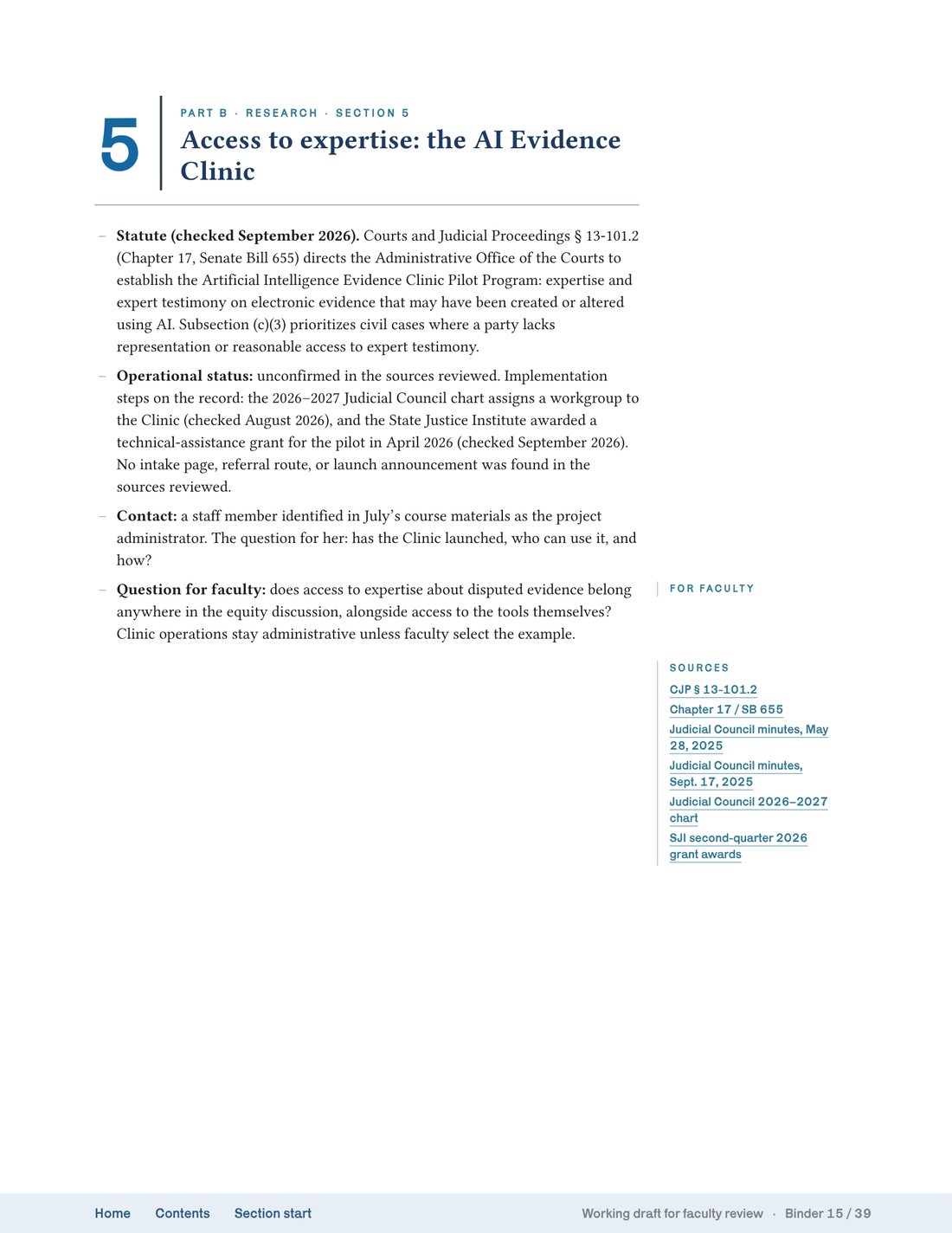
A Maryland statute calls for an AI evidence clinic, with priority for parties who lack a lawyer or an expert
“Courts and Judicial Proceedings § 13-101.2 [...] directs the Administrative Office of the Courts to establish the Artificial Intelligence Evidence Clinic Pilot Program: expertise and expert testimony on electronic evidence that may have been created or altered using AI. Subsection (c)(3) prioritizes civil cases where a party lacks representation or reasonable access to expert testimony. Operational status: unconfirmed in the sources reviewed.”
Page 9 · Courts and Judicial Proceedings §13-101.2 (Chapter 17, Senate Bill 655)
Where it shows upA possible connection, put to faculty to assess“The AI Evidence Clinic statute adds a second access question: what help is available when the authenticity of electronic evidence is disputed?”
 Page 9