PreparedComings and Goings course, planned for February 2027
Source lineage and faculty decisions
A working draft I wrote in September 2026 so the two judges could compare versions of Comings and Goings and write their own outline. It traces the activity from its published originals through the 2025 materials to the 2026 redesign, and records what each source supports and what faculty decided. It doesn’t pick a cast, a script or a schedule.
The packet
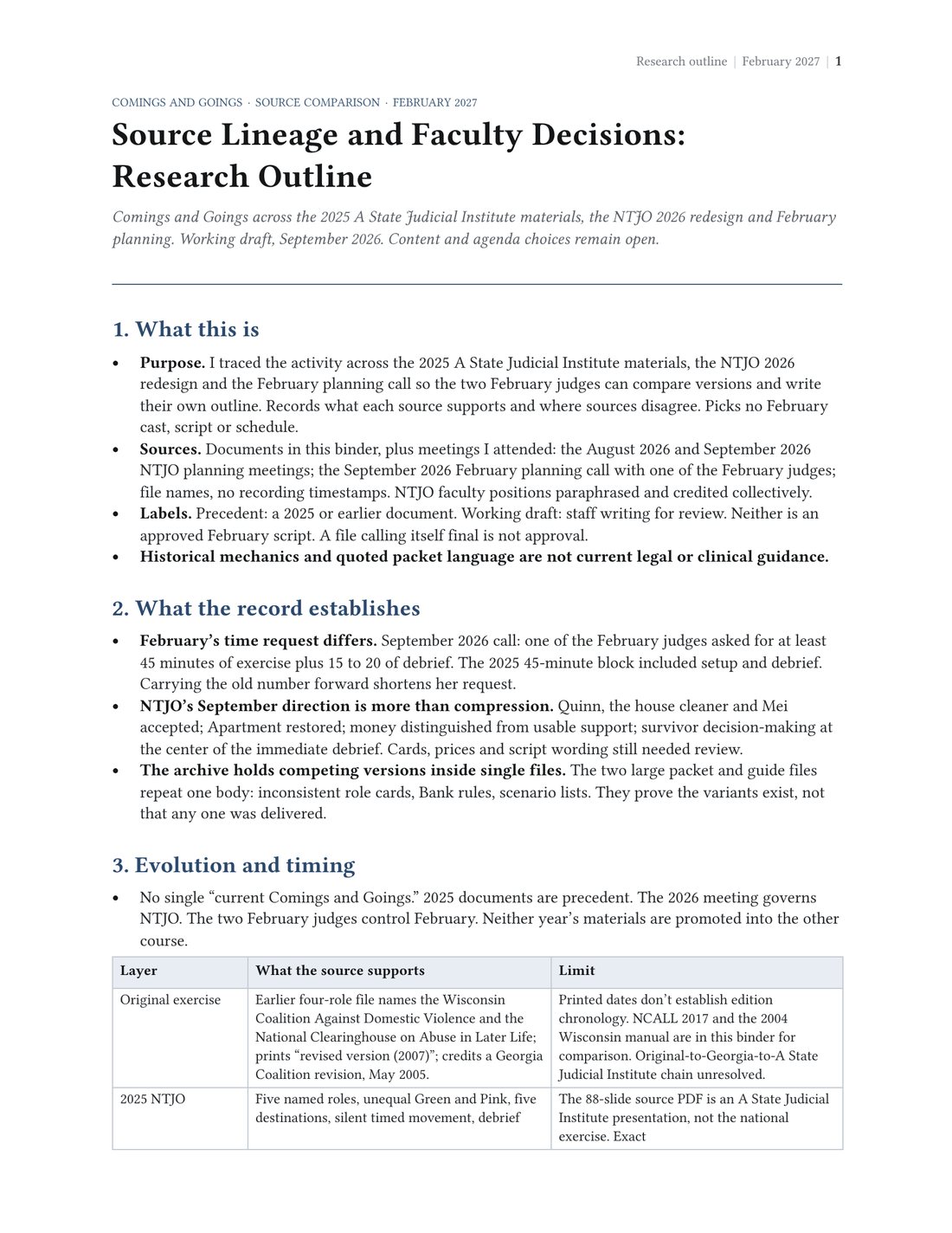 Page 1
Rebuilt for this portfolio from the packet as sent. The words are the packet’s own: roles stand in for names, A State Judicial Institute for the college, and seasons for exact dates.
What the research says, and where it went
- Faculty direction
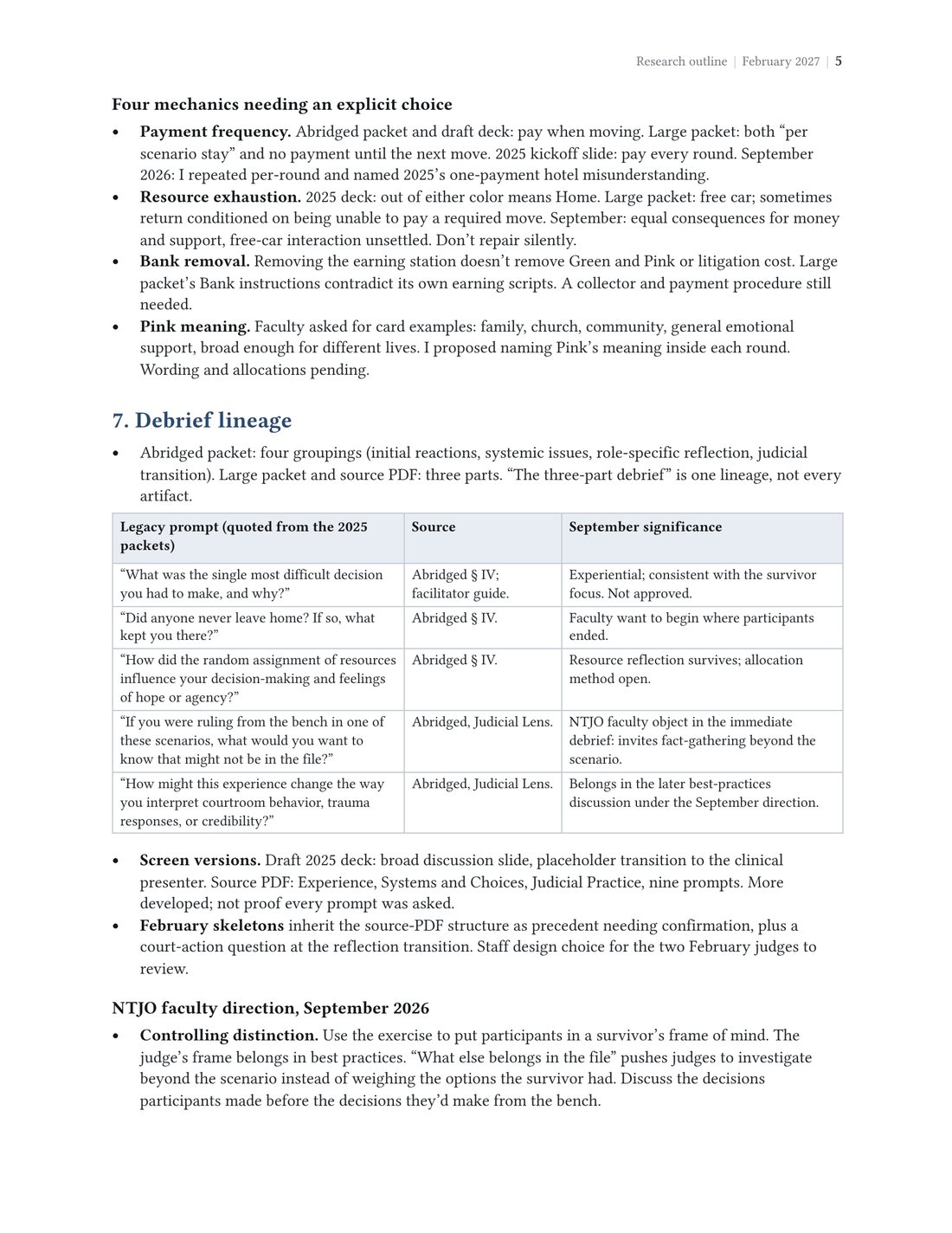
Put judges in the survivor’s frame first, and save the judge’s frame for best practices
“Controlling distinction. Use the exercise to put participants in a survivor’s frame of mind. The judge’s frame belongs in best practices. “What else belongs in the file” pushes judges to investigate beyond the scenario instead of weighing the options the survivor had. Discuss the decisions participants made before the decisions they’d make from the bench.”
Page 5 · The faculty’s direction, recorded in the outline. No research source is cited
Where it shows upThe orientation running order: survivor perspective first, judicial application after“Judicial faculty lead the survivor-perspective discussion [...] Judicial application with faculty-selected materials”
 Page 5
- Planning direction
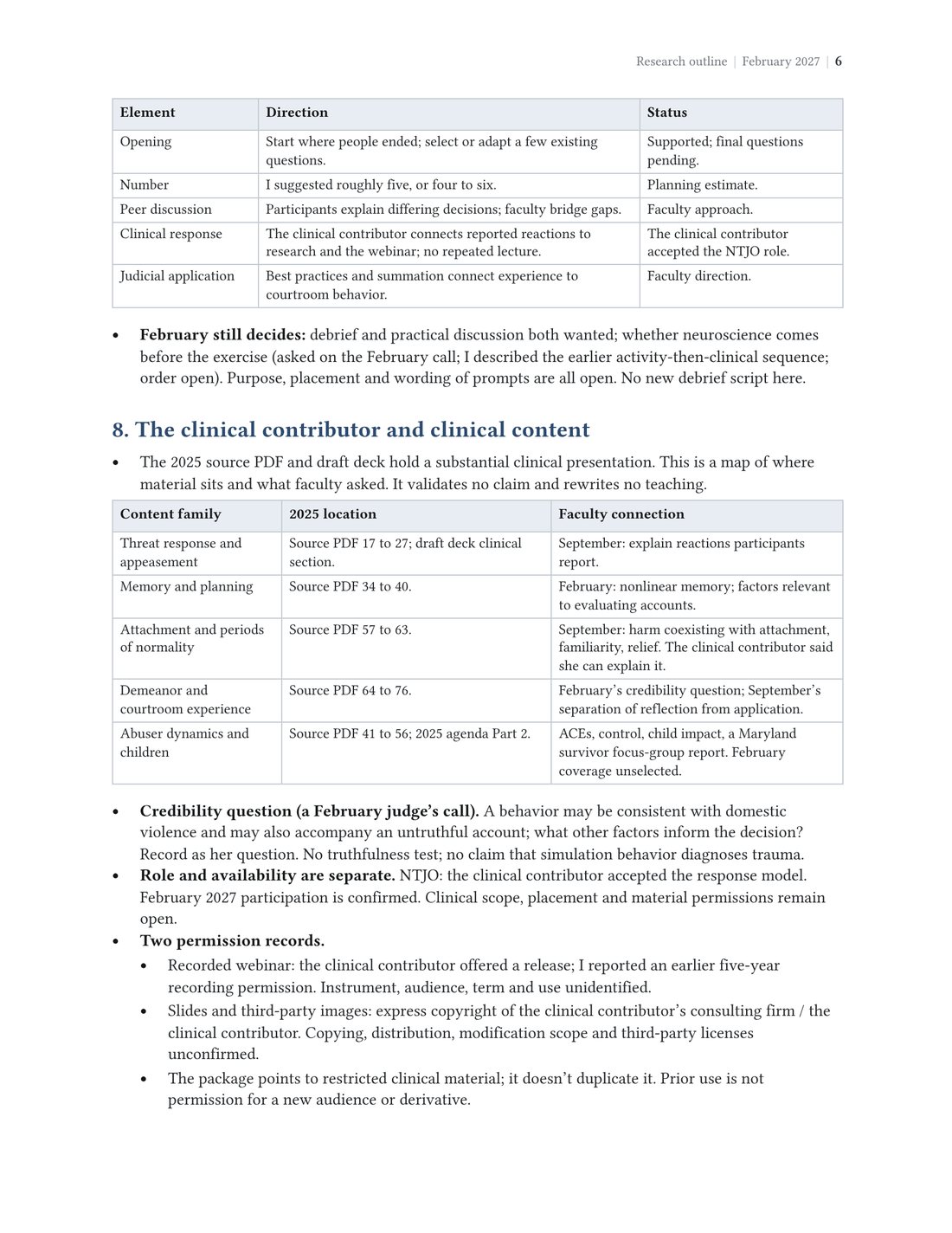
A planned clinical response would explain what participants report
“Clinical response [...] connects reported reactions to research and the webinar; no repeated lecture. [...] Threat response and appeasement [...] Source PDF 17 to 27; draft deck clinical section. [...] September: explain reactions participants report.”
Page 6 · The 2025 clinical presentation, pages 17 to 27, and the clinical respondent’s recorded webinar
Where it shows upThe faculty working page and the facilitation guide: a focused clinical response“a 15 to 20 minute response after the debrief [...] address what judges just experienced.”
 Page 6
- Faculty request
Faculty asked to show harm alongside attachment, familiarity and relief
“Attachment and periods of normality [...] Source PDF 57 to 63. [...] September: harm coexisting with attachment, familiarity, relief.”
Page 6 · The 2025 clinical presentation, pages 57 to 63. The outline says it validates no claim and rewrites no teaching
Where it shows upThe Home row on a character card’s back“Familiar routines and practical help may remain. So may danger. Staying or returning is never scored.”
Page 6 - Faculty question
Faculty asked about nonlinear memory and what else bears on credibility
“Memory and planning [...] Source PDF 34 to 40. [...] February: nonlinear memory; factors relevant to evaluating accounts. [...] A behavior may be consistent with domestic violence and may also accompany an untruthful account; what other factors inform the decision? [...] No truthfulness test; no claim that simulation behavior diagnoses trauma.”
Page 6 · The 2025 clinical presentation, pages 34 to 40, and a judge’s question from the planning call
Where it shows upThe planned afternoon, 1:50 to 2:10: clinical questions from the exercise“Explore the questions faculty selects about behavior and memory. Separate possible explanations from conclusions about an individual.”
Page 6 - On record
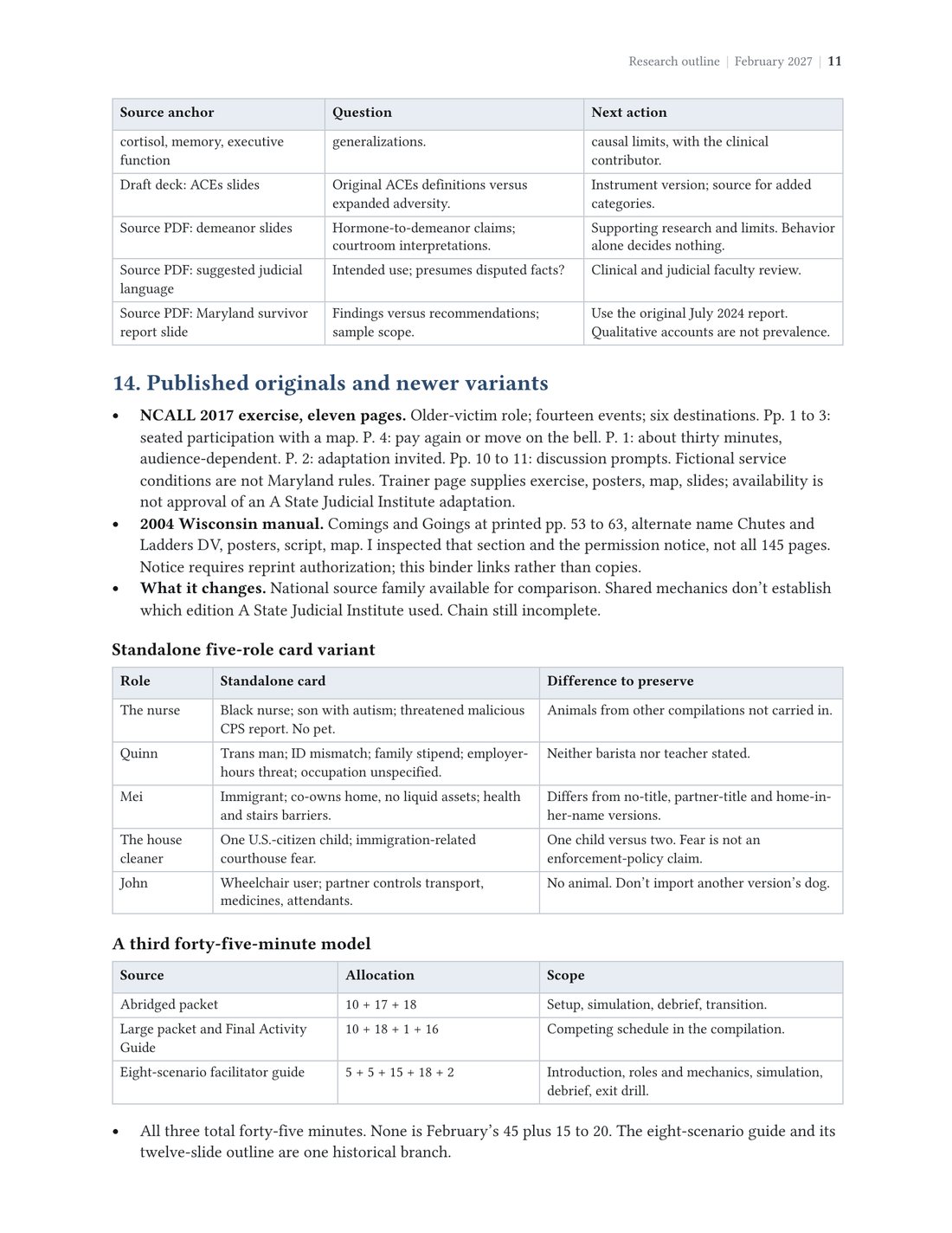
The 2017 national version already let people take part seated
“NCALL 2017 exercise, eleven pages. Older-victim role; fourteen events; six destinations. Pp. 1 to 3: seated participation with a map. P. 4: pay again or move on the bell. P. 1: about thirty minutes, audience-dependent. P. 2: adaptation invited. Pp. 10 to 11: discussion prompts. Fictional service conditions are not Maryland rules.”
Page 11 · NCALL (National Clearinghouse on Abuse in Later Life), the 2017 exercise and trainer resources
Where it shows upThe facilitation guide, before the envelopes open“You may stay seated, observe, pass on a question or step out without giving an explanation. You will not be asked to share personal experience.”
 Page 11
- Planning record
Help from people can come with pressure to go back
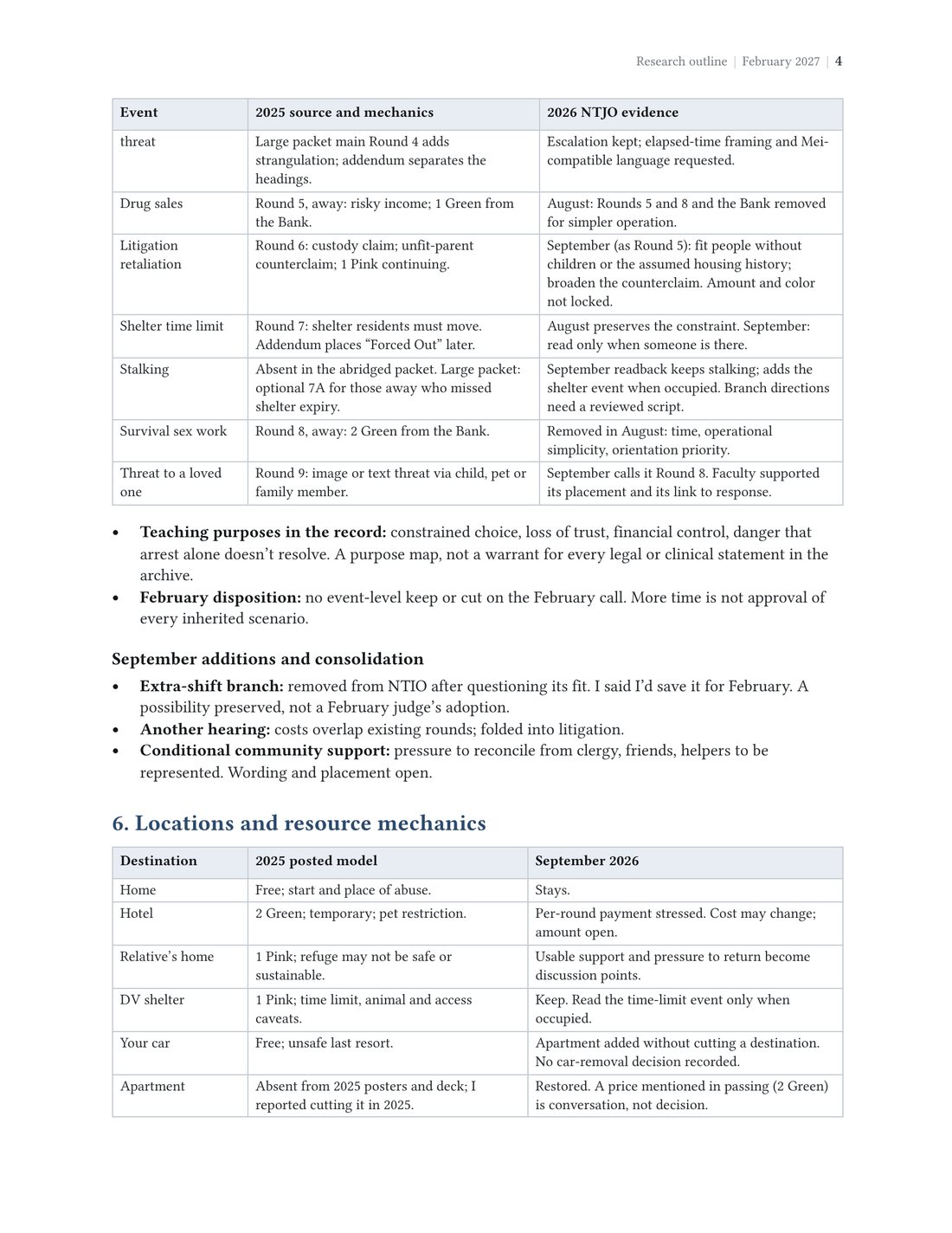
“Conditional community support: pressure to reconcile from clergy, friends, helpers to be represented. Wording and placement open. [...] Relative’s home [...] 1 Pink; refuge may not be safe or sustainable. [...] Usable support and pressure to return become discussion points.”
Page 4 · The September planning additions and the 2025 posted model. No research source is cited
Where it shows upThe Relative or Friend’s Home row on a character card’s back“Not confidential. Someone may urge reconciliation or ask you to leave.”
 Page 4
- On record
A Maryland report gathered survivors’ views in ten focus groups
“pp. 4 to 5 methods (ten virtual focus groups, 69 attendees, recruited through DV programs); pp. 8 to 14 support, advocacy, shelter, coordination; pp. 22 to 23 conditions for survivor participation; pp. 24 to 26 authors’ recommendations, not adopted requirements.”
Page 13 · Survivors’ Perspectives on Improving Maryland’s Response to Domestic Violence, July 2024, Governor’s Office of Crime Prevention and Policy (Jordan, Aylward, Agbeyegbe)
Where it shows upBackground for faculty. It isn’t tied to one part of the activity.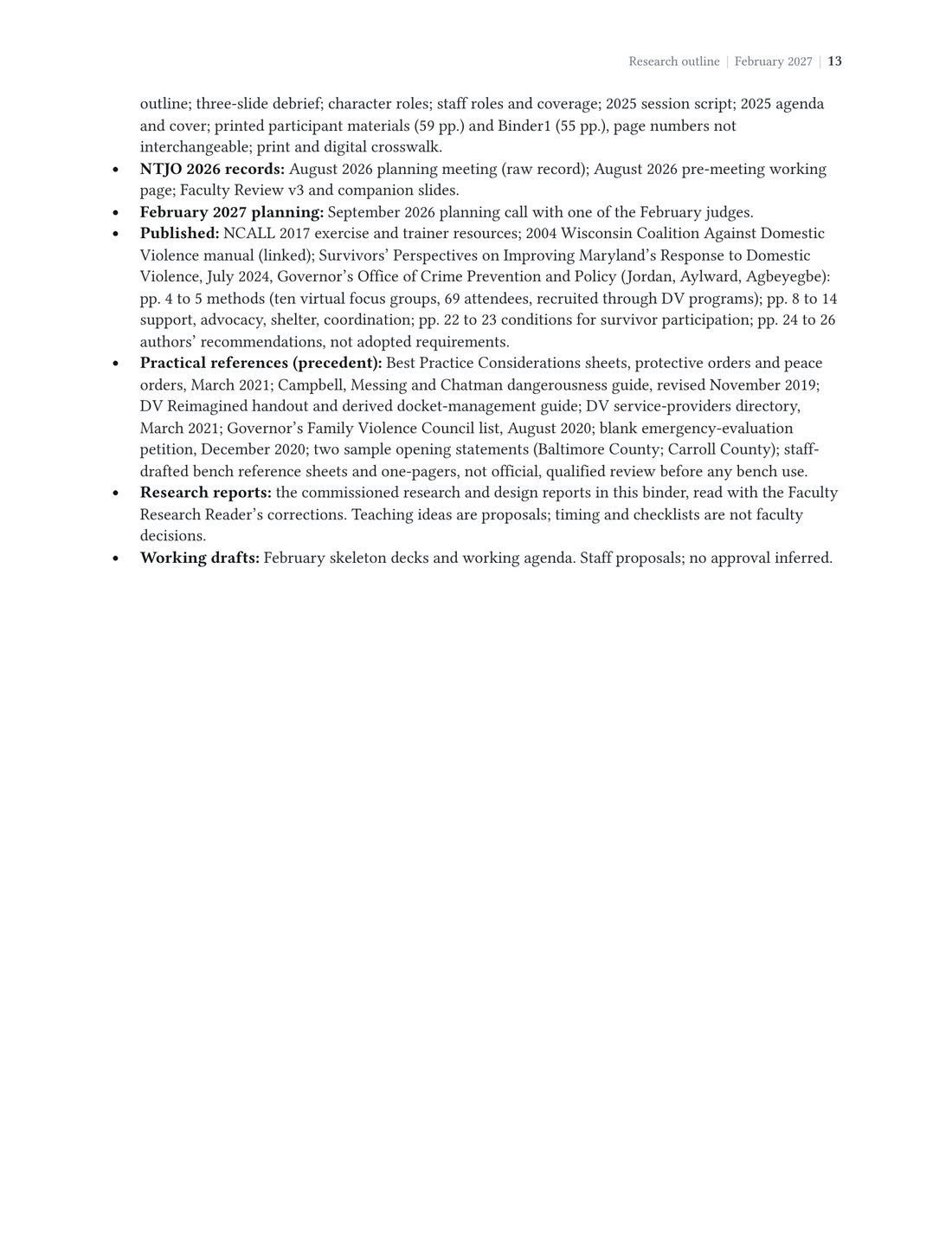 Page 13