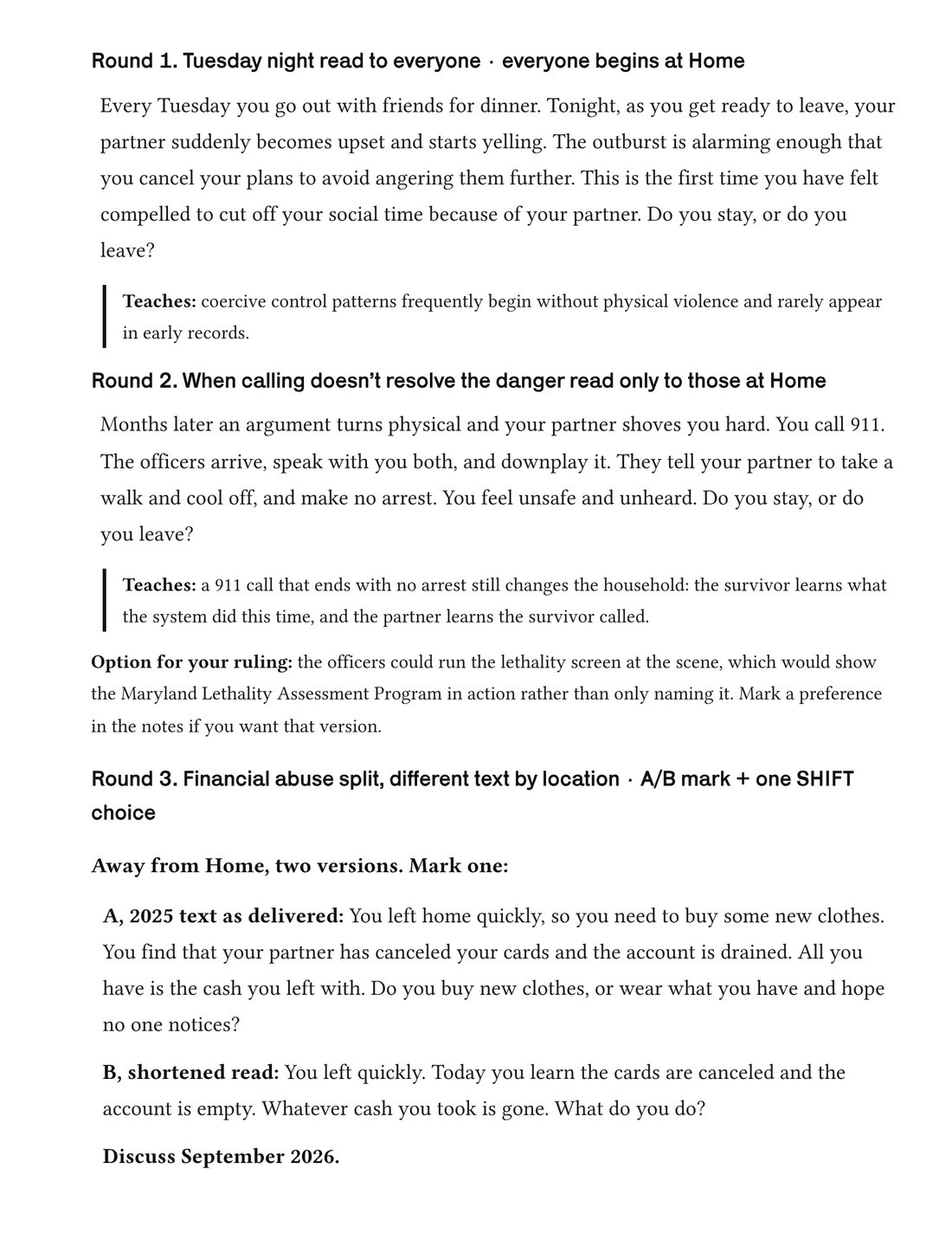
PreparedComings and Goings course, planned for February 2027
Faculty research binder: victims’ rights, IPV and judicial practice
A research binder I sent the two judges planning a February 2027 day: victims’ rights in the morning, and an afternoon on the barriers survivors face, built around the Comings and Goings activity. It puts Maryland filings, service data and survivor accounts first, then the research on legal process, simulation, debriefing and participation, then the activity’s design, with 45 annotated sources. It calls itself a selective research synthesis, not a systematic review.
The packet
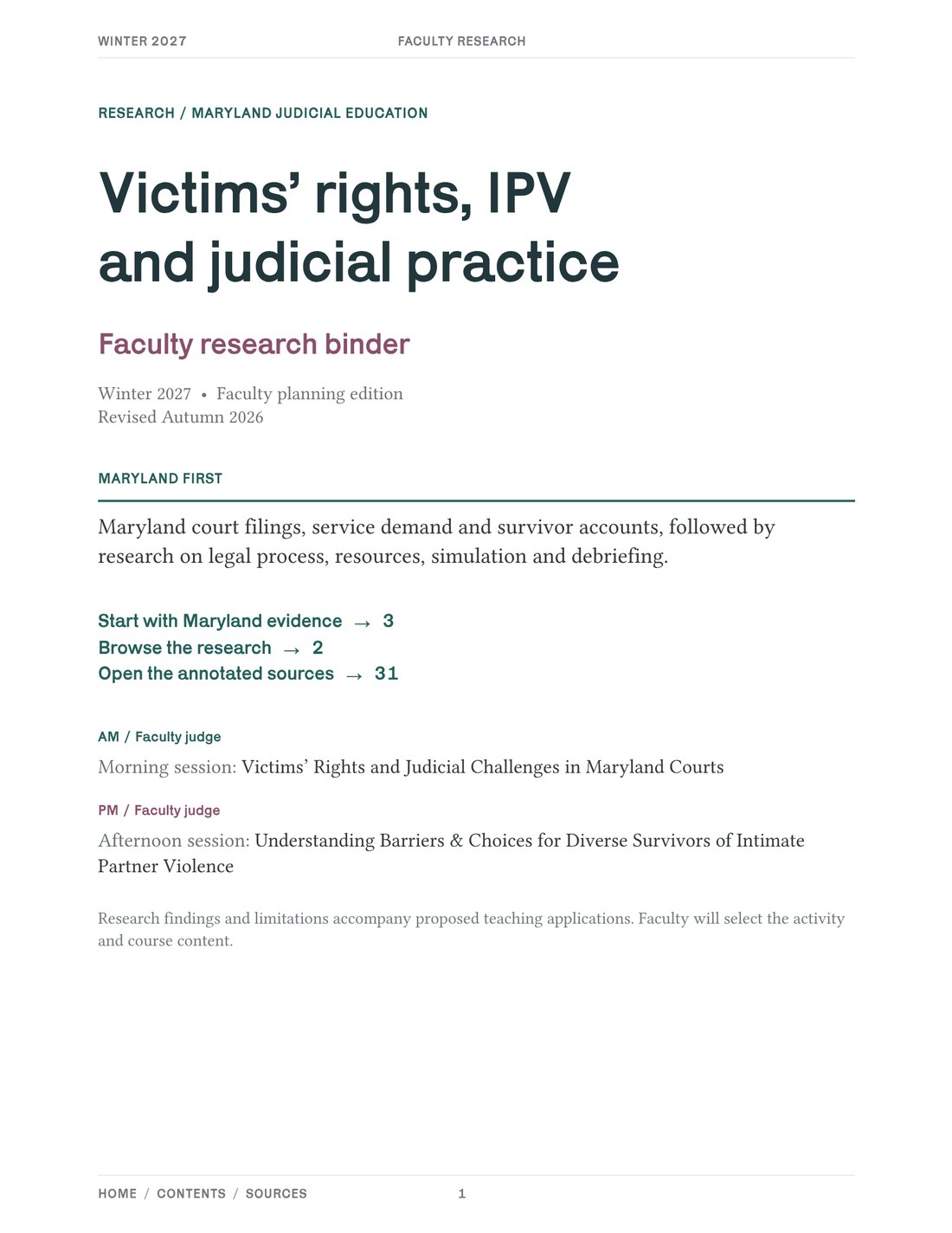 Page 1
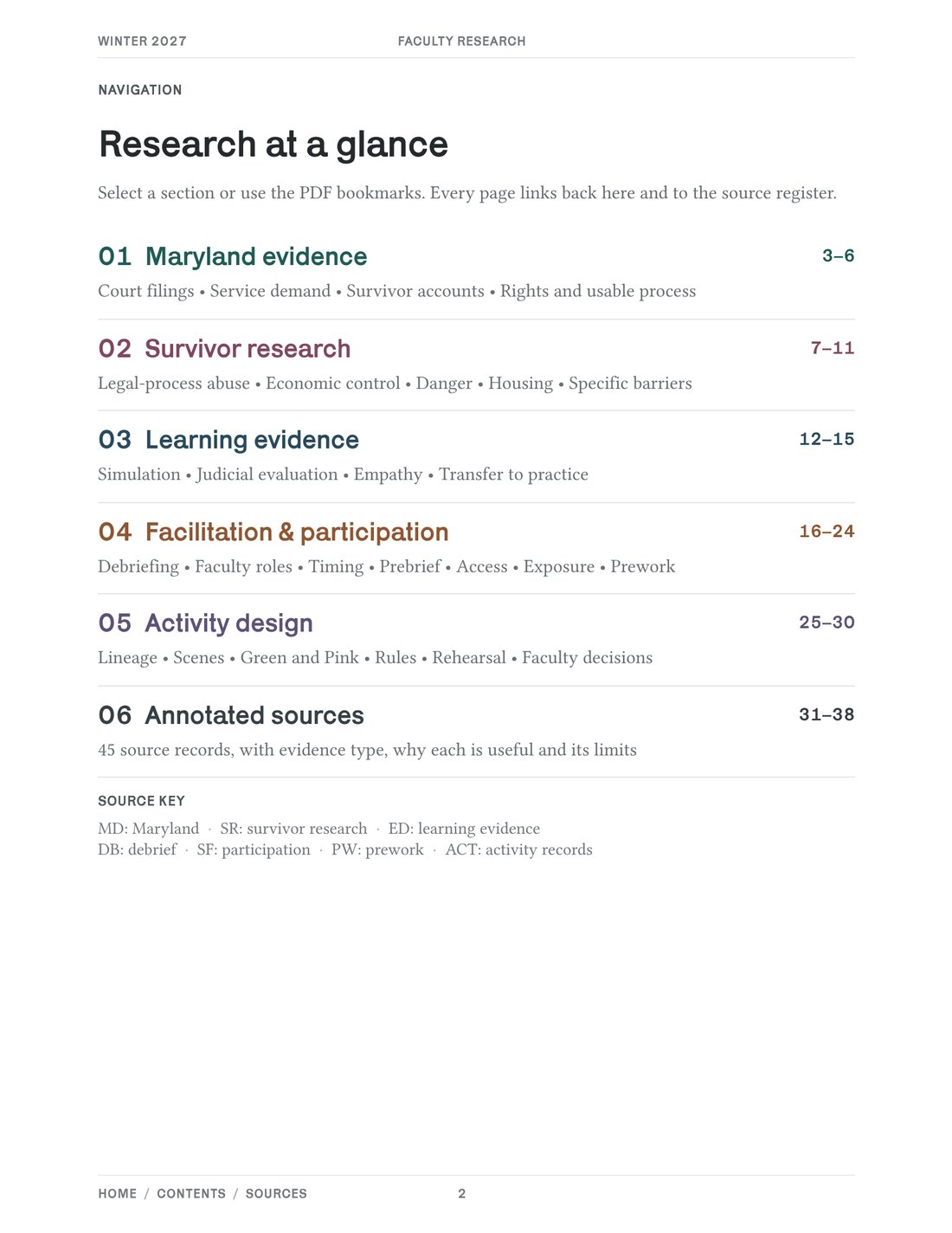 Page 2
Rebuilt for this portfolio from the packet as sent. The words are the packet’s own: roles stand in for names, A State Judicial Institute for the college, and seasons for exact dates.
Sent with it
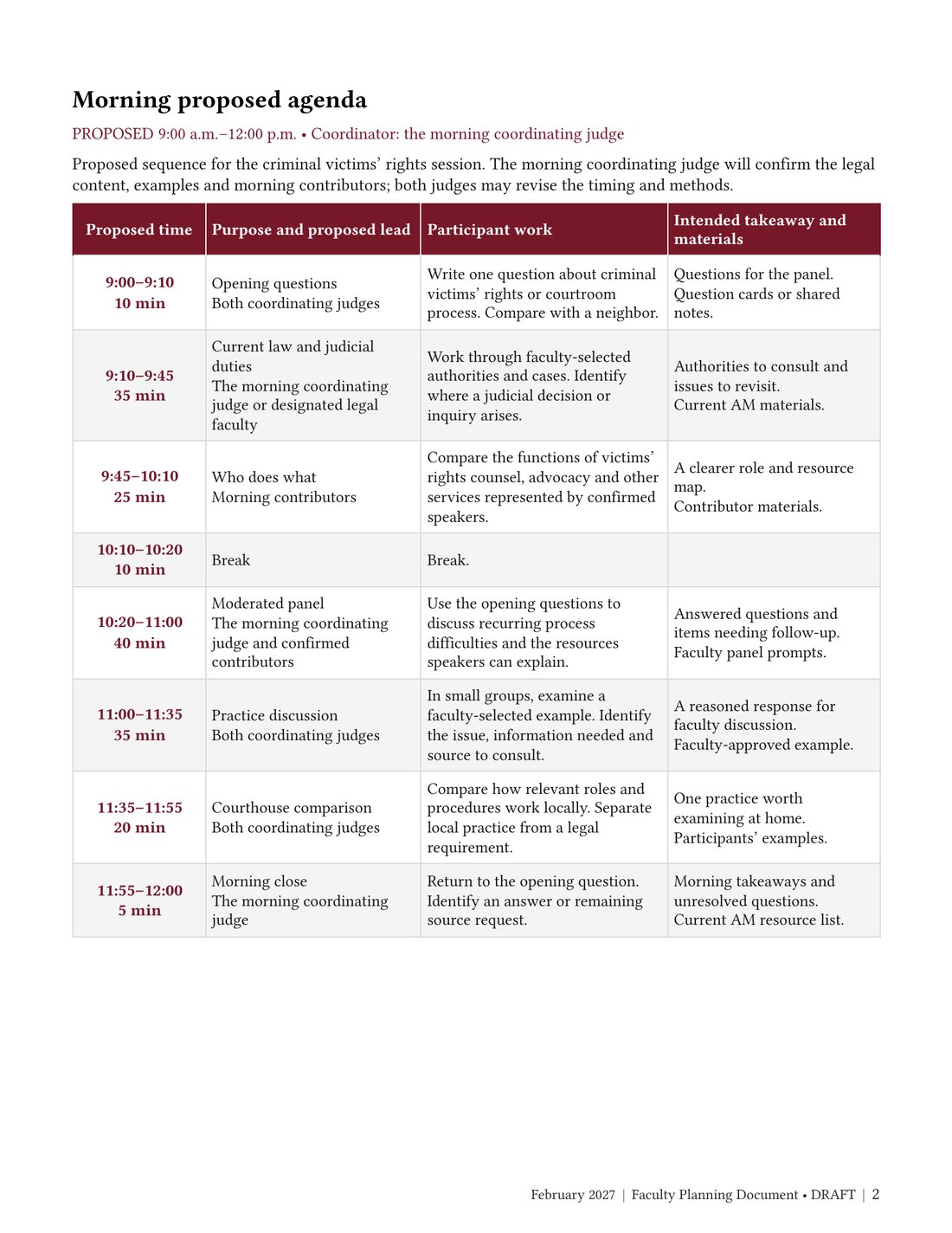 The faculty planning document: the proposed agenda, 3 pages
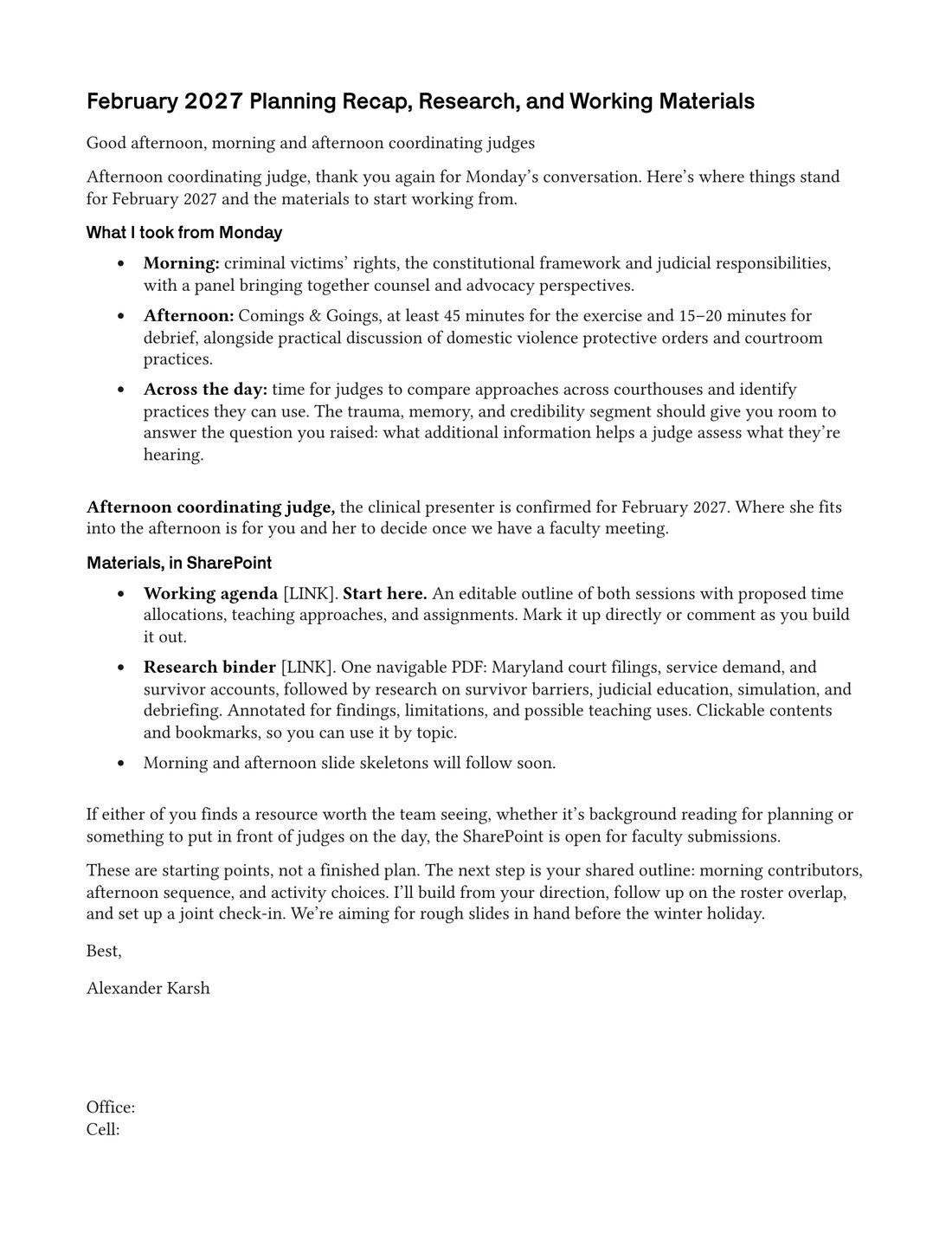 The recap note to the two judges, 1 page
What the research says, and where it went
- Studies show
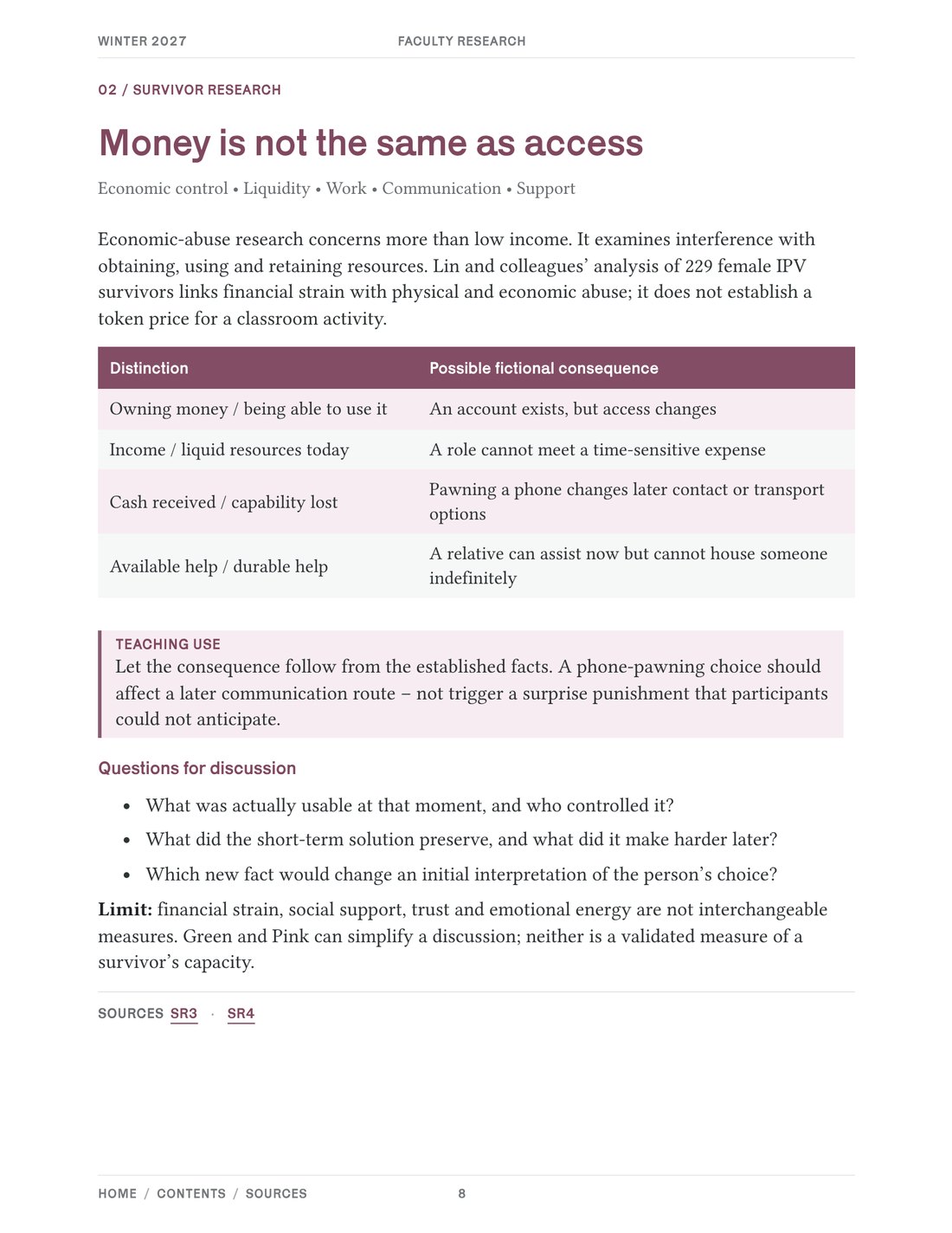
Having money isn’t the same as being able to use it
“Economic-abuse research concerns more than low income. It examines interference with obtaining, using and retaining resources. Lin and colleagues’ analysis of 229 female IPV survivors links financial strain with physical and economic abuse; it does not establish a token price for a classroom activity.”
Page 8 · Lin, Postmus, Hu & Stylianou (2023), IPV Experiences and Financial Strain Over Time
Where it shows upRound 3 of the orientation simulation, as drafted: the financial-abuse split“You find that your partner has canceled your cards and the account is drained. All you have is the cash you left with.”
 Page 8
- Studies show
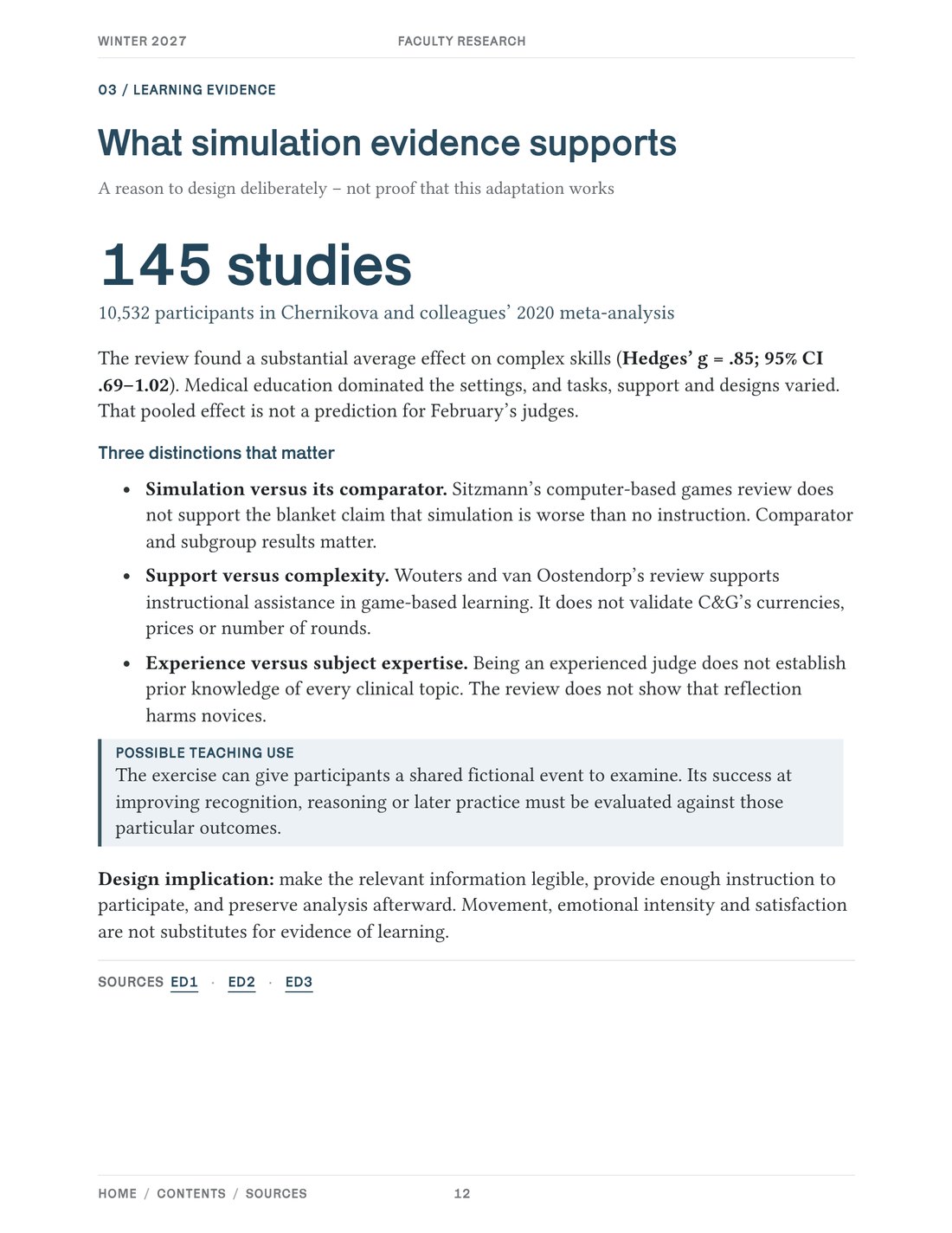
Across 145 studies, simulation helped build complex skills
“The review found a substantial average effect on complex skills (Hedges’ g = .85; 95% CI .69–1.02). Medical education dominated the settings, and tasks, support and designs varied. That pooled effect is not a prediction for February’s judges. [...] Design implication: make the relevant information legible, provide enough instruction to participate, and preserve analysis afterward.”
Page 12 · Chernikova et al. (2020), Simulation-Based Learning in Higher Education: A Meta-Analysis
Where it shows upThe planned day’s teaching approach, in the faculty planning document“The afternoon moves from the exercise to reflection, clinical questions and practical resources.”
 Page 12
- Studies show
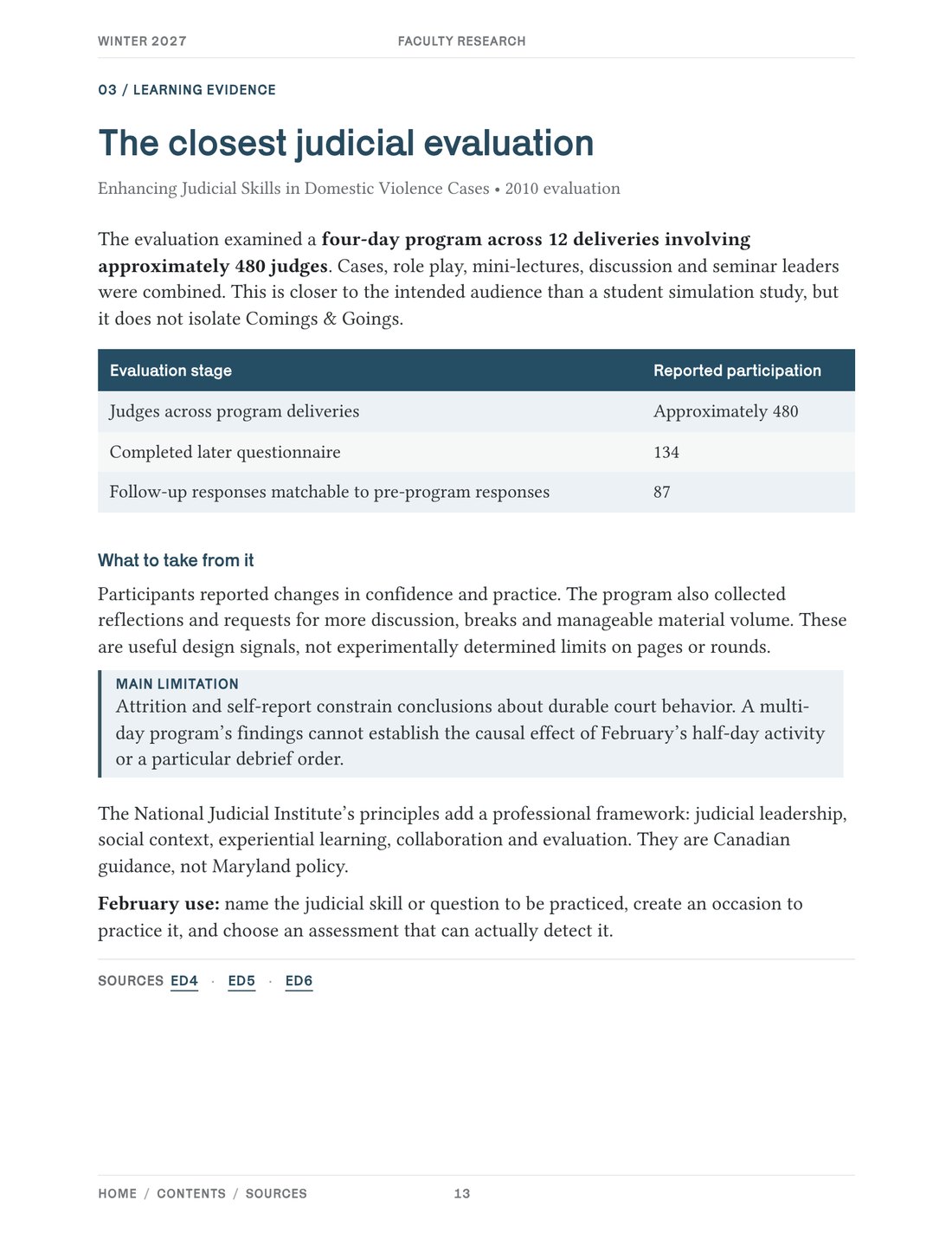
The closest study of judges rests on self-report
“The evaluation examined a four-day program across 12 deliveries involving approximately 480 judges. [...] Participants reported changes in confidence and practice. [...] Attrition and self-report constrain conclusions about durable court behavior. A multi-day program’s findings cannot establish the causal effect of February’s half-day activity or a particular debrief order.”
Page 13 · Jaffe (2010), Enhancing Judicial Skills in Domestic Violence Cases: Process and Outcome Evaluation
Where it shows upThe planned day’s teaching approach, in the faculty planning document“Judicial IPV research describes similar methods but does not establish that this half-day format changes practice.”
 Page 13
- Studies show
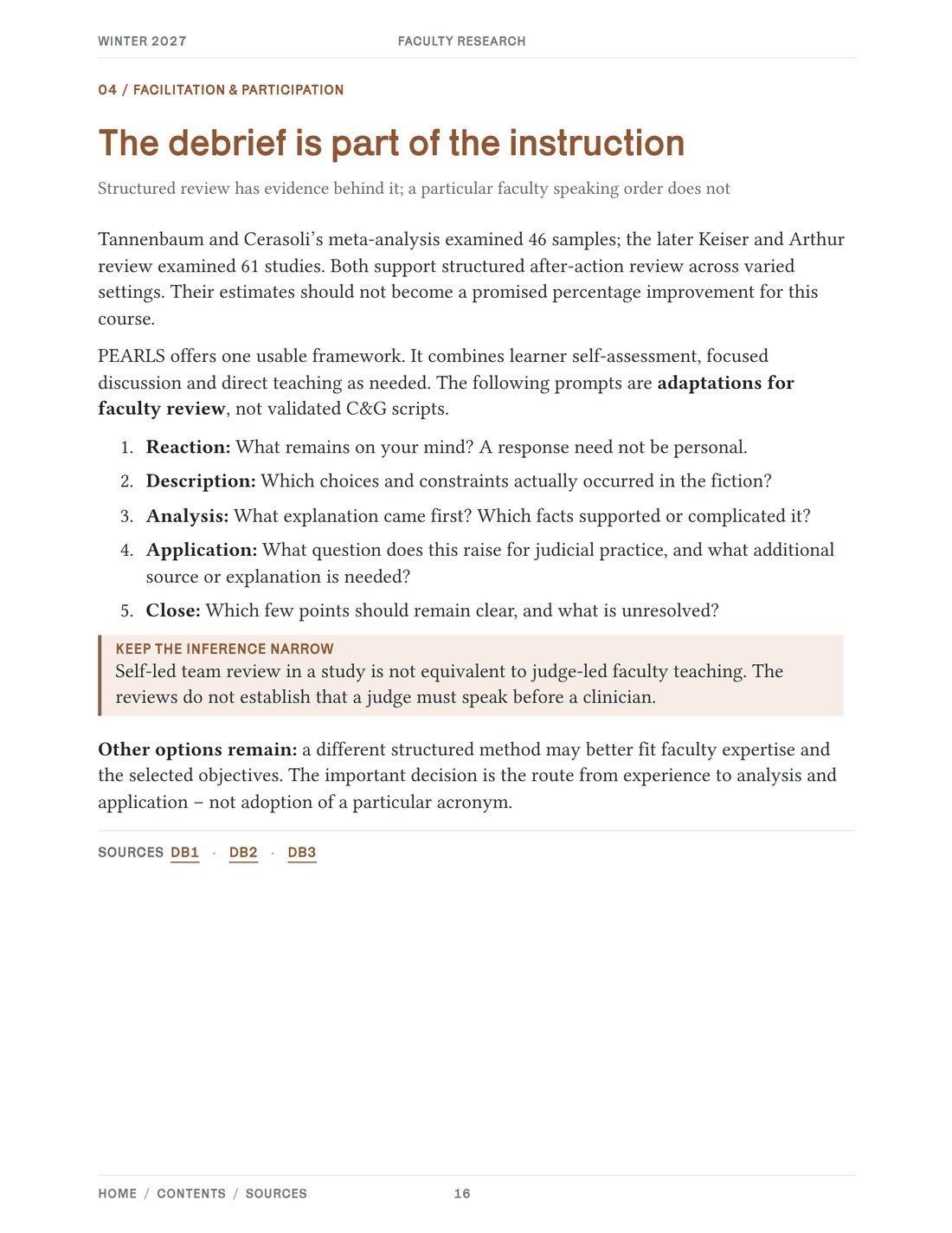
A structured debrief has evidence behind it
“Tannenbaum and Cerasoli’s meta-analysis examined 46 samples; the later Keiser and Arthur review examined 61 studies. Both support structured after-action review across varied settings. Their estimates should not become a promised percentage improvement for this course. [...] The reviews do not establish that a judge must speak before a clinician.”
Page 16 · Tannenbaum & Cerasoli (2013) and Keiser & Arthur (2021), meta-analyses of debriefs, with prompts adapted from Eppich & Cheng (2015), PEARLS
Where it shows upThe planned afternoon, 1:25 to 1:45: the survivor experience debrief“Reflect on choices, unavailable options and changing circumstances. Discuss the role experience without judging participants’ performance.”
 Page 16
- Guidance
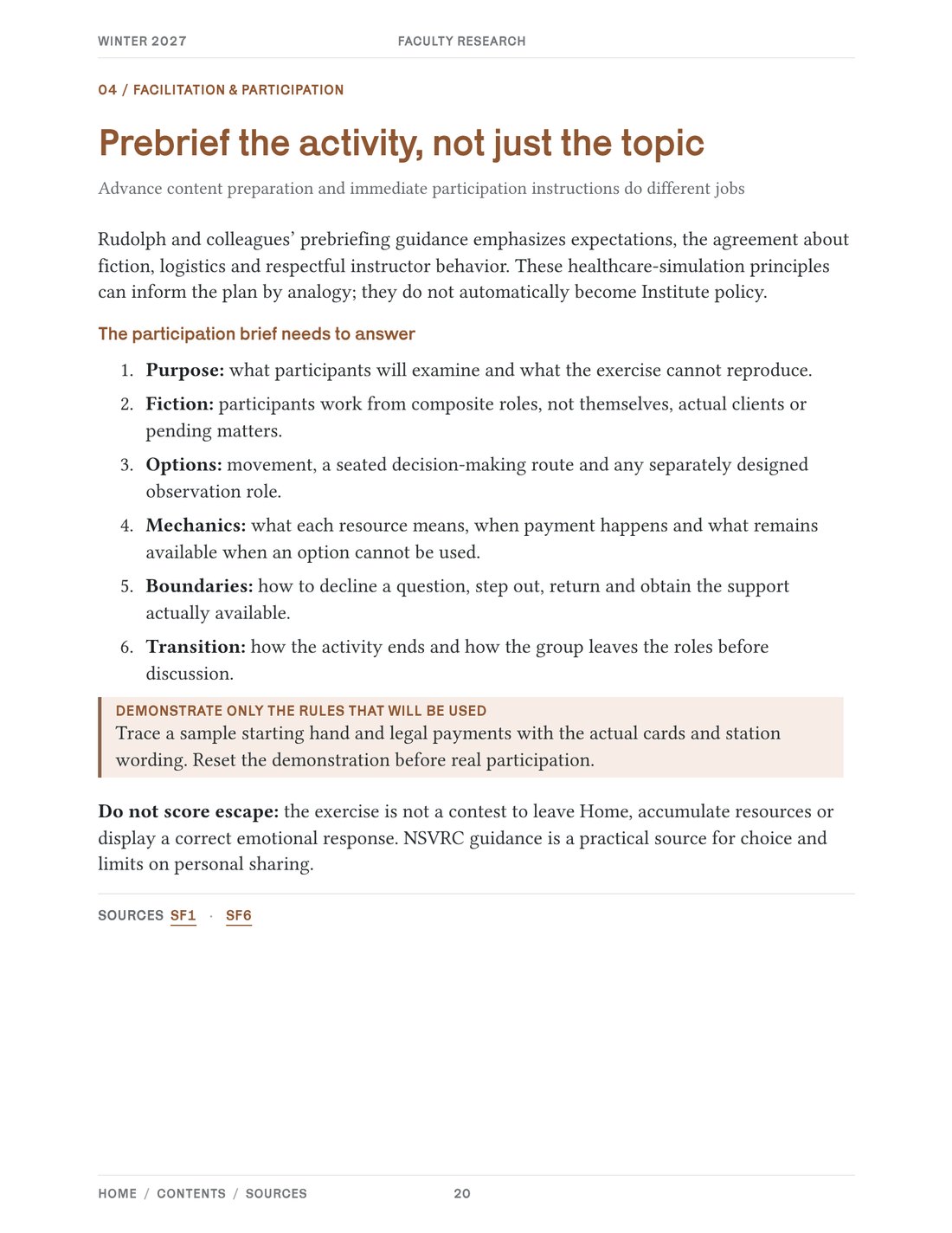
Walk people through the actual rules before they play
“Rudolph and colleagues’ prebriefing guidance emphasizes expectations, the agreement about fiction, logistics and respectful instructor behavior. These healthcare-simulation principles can inform the plan by analogy [...] Trace a sample starting hand and legal payments with the actual cards and station wording. Reset the demonstration before real participation.”
Page 20 · Rudolph et al. (2014), Establishing a Safe Container for Learning in Simulation
Where it shows upThe planned afternoon, 12:30 to 12:40: welcome and activity briefing“Orient afternoon arrivals. Review the activity, demonstrate a sample move and explain participation options.”
 Page 20
- On record
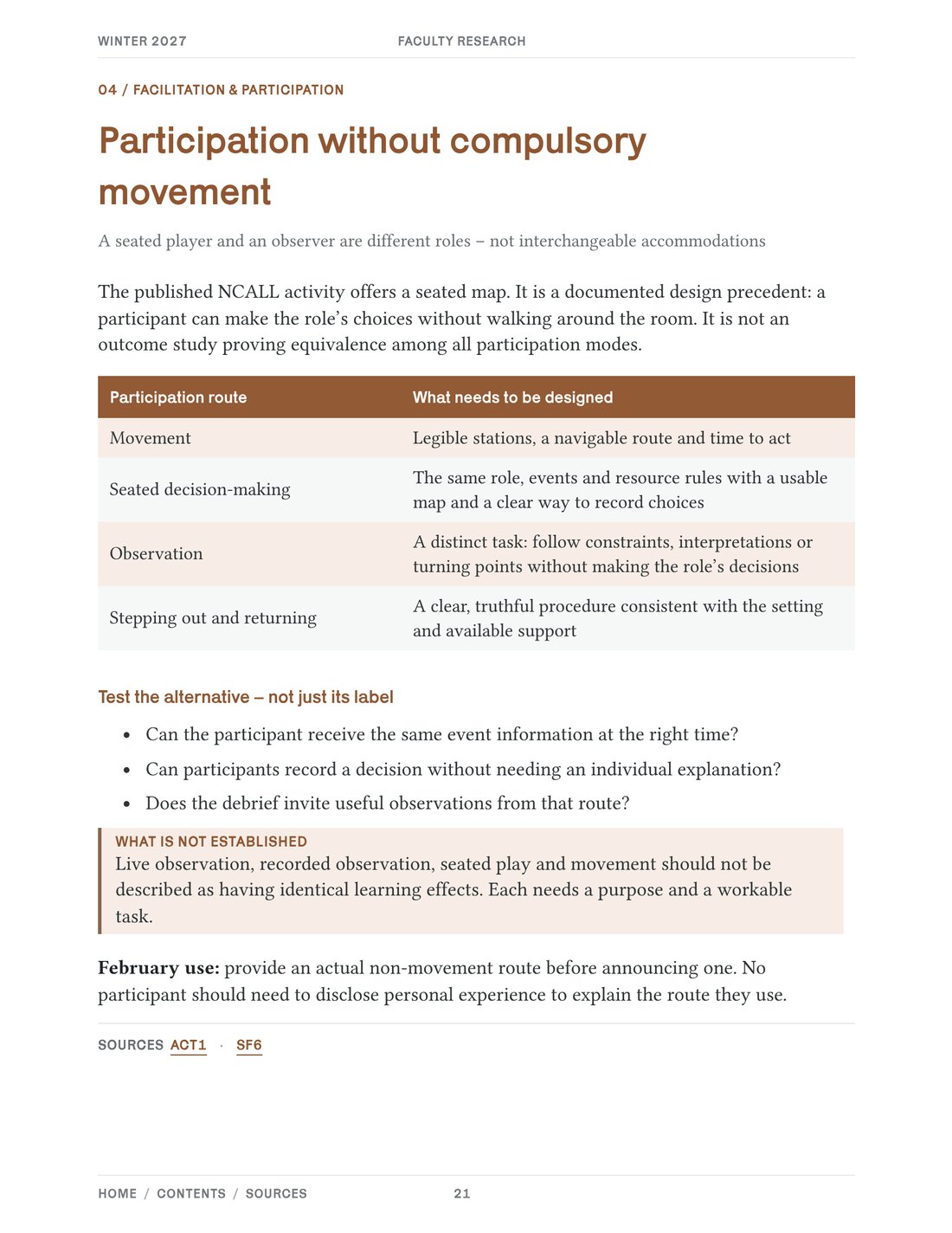
The original exercise already offered a seated route
“The published NCALL activity offers a seated map. It is a documented design precedent: a participant can make the role’s choices without walking around the room. It is not an outcome study proving equivalence among all participation modes. [...] February use: provide an actual non-movement route before announcing one.”
Page 21 · NCALL (2017), Comings and Goings: Walking in the Shoes of an Older Victim
Where it shows upThe planned afternoon, 12:40 to 1:25: Comings and Goings“Take part through movement or a defined seated/observer role. Follow the faculty-selected scenario and resource rules.”
 Page 21
- Studies show
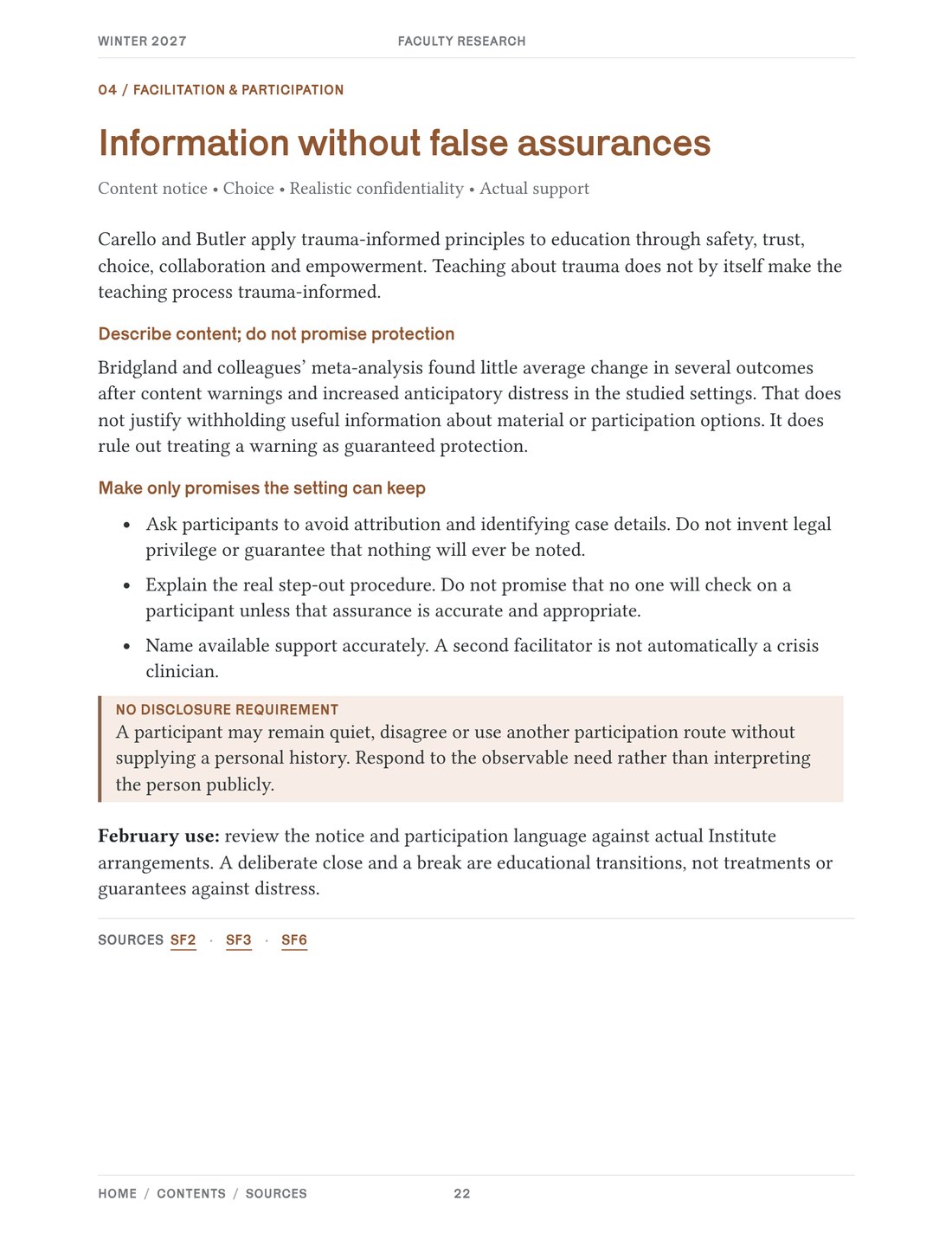
Give real choices, and don’t treat a content warning as protection
“Carello and Butler apply trauma-informed principles to education through safety, trust, choice, collaboration and empowerment. [...] Bridgland and colleagues’ meta-analysis found little average change in several outcomes after content warnings and increased anticipatory distress in the studied settings. That does not justify withholding useful information about material or participation options. It does rule out treating a warning as guaranteed protection.”
Page 22 · Carello & Butler (2015), on trauma-informed teaching, and Bridgland et al. (2024), a meta-analysis of content warnings
Where it shows upThe planning document’s decisions and next steps, item 5“Offer a defined non-movement role, explain how to step out, avoid requiring personal disclosure, and confirm any recording or confidentiality rules before announcing them.”
 Page 22
- Research limit
No reviewed study shows one way of dealing resources is better
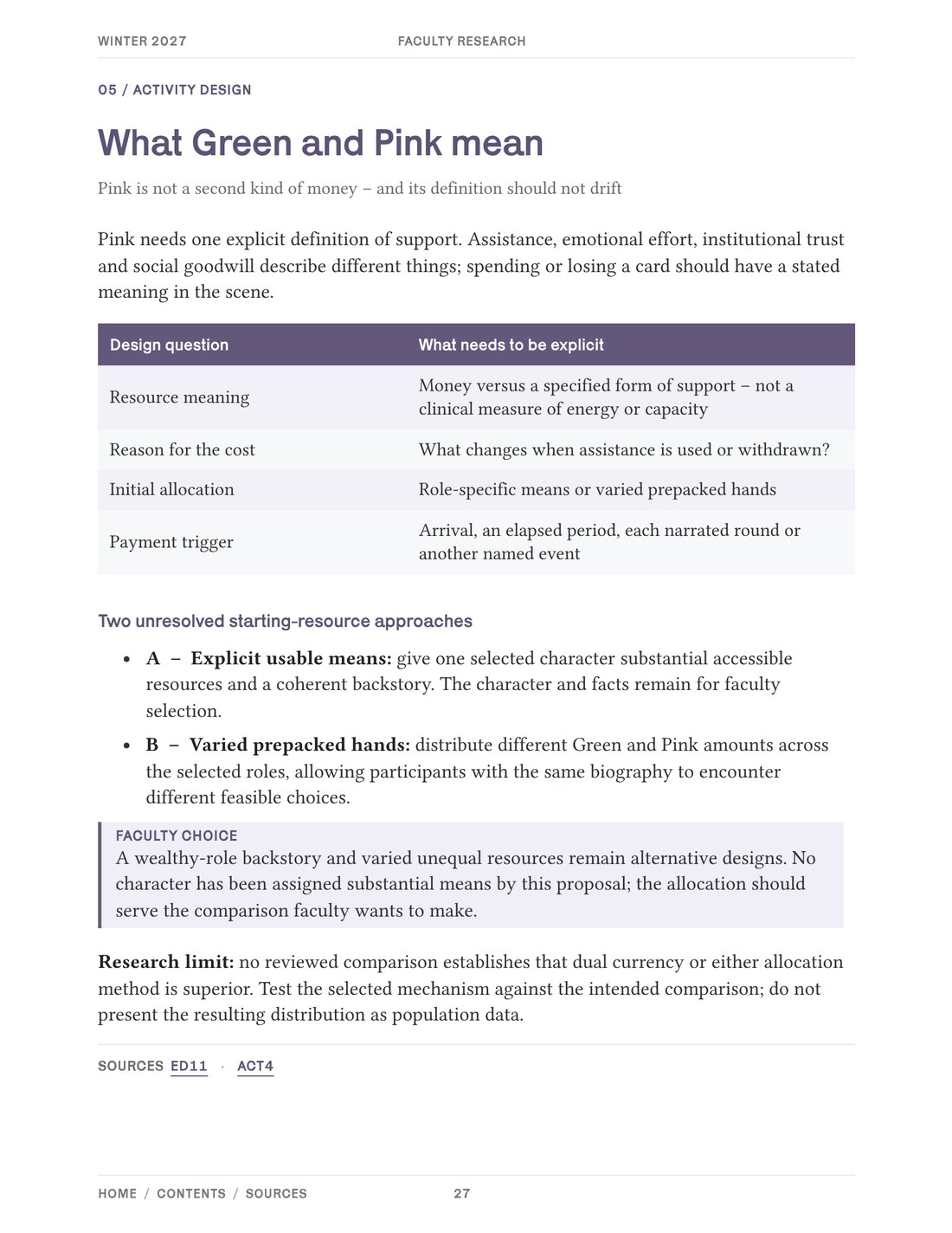
“B – Varied prepacked hands: distribute different Green and Pink amounts across the selected roles, allowing participants with the same biography to encounter different feasible choices. [...] Research limit: no reviewed comparison establishes that dual currency or either allocation method is superior. Test the selected mechanism against the intended comparison [...]”
Page 27 · No source is cited for the limit itself: it reports that the reviewed research held no such comparison
Where it shows upVaried starting hands, on the simulation page“What I designed and then gave to faculty as a choice was to keep three characters and vary each character’s starting quantities.”
 Page 27