Alexander Karsh.

DeliveredTwo half-day courses, autumn 2026

The Permanent Record

I was sent two slide decks for one day of courses, and they had nothing in common. I rebuilt both on one livery.

CoursesTermination of parental rights, a half day for Maryland's judges and magistrates. Its morning companion, on children in need of assistance, is shown here under a changed name, Cases in Need of Attention
FacultyTwo circuit court judges, with a panel of counsel for each party
My roleThe livery, the redesign of both decks, the slides that had no original, the illustrations, and the badges and table assignments
StatusDelivered, autumn 2026
2 to 1
faculty decks rebuilt on one livery
22
boards in the exhibit
14 to 25
point size of the labels on the ranked plans slide
12
illustrations drawn for the deck

What the two coordinators said

“I like what you did with the practical exercise.”

The coordinator of the termination-of-parental-rights course, a faculty check-in, August 2026

“By the way, I think the slides are beautiful, thank you.”

The coordinator of the child-in-need-of-assistance course, a faculty walkthrough. She thanked me and a faculty magistrate together: the deck was shared work.

One slide, before and after

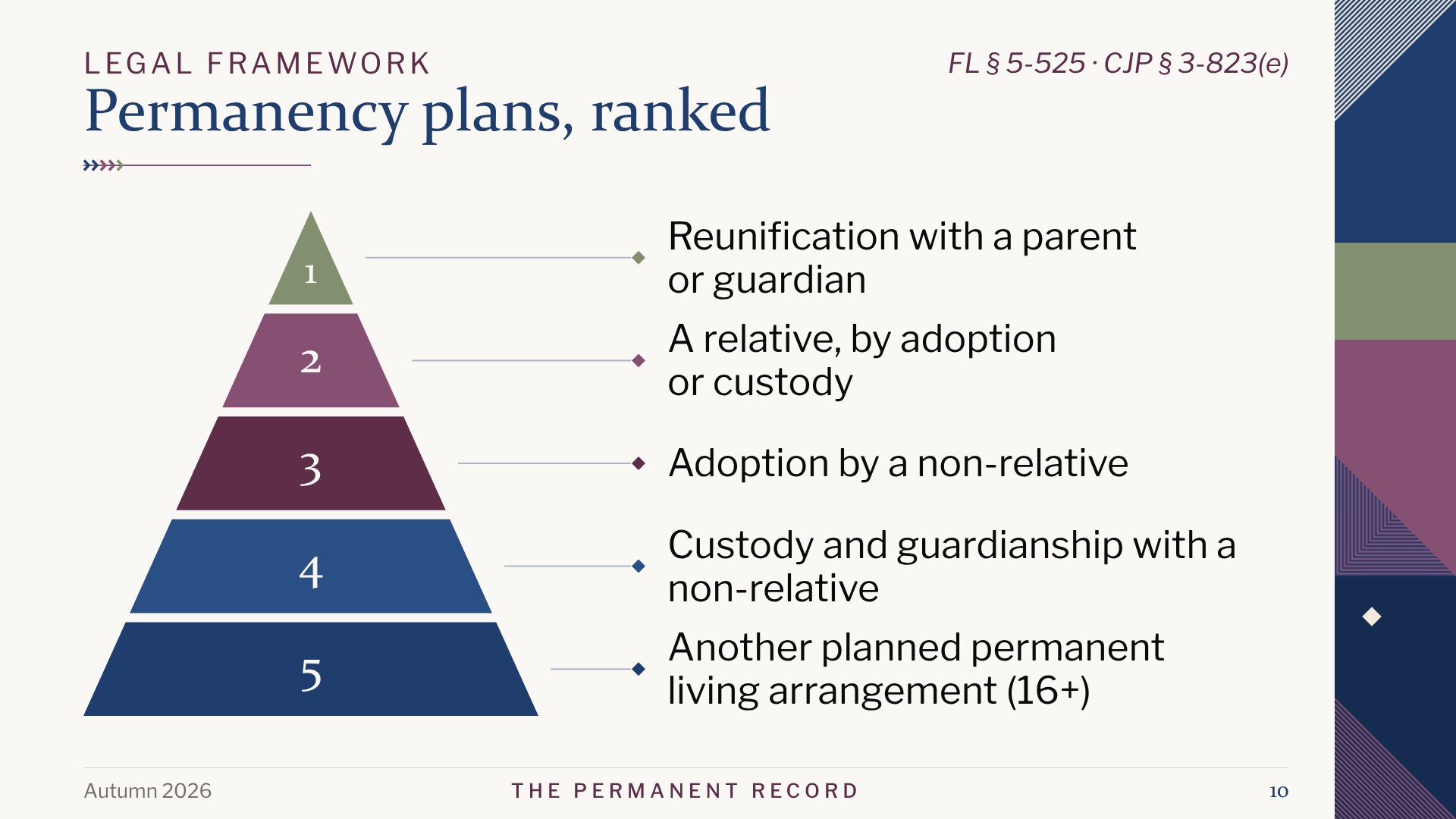
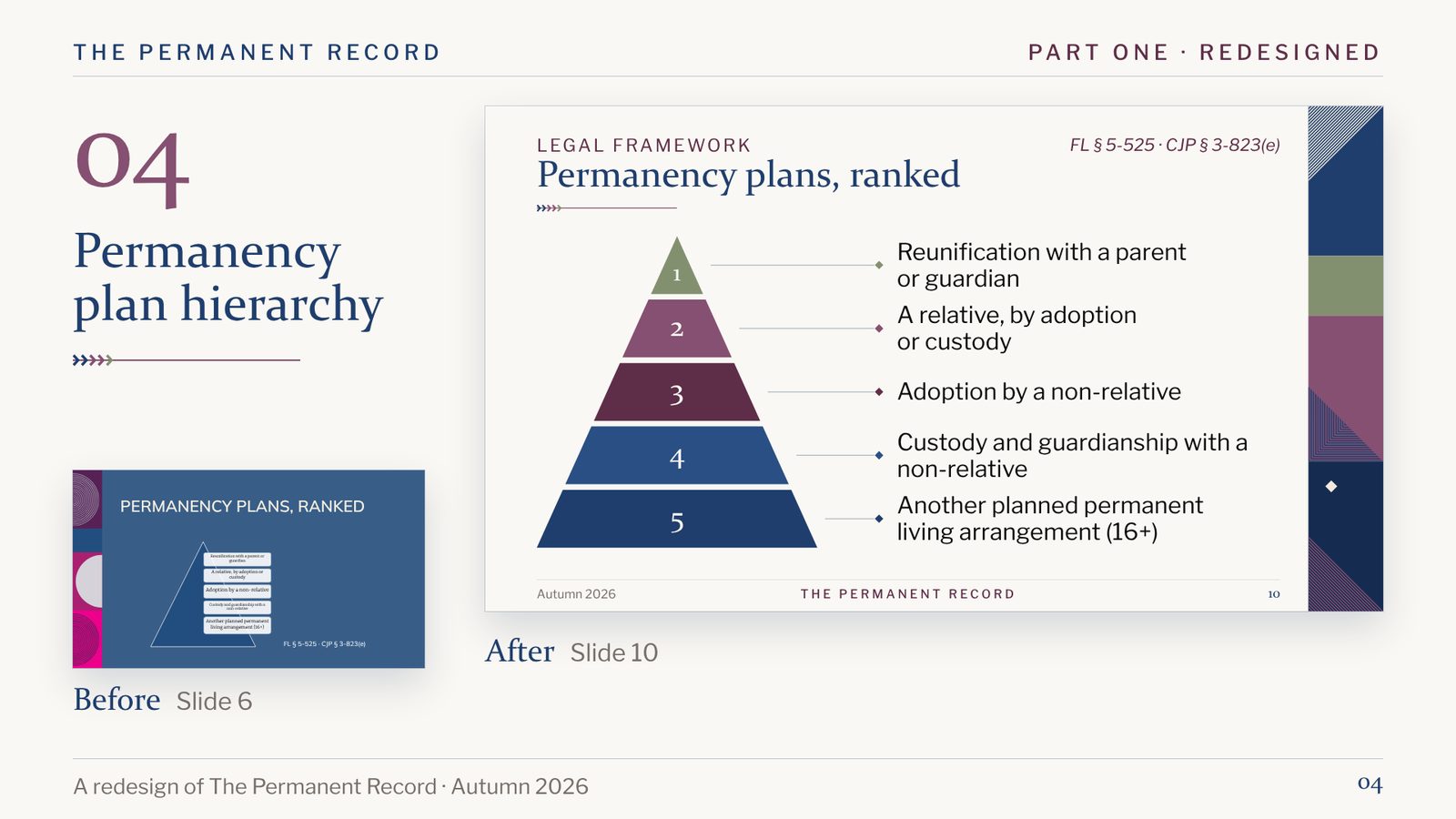
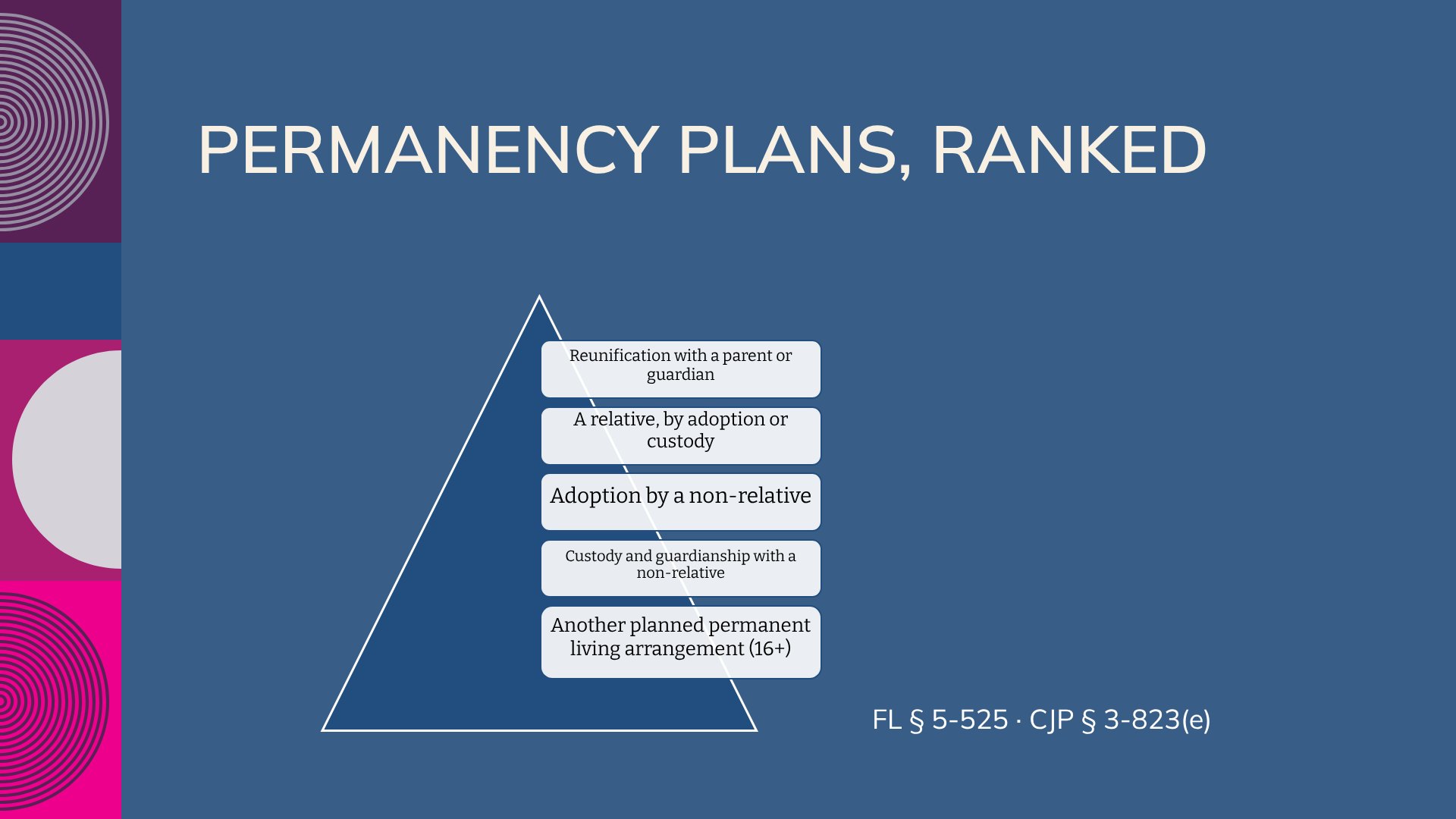
Same five plans, same statute. The ranking is the content, so in the redesign the ranking is the picture.

Before, slide 6: Permanency Plans, Ranked. The five plans as a short list of small text in boxes over a narrow outlined triangle, on a blue slide.
BeforeSlide 6. The five plans as a list, set at 14 point.
After, slide 10: Permanency plans, ranked. A five-level pyramid, each level numbered and coloured, joined by a line to the plan it stands for, with the statute citation above.
AfterSlide 10. A full pyramid, 25 point labels, each rank joined to its plan.

How two decks became one day

The morning course was on children separated from their parents, shown here under a changed name, Cases in Need of Attention. The afternoon was on termination of parental rights. Each had its own coordinators and its own slide deck, and the subject they shared is a heavy one.

The morning deck came to me in bright orange and blue, with circles and swoops and no cohesion. The layouts didn't suit what was on the slides. The afternoon deck was an angry magenta and a dark blue, with weird shapes everywhere.

I wanted the day to move as one day of learning, even though it was two courses. So the first job was a livery that suited the subject and its weight without throwing out what the coordinators had sent me. I settled on navy, mauve and sage. The navy is the afternoon deck's blue toned down, and the morning deck's blue darkened. Mauve took the place of the magenta. Sage was my own invention.

Then I played with the shapes. The morning course got circles, arcs and soft shapes. By the afternoon they'd turned to diamonds, triangles and hard edges. Mauve is the morning's primary color and navy its secondary. The afternoon flips them, and sage is the accent in both.

I'm really pleased with how the slides turned out.
CINA, before and after

Two examples from the morning course: selecting a useful comparison from a table, then dividing a policy-heavy slide into a sequence.

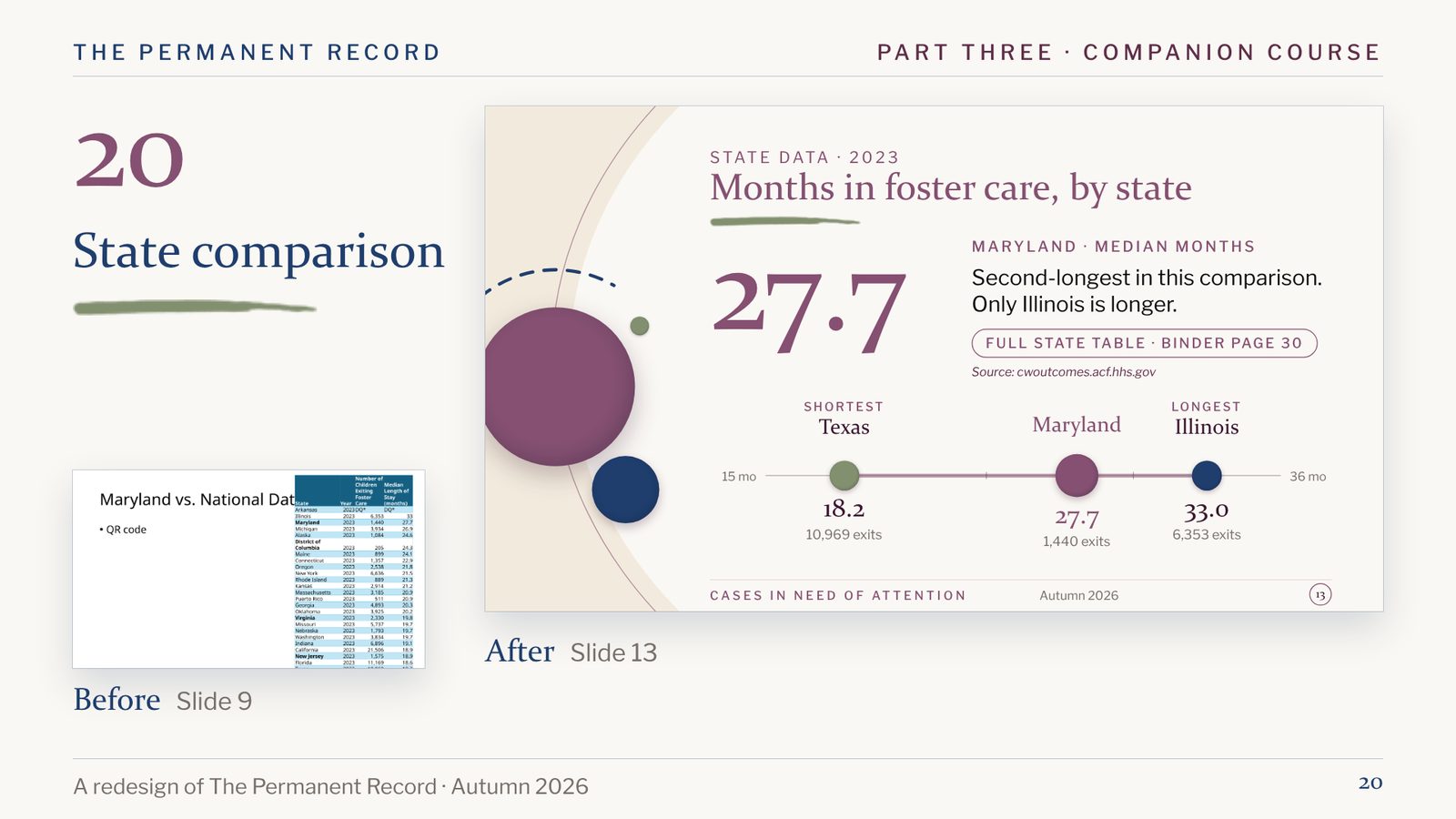
A state table becomes a comparison

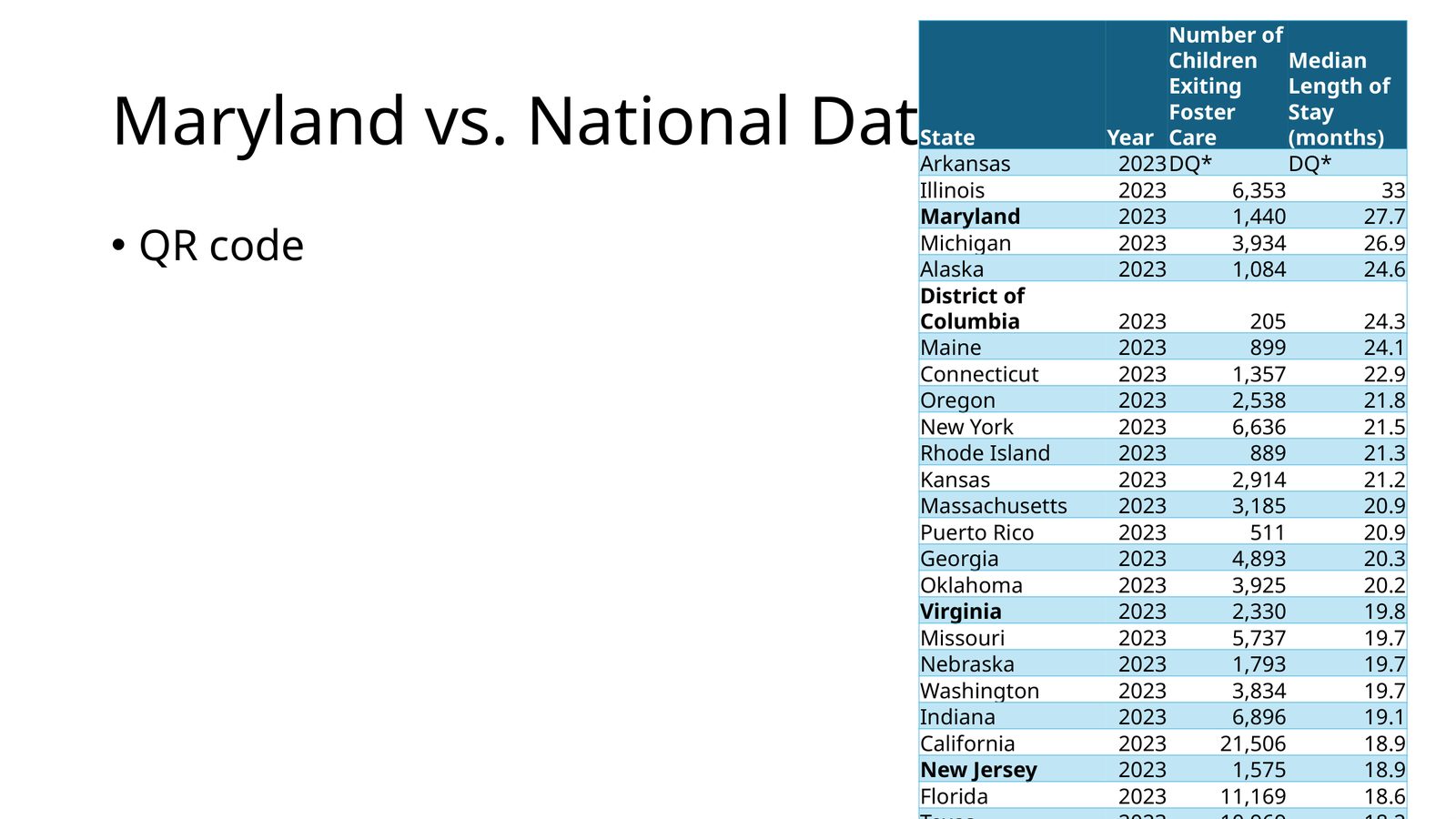
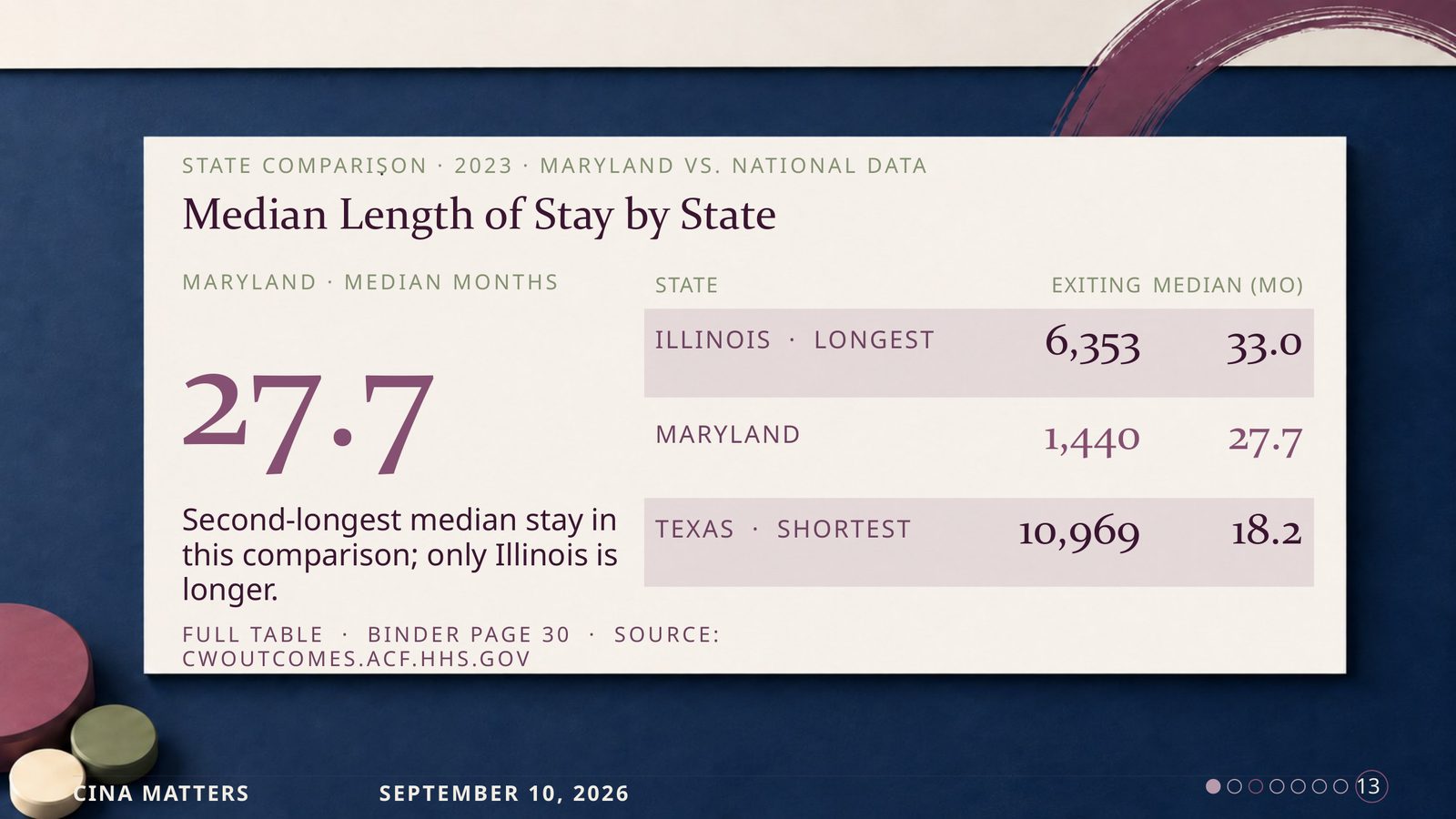
Maryland’s median receives the emphasis, with the longest and shortest stays in the supplied comparison alongside it. The full table remains a reference.

Before, CINA slide 9: the full state table of median months in foster care, shown as supplied in the morning deck.
BeforeSource slide 9. Full state table.
After: design iteration, slide 13. Maryland’s median receives the emphasis; the longest and shortest stays appear beside it.
After · iterationSlide 13. Selected comparison.

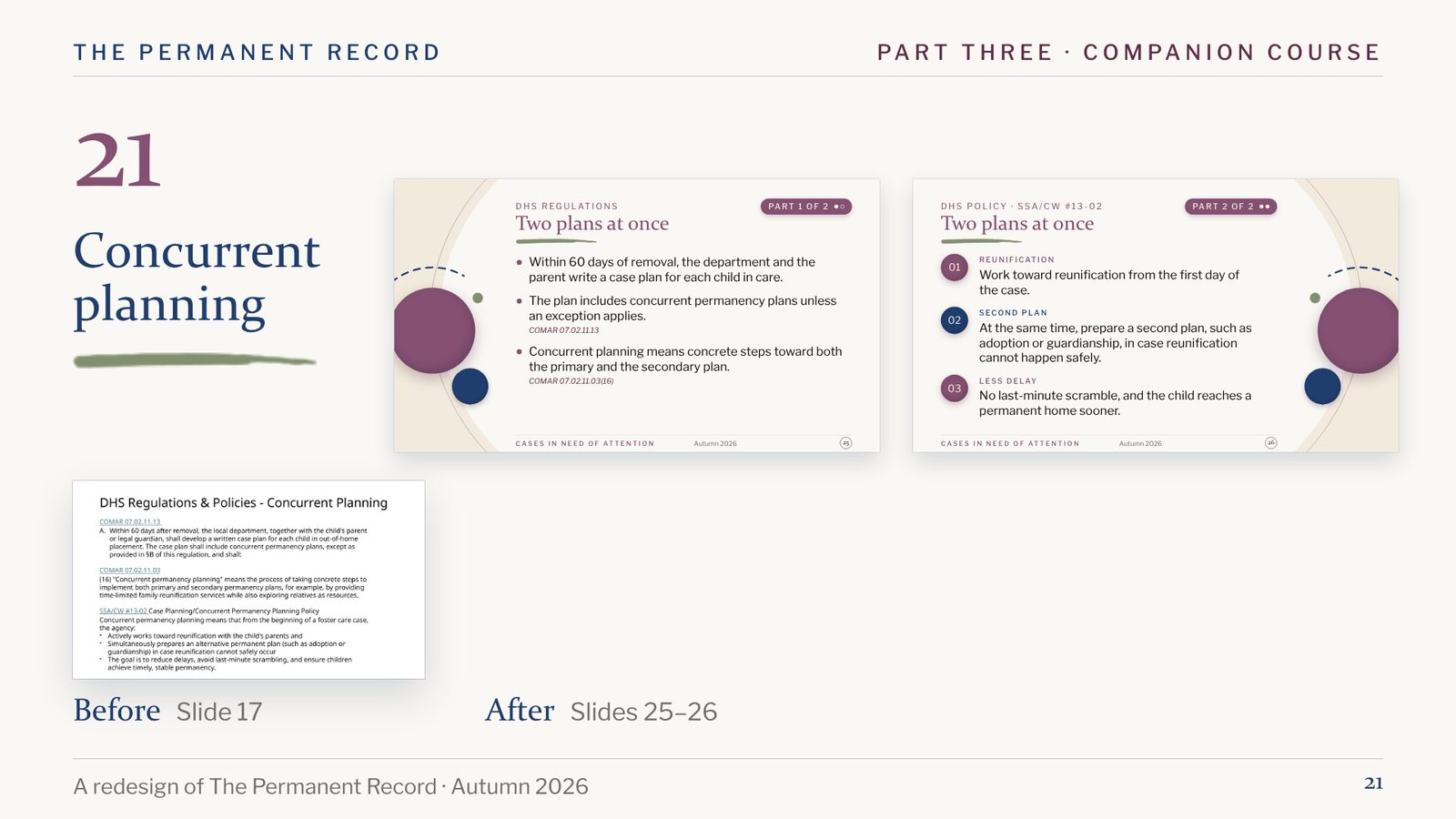
One slide becomes two

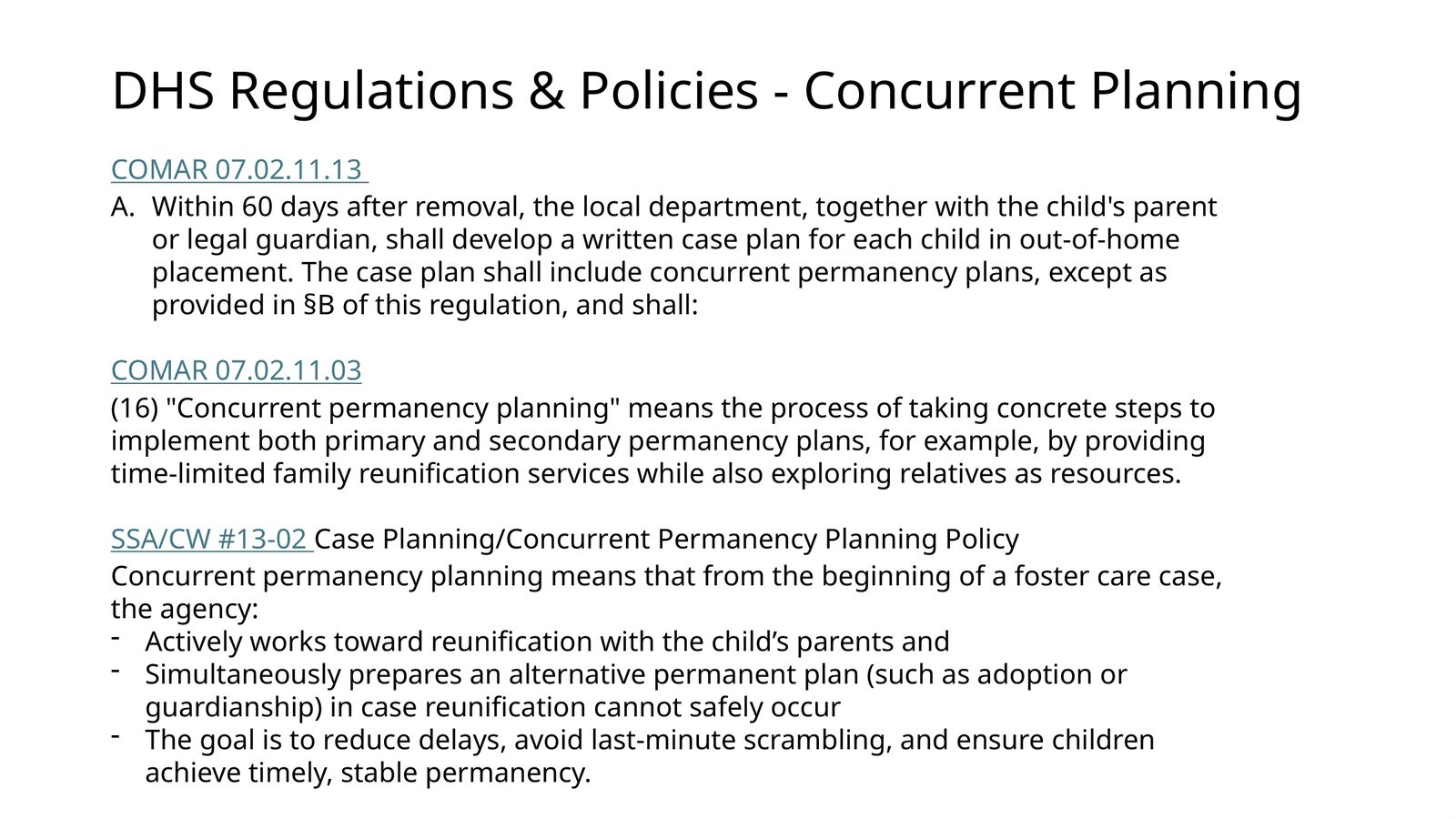
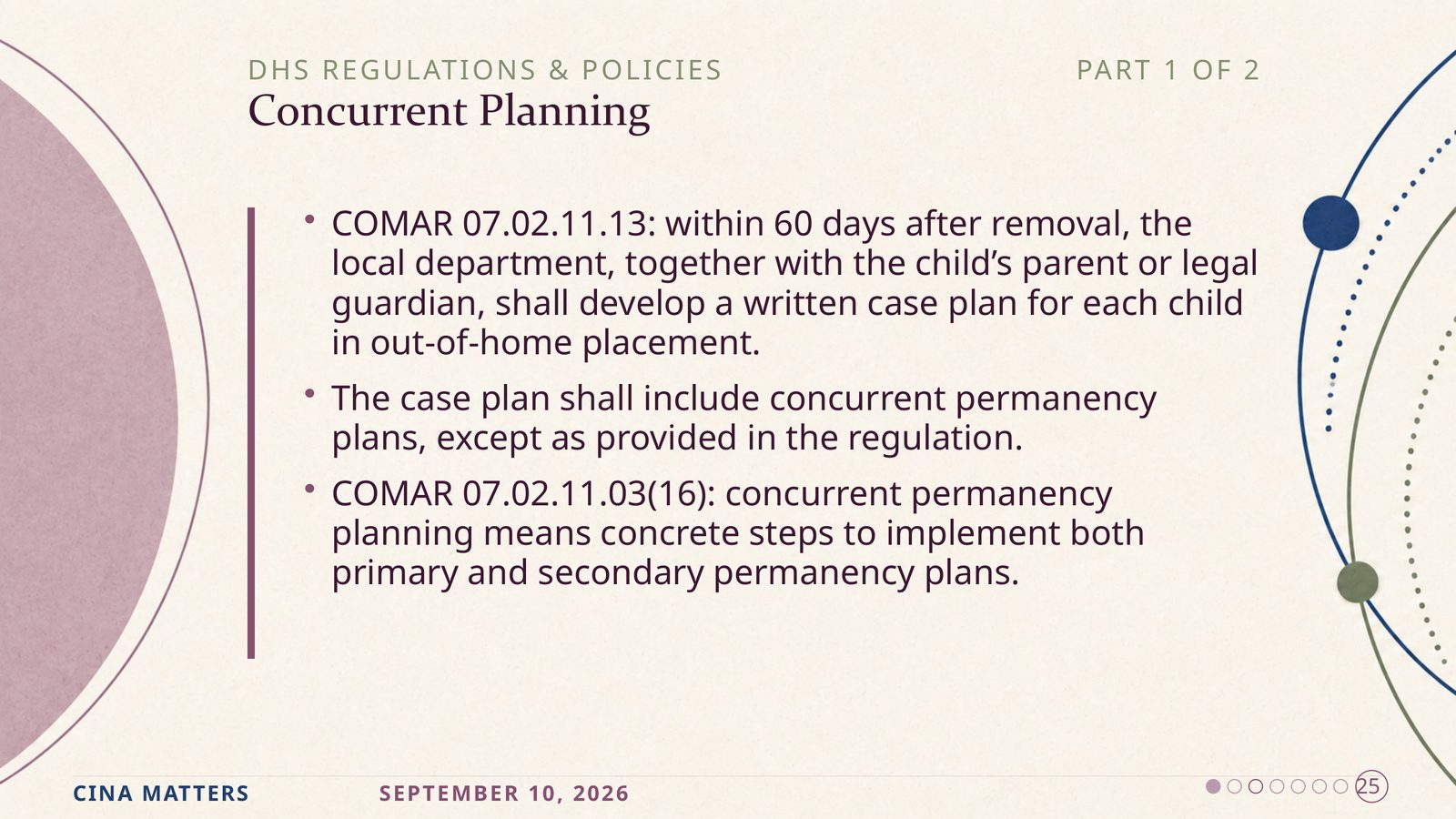
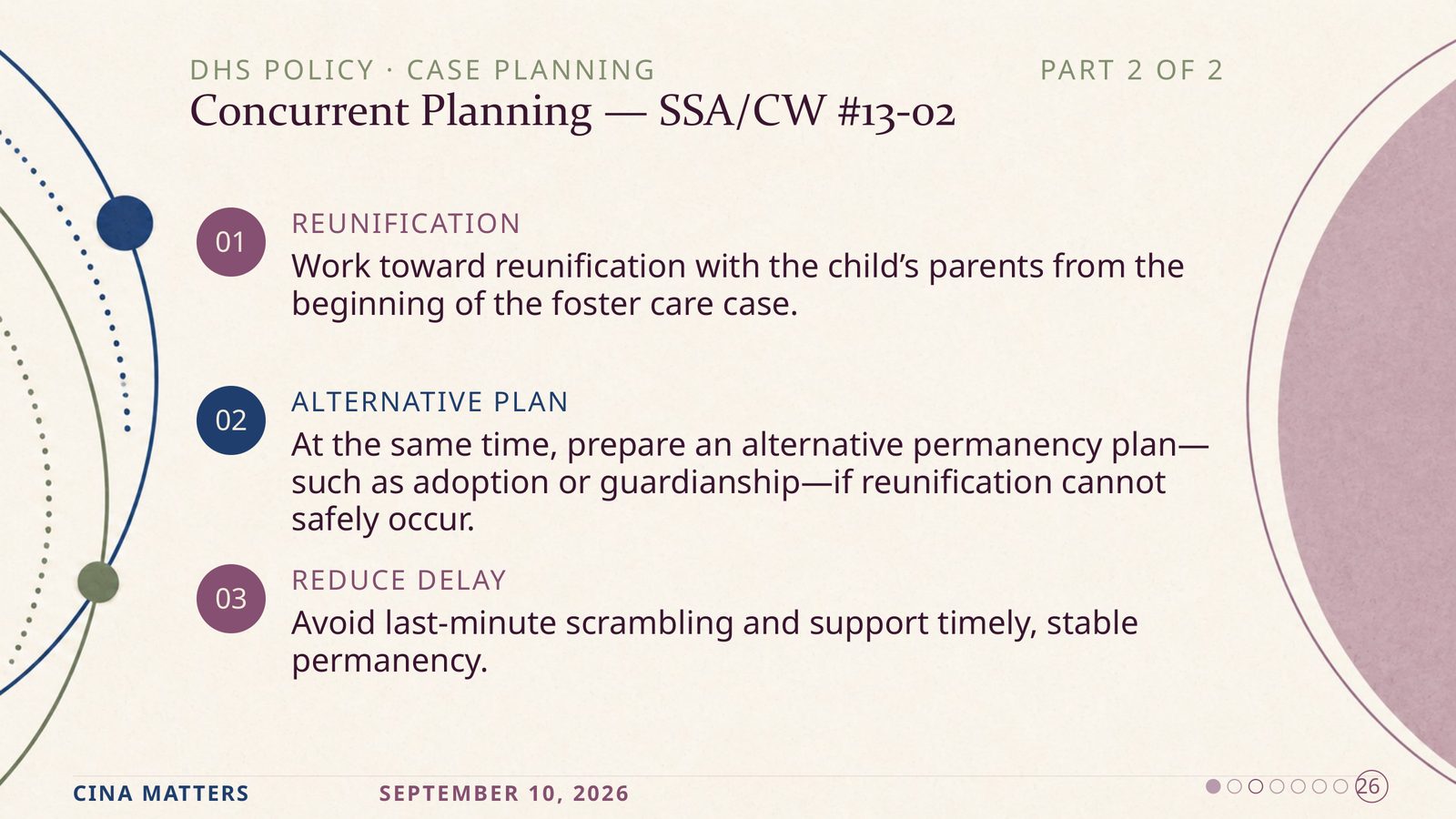
I separated the regulation from the agency policy and kept a repeated layout across the two slides. The sequence is visible before the presenter begins.

Before, CINA slide 17: the regulation and the agency policy together on one dense slide.
BeforeSource slide 17. Regulation and policy together.
After: design iteration, slide 25. Part 1, regulation, on its own, in the shared layout.
After · iterationSlide 25. Part 1: regulation.
After: design iteration, slide 26. Part 2, agency policy, repeating the layout from Part 1.
After · iterationSlide 26. Part 2: agency policy.

These are selected design iterations, not a final or faculty-approved deck. Faculty own the legal substance; the redesign includes wording changes. The companion-course boards in the gallery below are portfolio presentations of these examples, using changed course names and a different visual treatment.

Directing AI production

I used AI to produce course materials and designed the rules for that work. Recurring corrections became requirements that could be checked against the PowerPoint file.

The type-size rule

Readable type, checked in the file

I set an 18-point minimum, with a 14-point exception for running footers. The checker scales those thresholds to the slide canvas and reports explicitly sized text below the floor.

type_floor.pyRead-only check mode

python3 type_floor.py --check deck.pptx

The check inspects explicit text-size declarations. Visual review is still needed for inherited formatting, clipping and the finished slide.

The shipping check

A result tied to a particular deck

The shipping script combines the checks and writes their results with the deck’s SHA-256 hash. A later verification compares that hash with the file being reviewed.

ship_check.pyResults and file identity

ok = rec["sha256"] == sha(deck)
sys.exit(0 if ok and
         rec["gates_failed"] == 0 else 1)

A matching hash identifies the checked bytes; it does not establish faculty approval.

Source code is shown as implementation evidence. This exhibit does not claim that these scripts certified the slides above.

The 22 original boards

The original exhibit is preserved below, including its companion-course examples. Each spread pairs a slide from the original faculty deck with its redesign. The slides in part two had no original version. The factor slides are the exception: I rebuilt them and gave each factor its own color and shape.

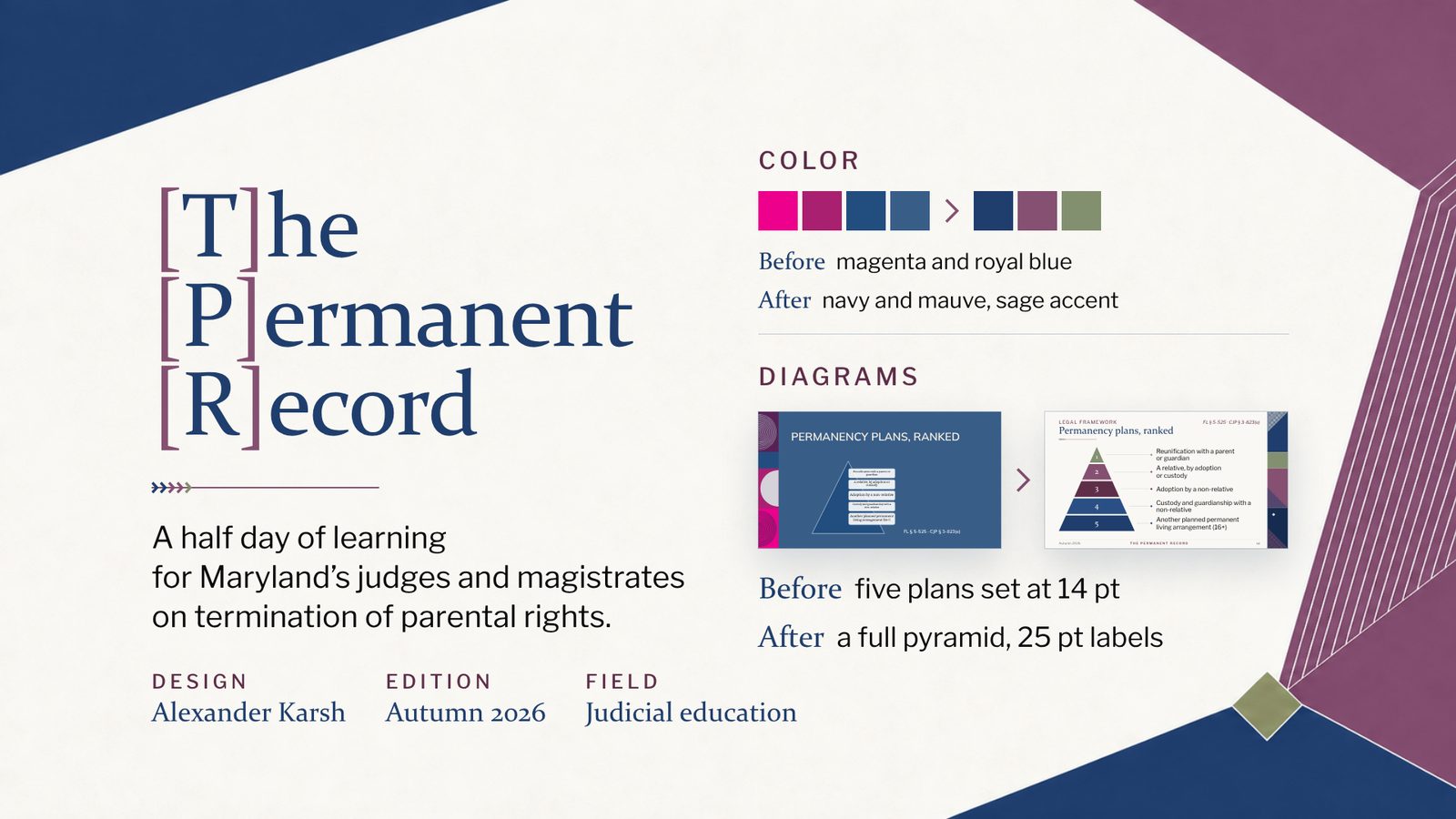
  1. Board 00, the cover: The Permanent Record, a half day of learning for Maryland's judges and magistrates on termination of parental rights. It previews the color change and the permanency plans pyramid.
    00Cover
    Open board 00 full size
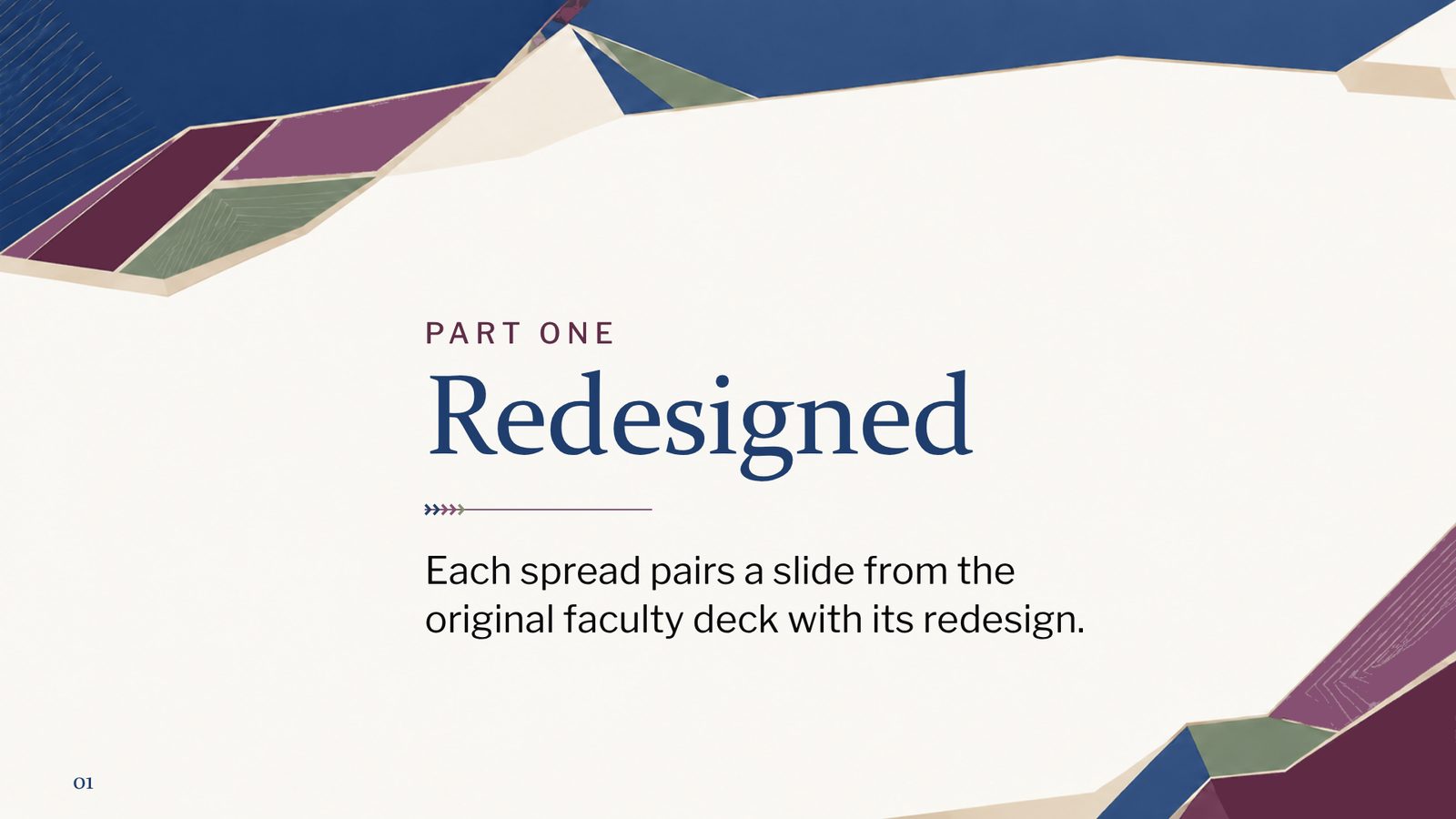
  2. Board 01, part one divider: Redesigned.
    01Part one · Redesigned
    Open board 01 full size
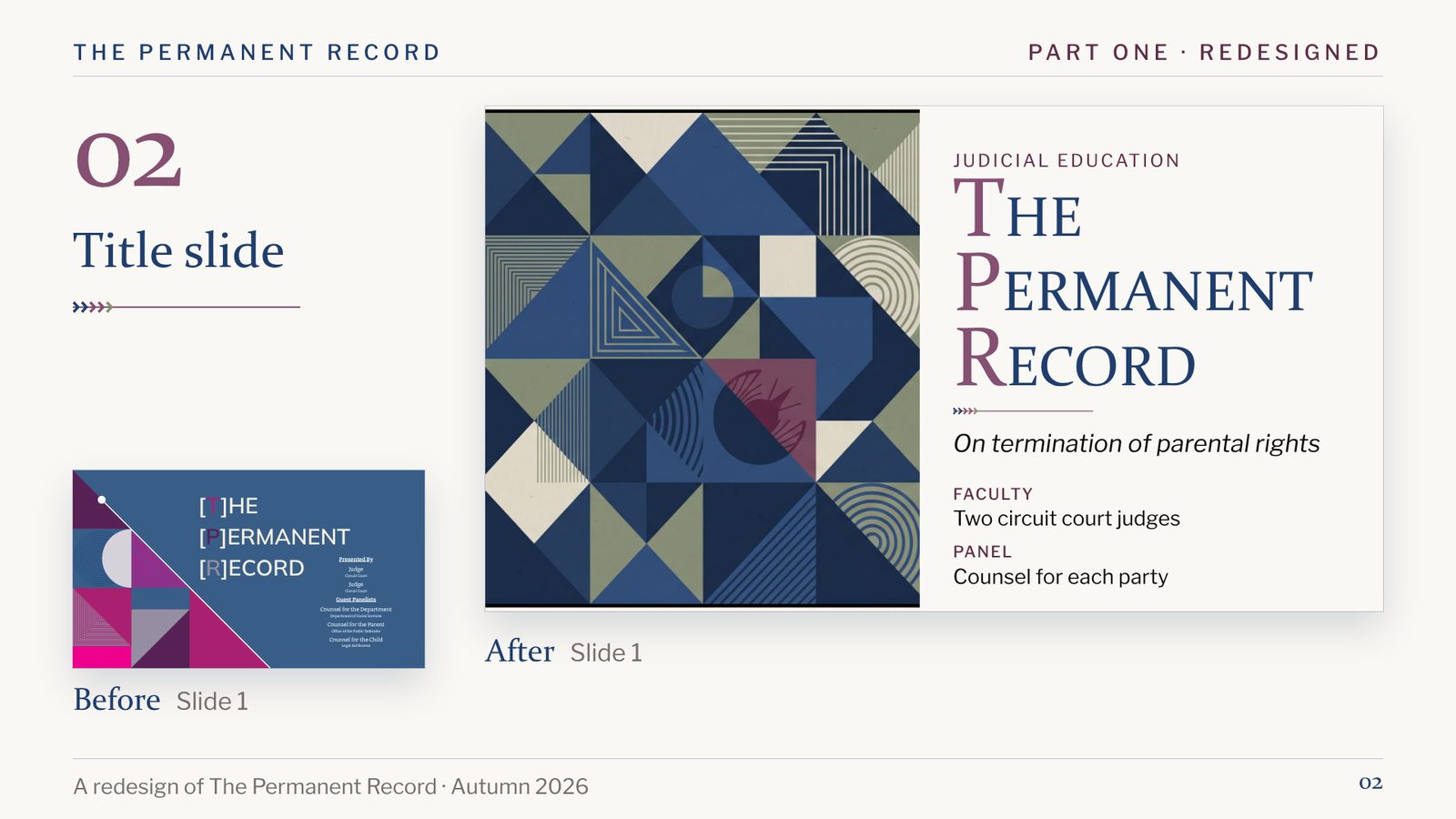
  3. Board 02, the title slide. Before: the original in magenta and royal blue. After: The Permanent Record, on termination of parental rights, with two circuit court judges and a panel of counsel for each party.
    02Title slide
    Open board 02 full size
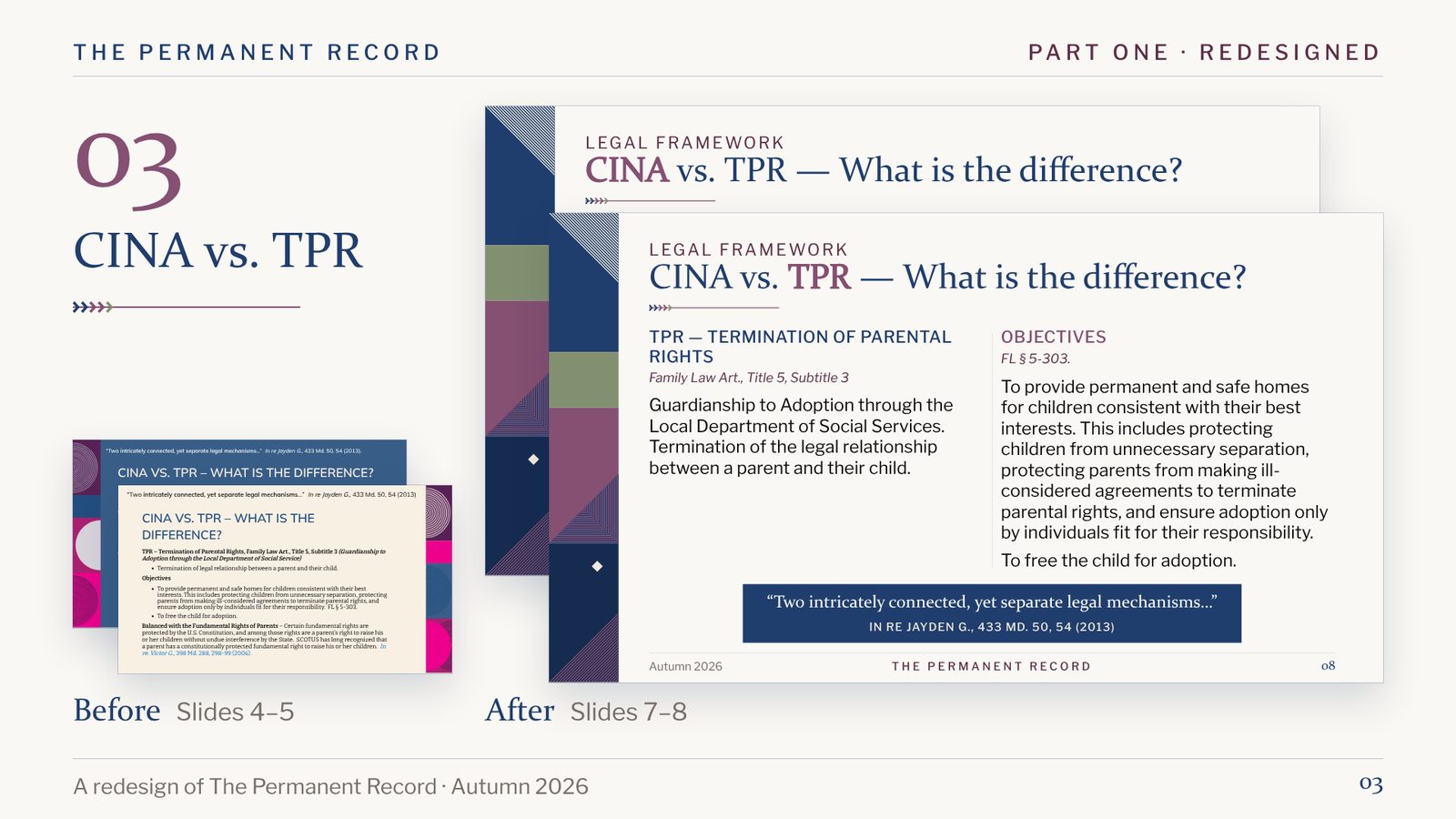
  4. Board 03, CINA vs. TPR. Before: two text-heavy original slides. After: one slide asking what the difference is, with the two statutes side by side.
    03CINA vs. TPR
    Open board 03 full size
  5. Board 04, permanency plans, ranked. Before: five plans as a short list on a blue slide. After: a five-level pyramid, each level joined by a line to its plan.
    04Permanency plan hierarchy
    Open board 04 full size
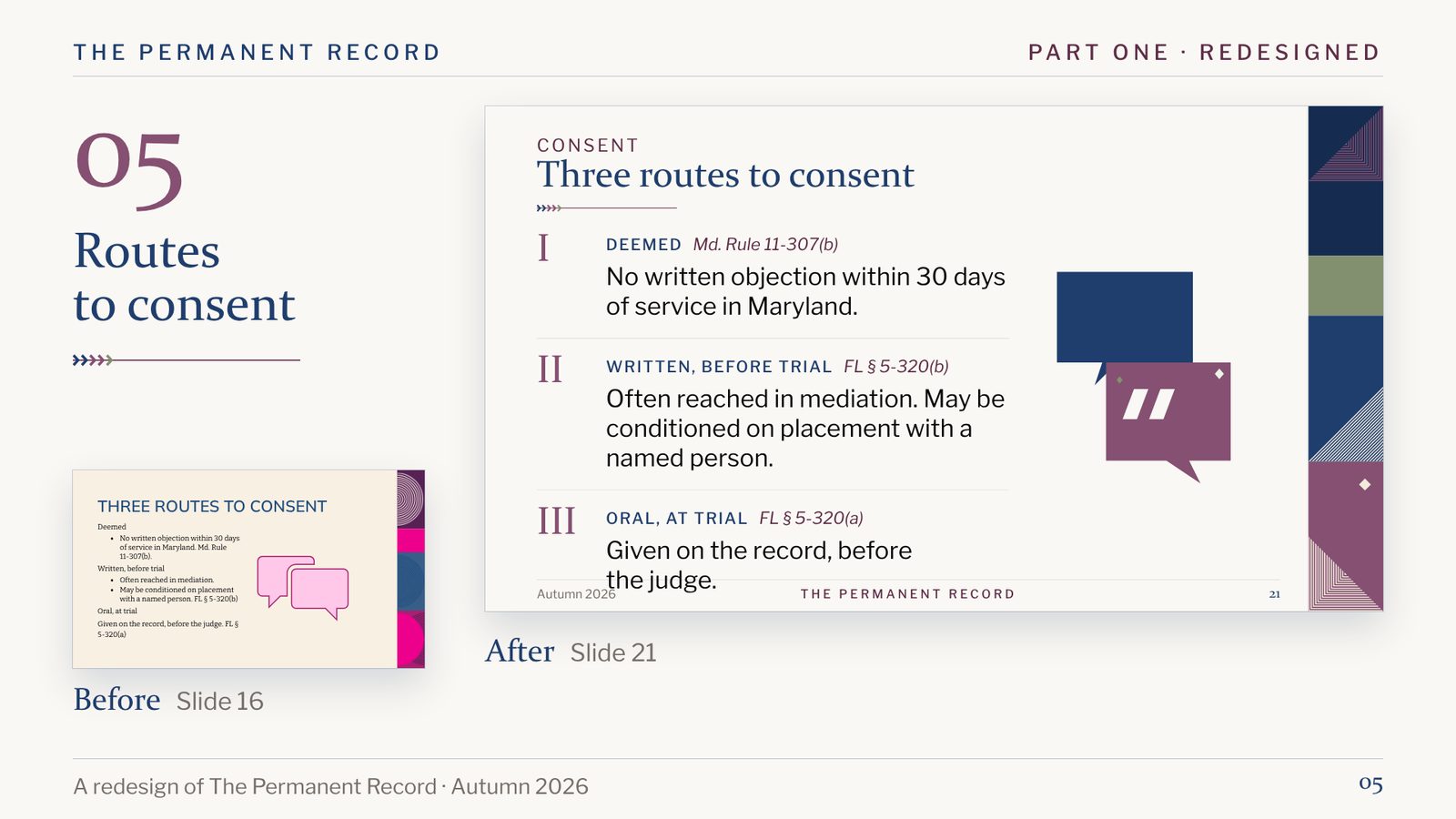
  6. Board 05, three routes to consent. Before: a text list beside speech bubbles. After: three numbered routes, each with its citation.
    05Routes to consent
    Open board 05 full size
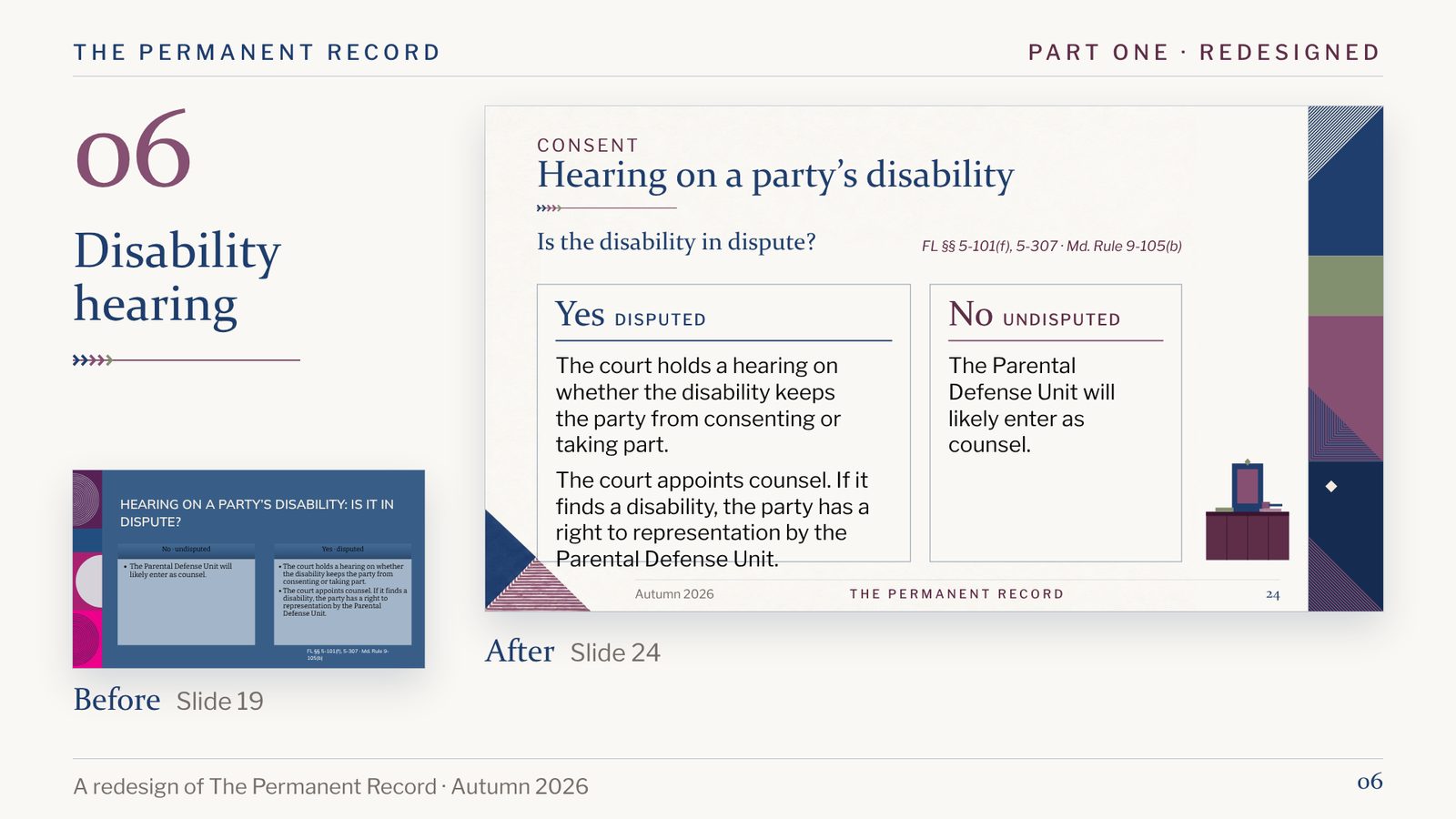
  7. Board 06, hearing on a party's disability. Before: the original slide. After: the disputed and undisputed paths in two columns.
    06Disability hearing
    Open board 06 full size
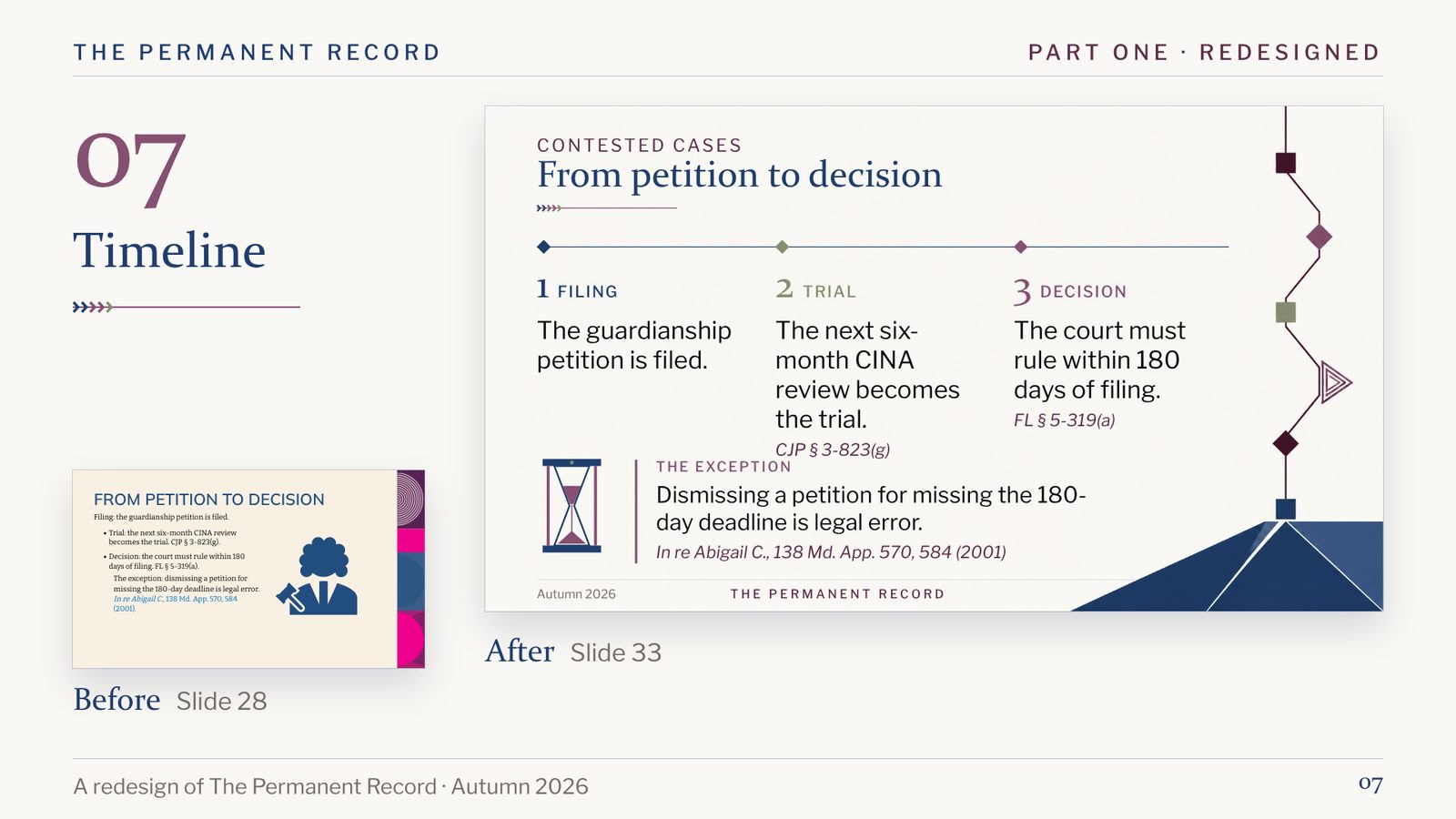
  8. Board 07, timeline from petition to decision. Before: the original slide. After: three numbered steps down a line, with the exception set apart.
    07Timeline
    Open board 07 full size
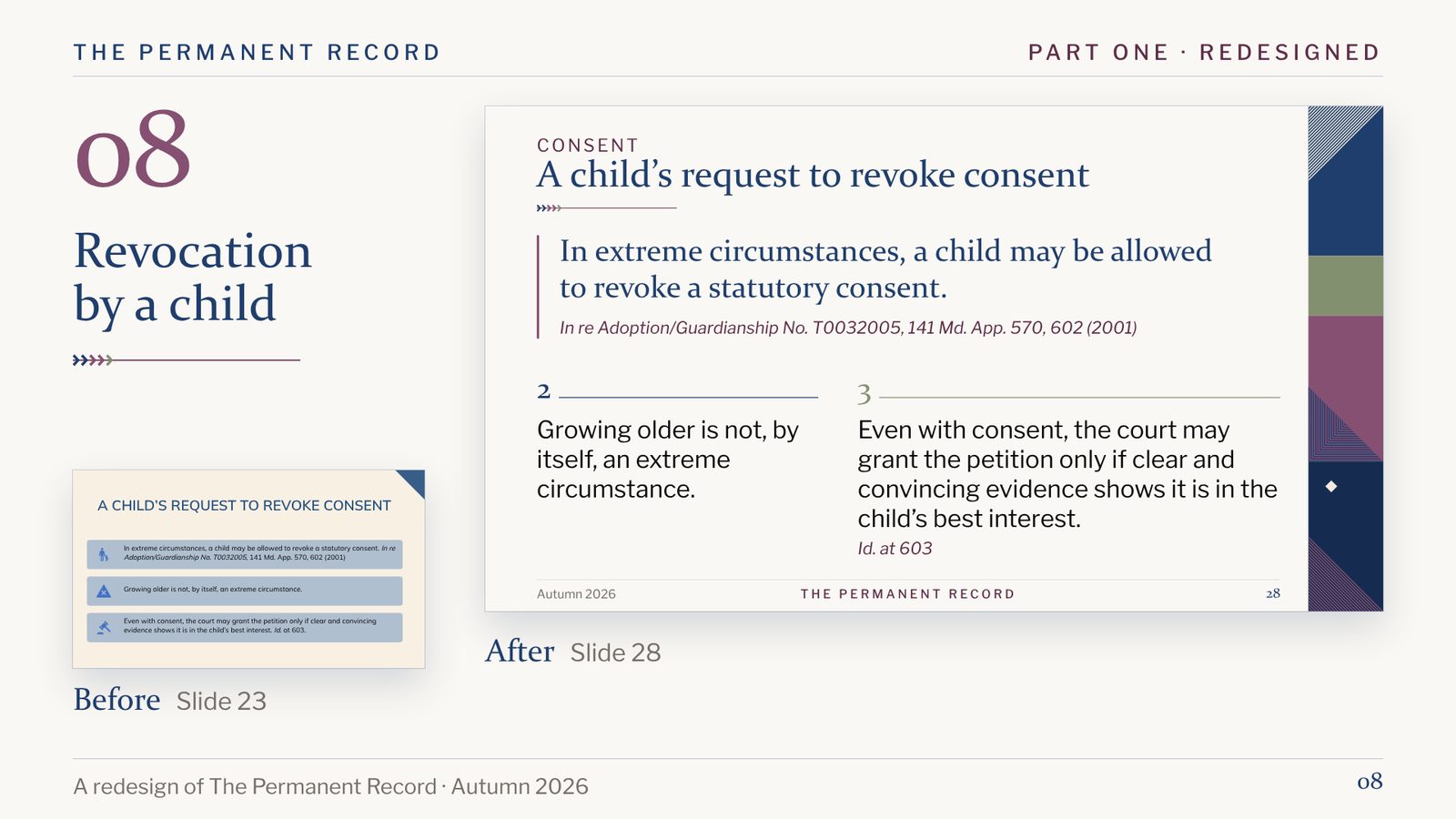
  9. Board 08, a child's request to revoke consent. Before: the original slide. After: three numbered points with their citations.
    08Revocation by a child
    Open board 08 full size
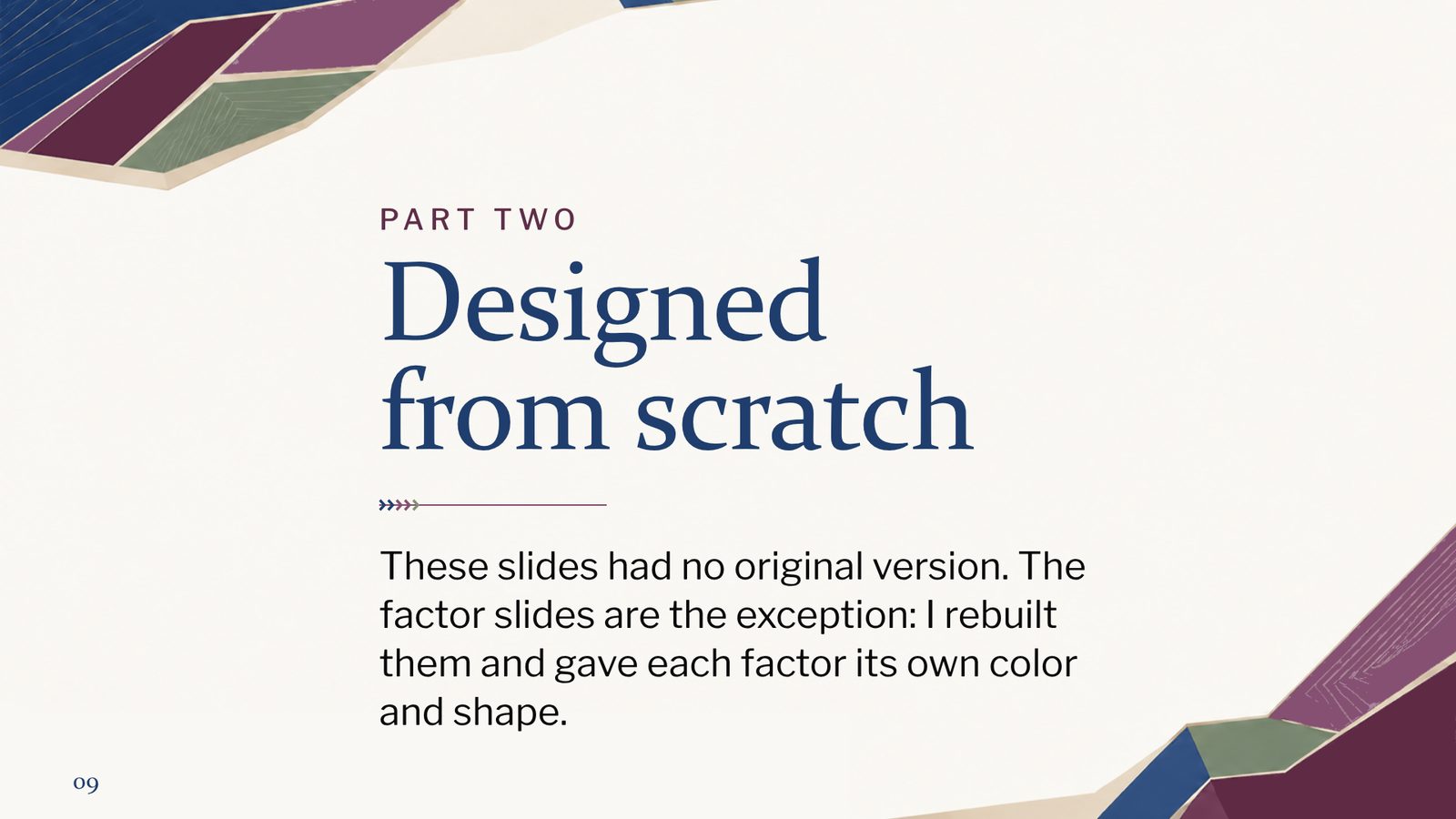
  10. Board 09, part two divider: Designed from scratch.
    09Part two · Designed from scratch
    Open board 09 full size
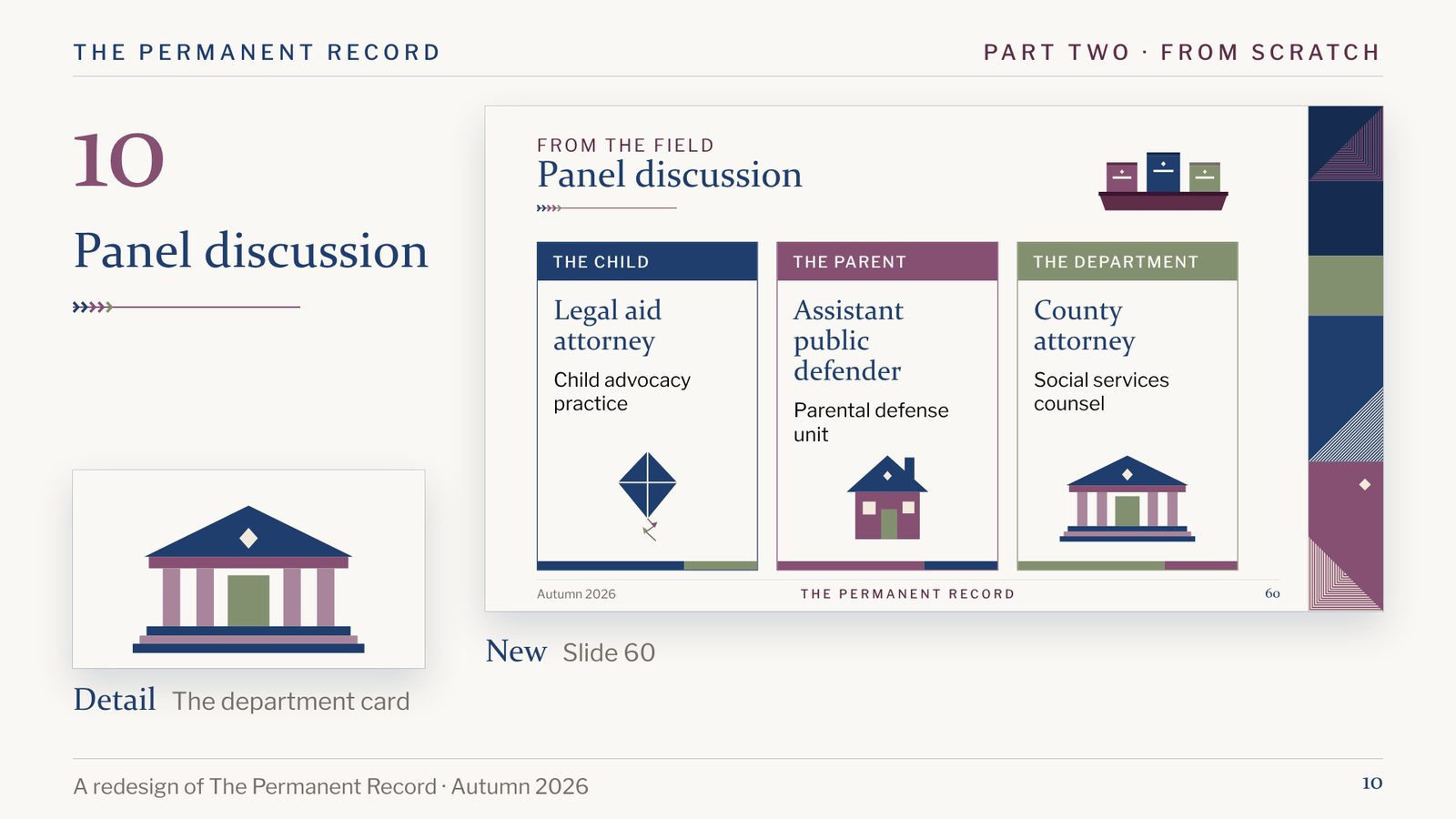
  11. Board 10, panel discussion. A new slide with a card each for the child's attorney, the parent's defender and the department's counsel.
    10Panel discussion
    Open board 10 full size
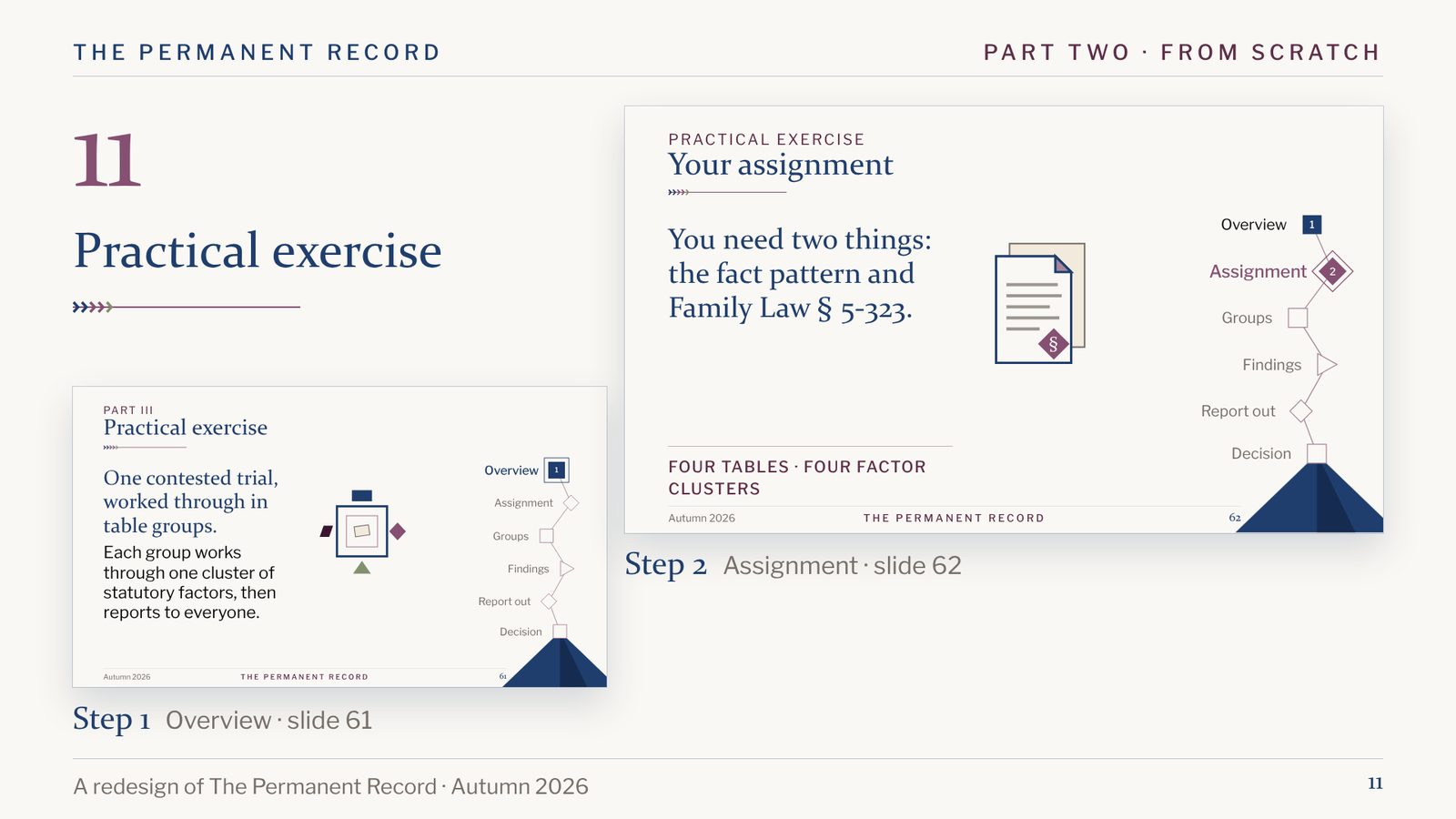
  12. Board 11, practical exercise. Two new slides: the overview and the assignment, steps one and two of six.
    11Practical exercise, steps 1 and 2
    Open board 11 full size
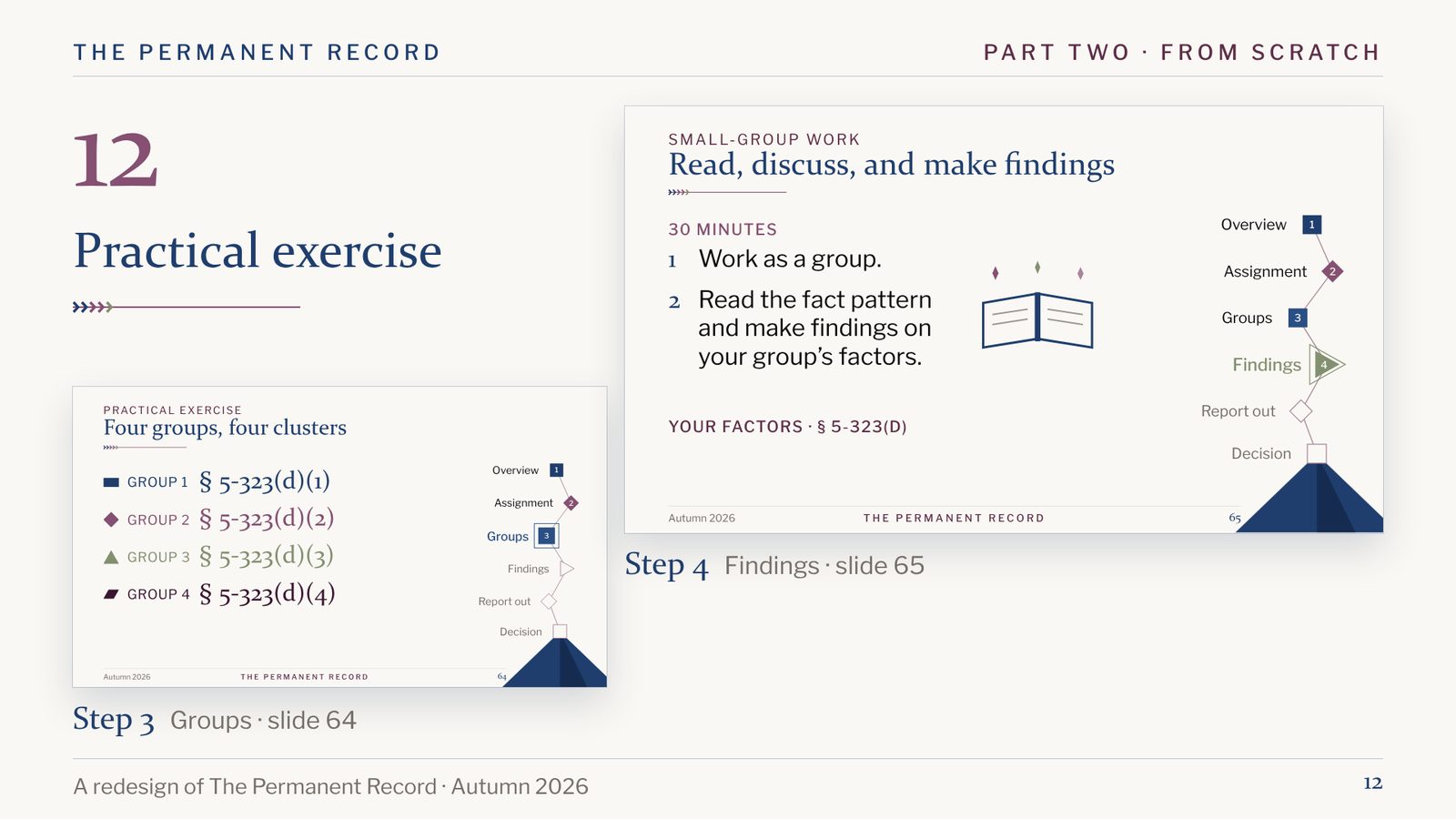
  13. Board 12, practical exercise. Two new slides: the four groups and the findings step.
    12Practical exercise, steps 3 and 4
    Open board 12 full size
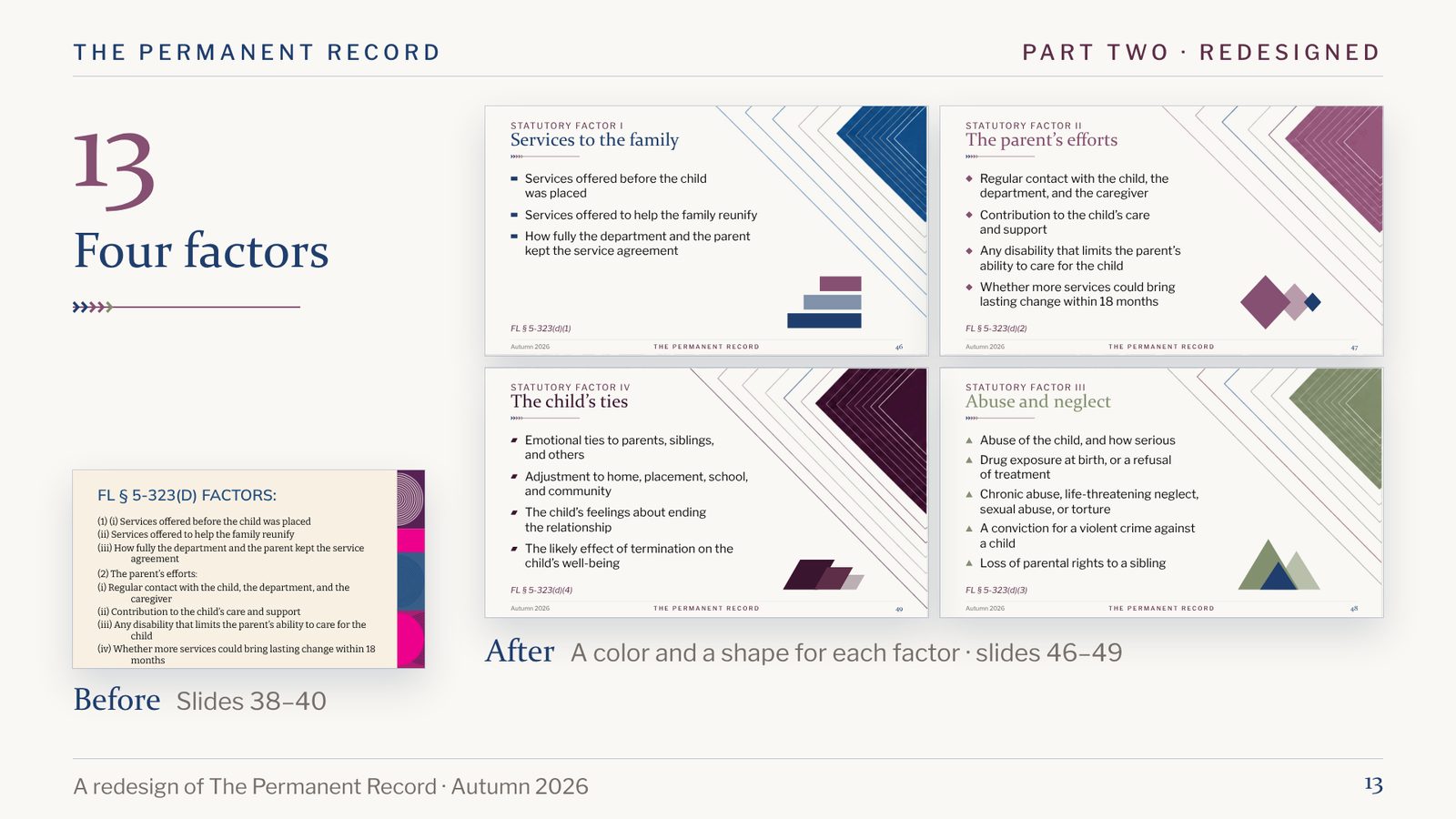
  14. Board 13, the four statutory factors. Before: the original slides. After: four slides, each factor with its own color and shape.
    13Four factors
    Open board 13 full size
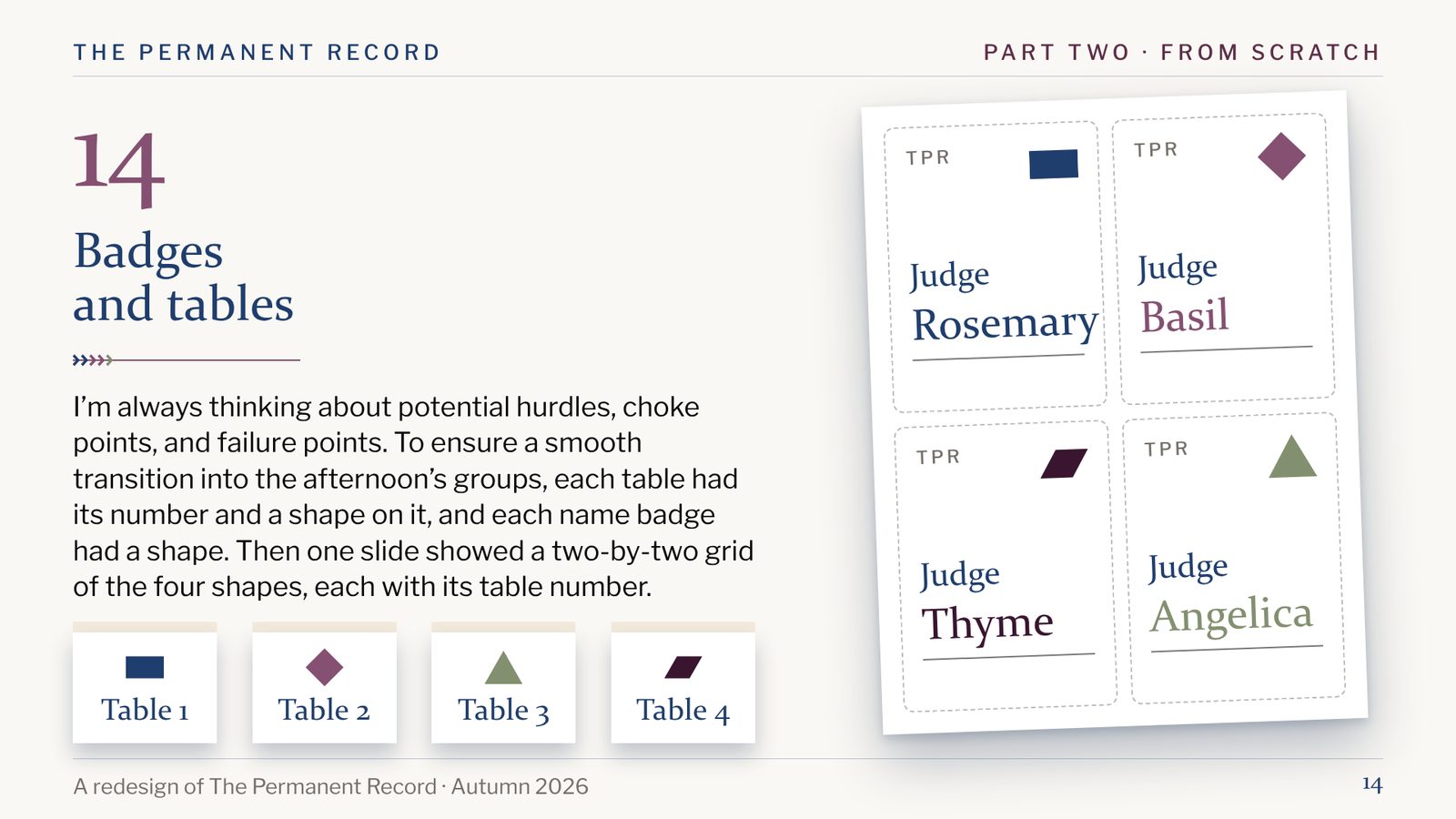
  15. Board 14, badges and tables. Four table signs and four name badges, each badge carrying a shape.
    14Badges and tables
    Open board 14 full size
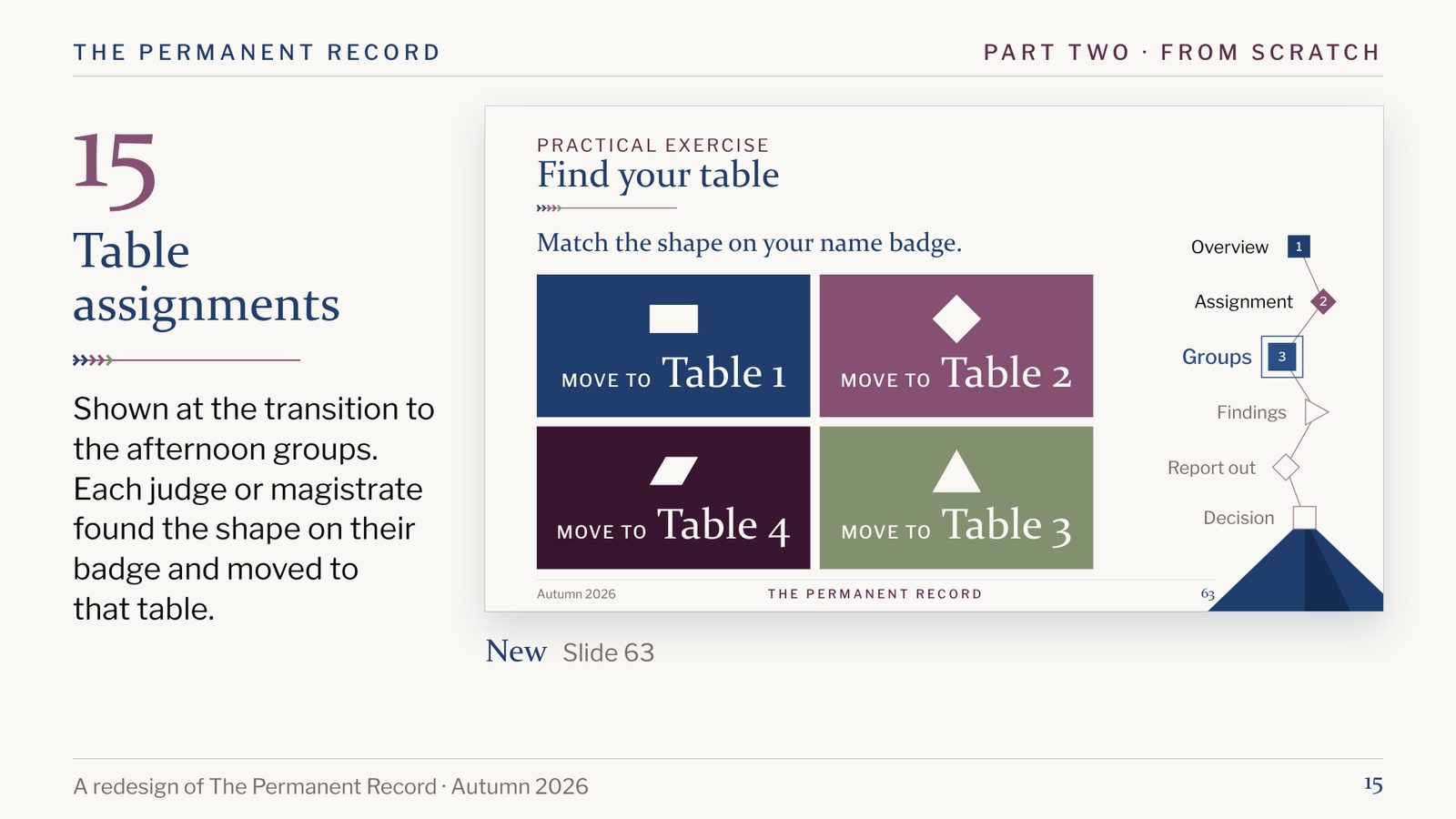
  16. Board 15, table assignments. The slide that sends each shape to its table.
    15Table assignments
    Open board 15 full size
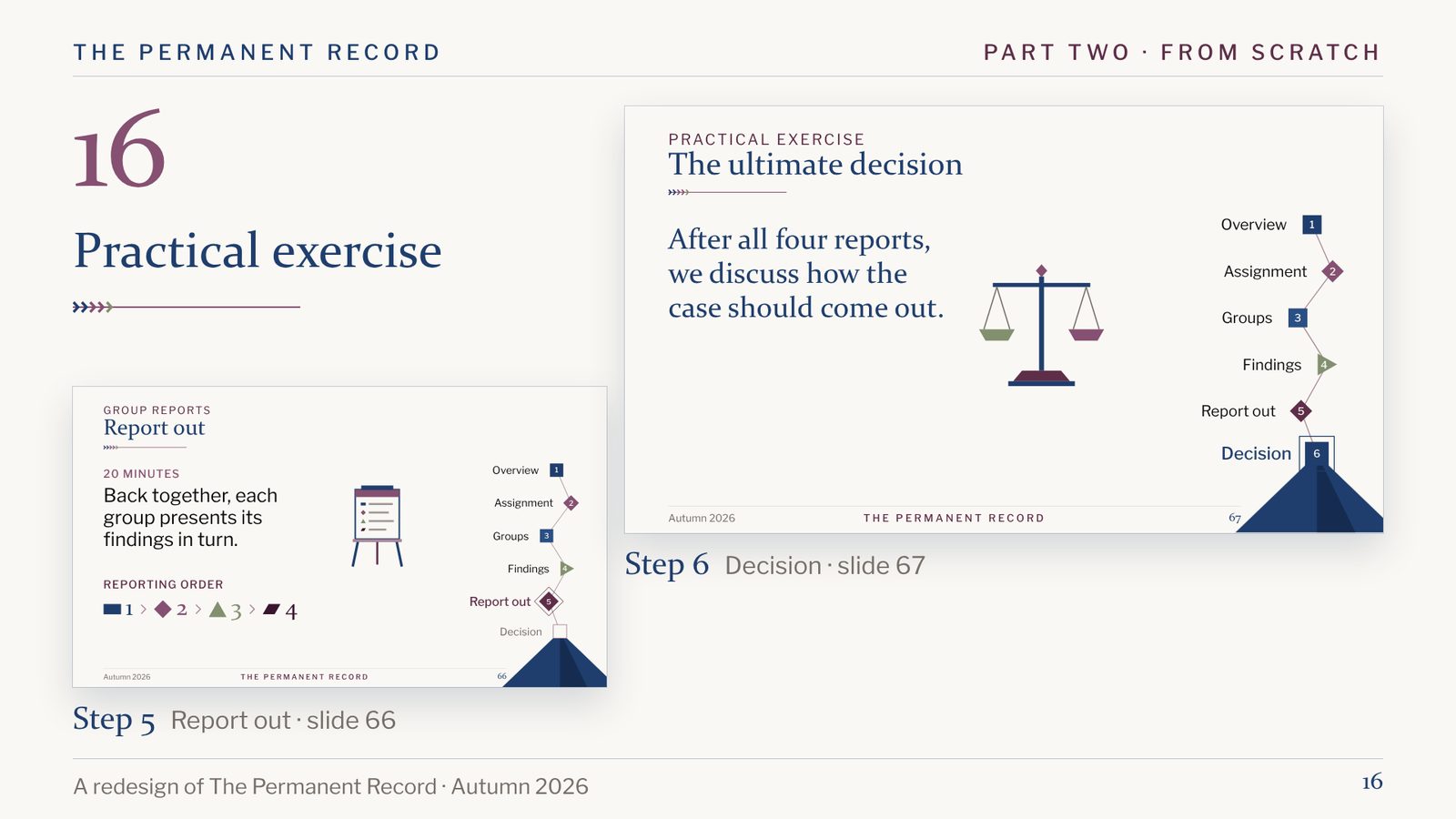
  17. Board 16, practical exercise. Two new slides: reporting out and the decision.
    16Practical exercise, steps 5 and 6
    Open board 16 full size
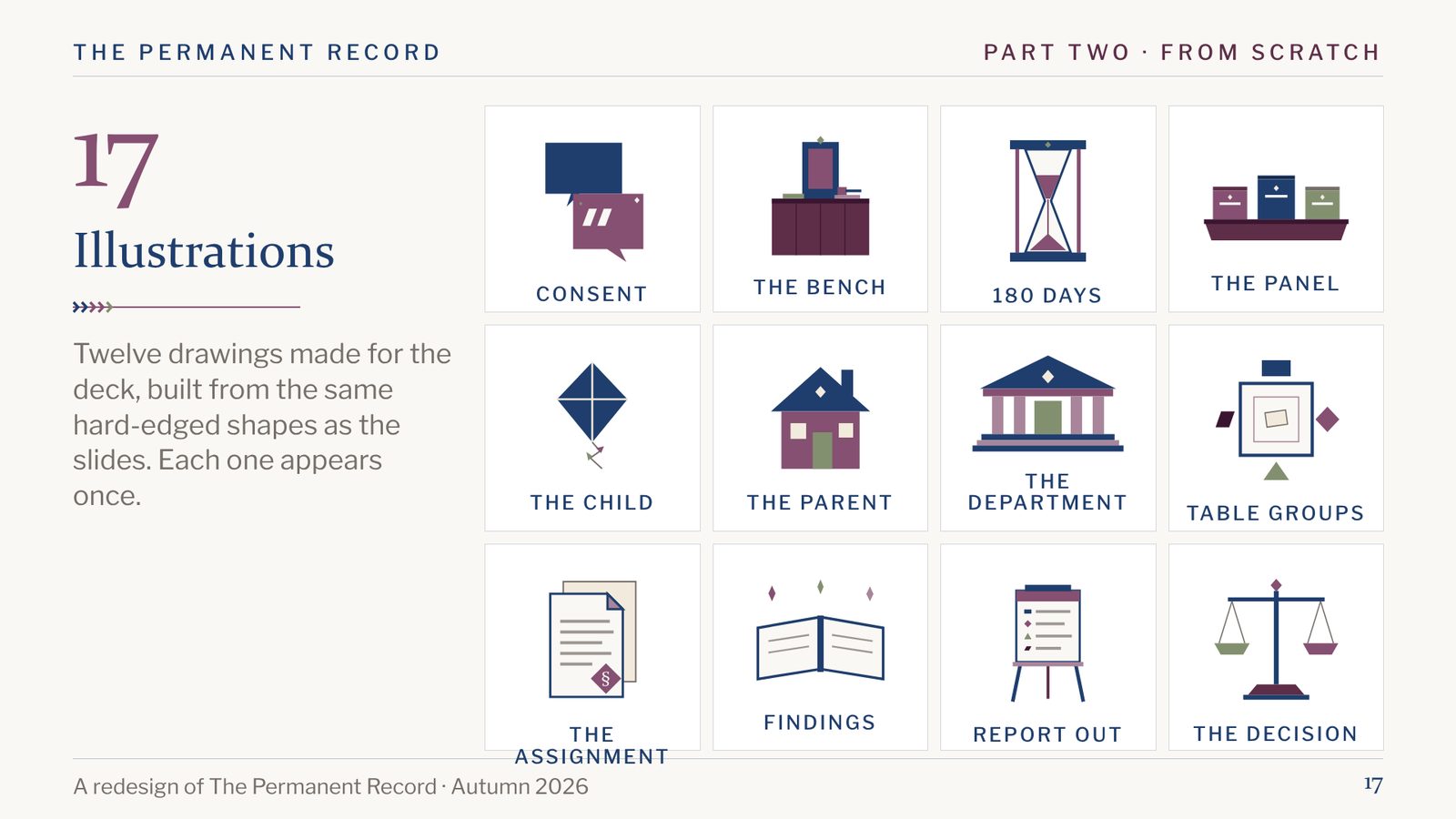
  18. Board 17, illustrations. Twelve drawings made for the deck from hard-edged shapes.
    17Illustrations
    Open board 17 full size
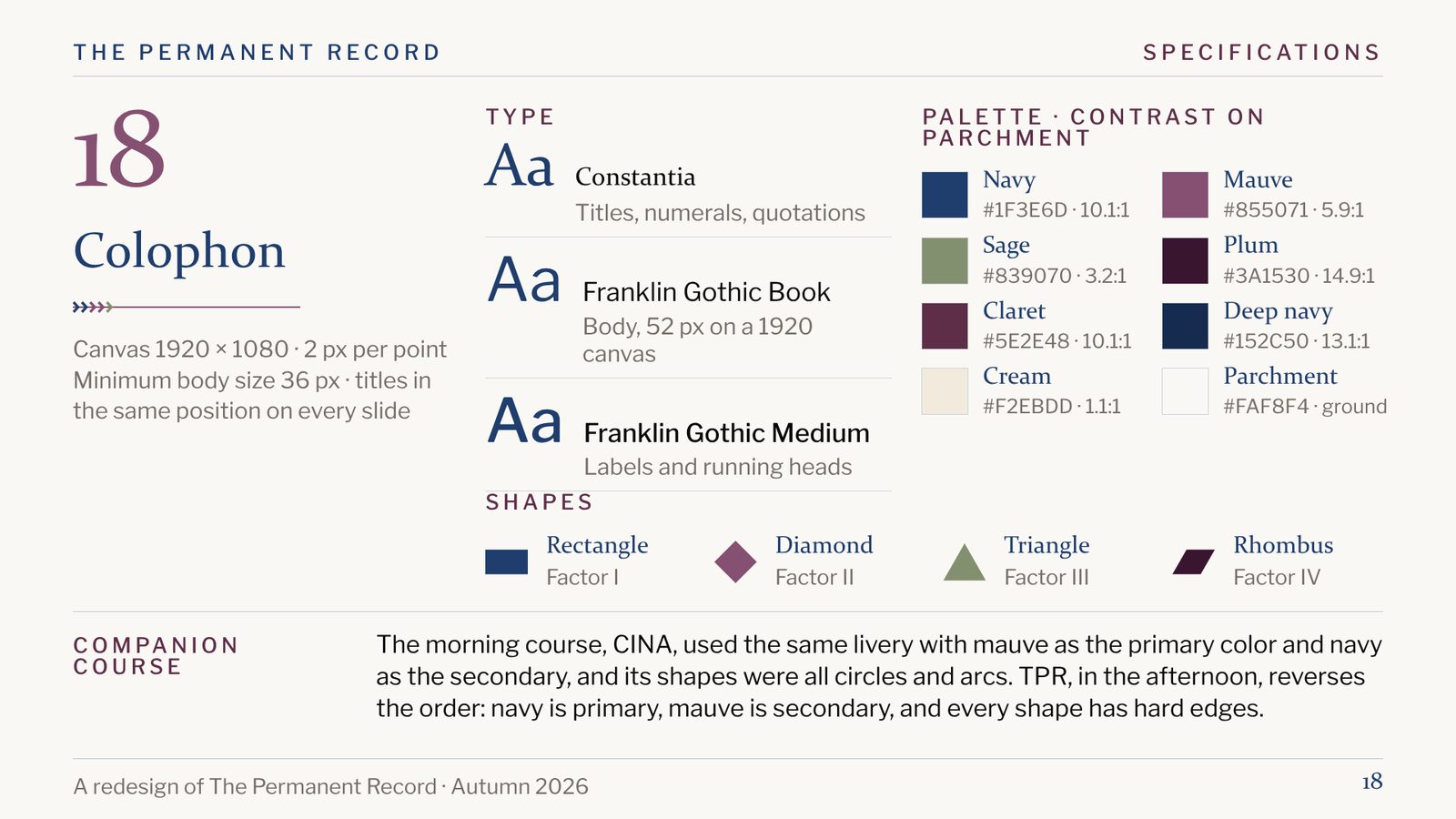
  19. Board 18, the colophon. The deck's type, its palette with contrast ratios, and its four shapes.
    18Colophon
    Open board 18 full size
  20. Board 19, part three divider: Companion course.
    19Part three · Companion course
    Open board 19 full size
  21. Board 20, months in foster care by state. Before: the original slide from the morning course. After: the redesigned comparison.
    20CINA state comparison
    Open board 20 full size
  22. Board 21, concurrent planning. Before: the original slide from the morning course. After: two redesigned slides on working two plans at once.
    21CINA concurrent planning
    Open board 21 full size
PreviousInstructional and visual designNextThe design rules