Same words. Different room.
Judges and faculty own the law and the clinical substance. I own the learning architecture, the practice mechanics and the tools that make it usable.
I inherited the 2023 version of this course: a 256-slide deck, a binder, two stand-alone scenarios and a set of evaluations. Over two seasons I rebuilt it with the coordinator and six faculty. Their words stayed theirs, checked against every source file.
Program manager · Spring to summer 2026 · Names barred throughout
The morning the printer broke ↓Summer 2026, one day, 9:00 to 3:30
Judicial officers, appellate through Orphans’ Court
Five judges and one clinician
Program manager, spring to summer
Fifteen participant evaluations, self-reports
The course coordinator, a planning call, July 2026“I feel very comfortable with you at the helm.”
The same coordinator, a working session later that month“It’s because you do so much, and you really… you are so good-natured, and you’re doing a great job.”
One day, eight sessions, and a case that ran through all of them.
One fictional defendant came back after every block, with one new layer in his file. Faculty held the science and the law; I built the day around him. Thirteen of the fifteen judges who answered said they intend to use the concepts.
Morning · The science
Afternoon · The bench
My first rule
My first rule for myself was to lighten the faculty’s load. They’re busy volunteers, not teachers, and my job isn’t to hand them more work: a pre-course packet I think is full of wonderful research is, on their end, one more thing to get through, and so is every email. The question I kept asking was what would make this easier, and what would make them want to come back and volunteer to teach again.
What I did, workstream by workstream
Faculty and rosterI read the 2023 evaluations first. The consensus in them was that the clinician’s simulation of what it’s like to hear voices in a courtroom was one of the most memorable parts of the day. She probably would have been invited back anyway, and I think the court and the coordinating judge wanted her. What I did was go into the first planning meeting saying we needed her because of that 2023 feedback, and then make sure the budget and the procurement were there to fly her in and cover the hotel. I rebuilt the lineup when a 2023 judge declined. When a faculty judge retired mid-planning and lost courthouse access, I moved her materials to attachments she could open from home.
“I will never forget that the next time I deal with someone who may be hearing voices.”
“The audio exercise most supported my understanding of what litigants with certain psychiatric issues are experiencing and encouraged me to explore various approaches to helping litigants with said issues.”
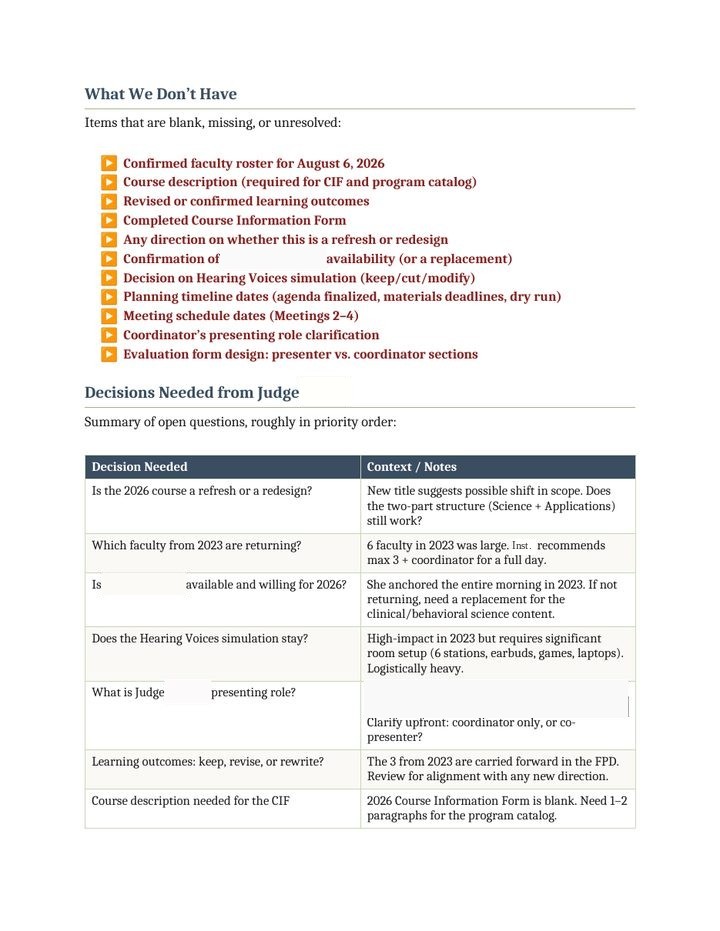
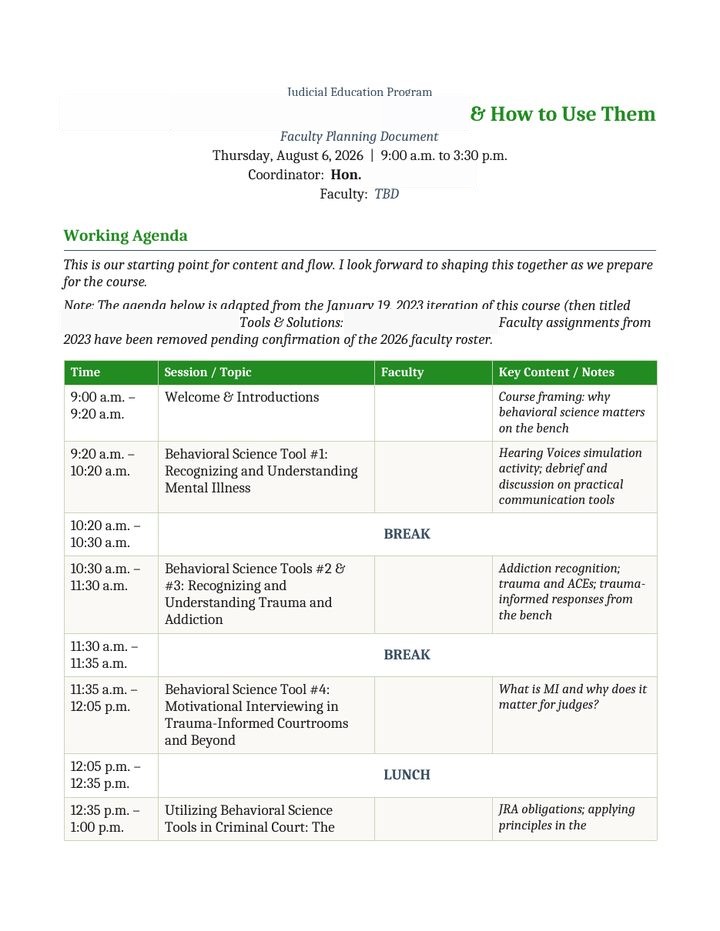
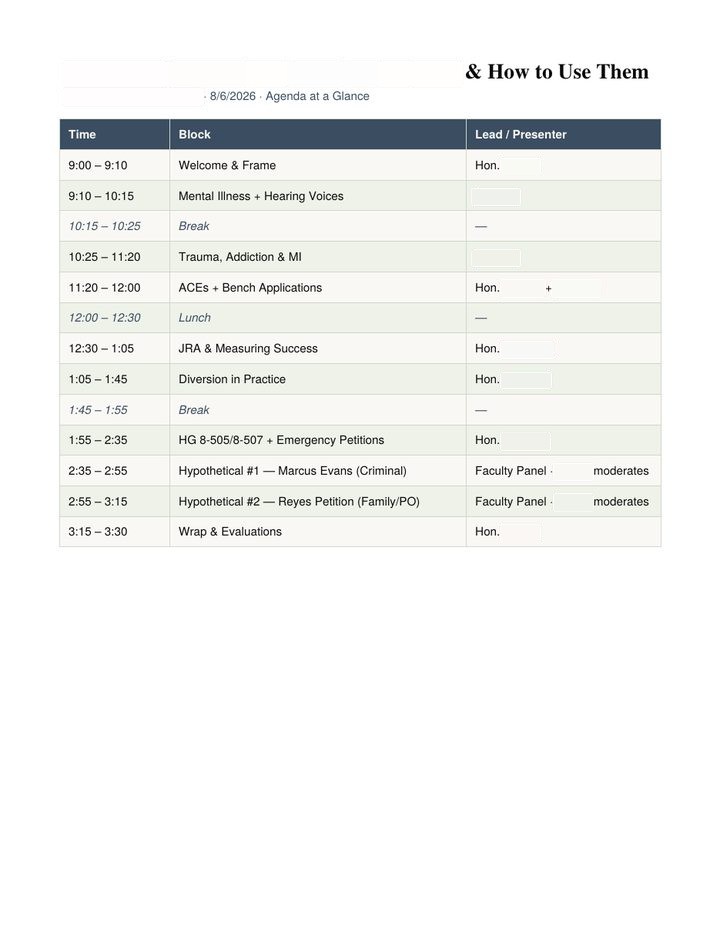
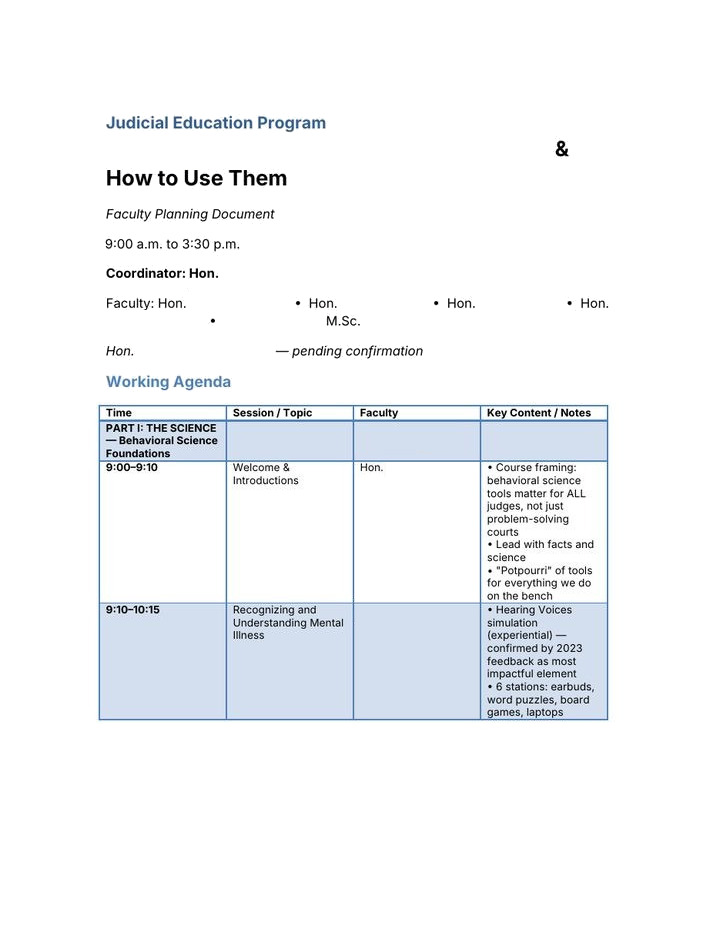
Agenda and learning outcomesI turned the 2023 agenda into the first planning document and revised it after every faculty conversation, always as a proposal. Learning outcomes went from three, to four by spring, to six on the day. I caught a ten-minute change to the opening that existed only in the dry-run recording.
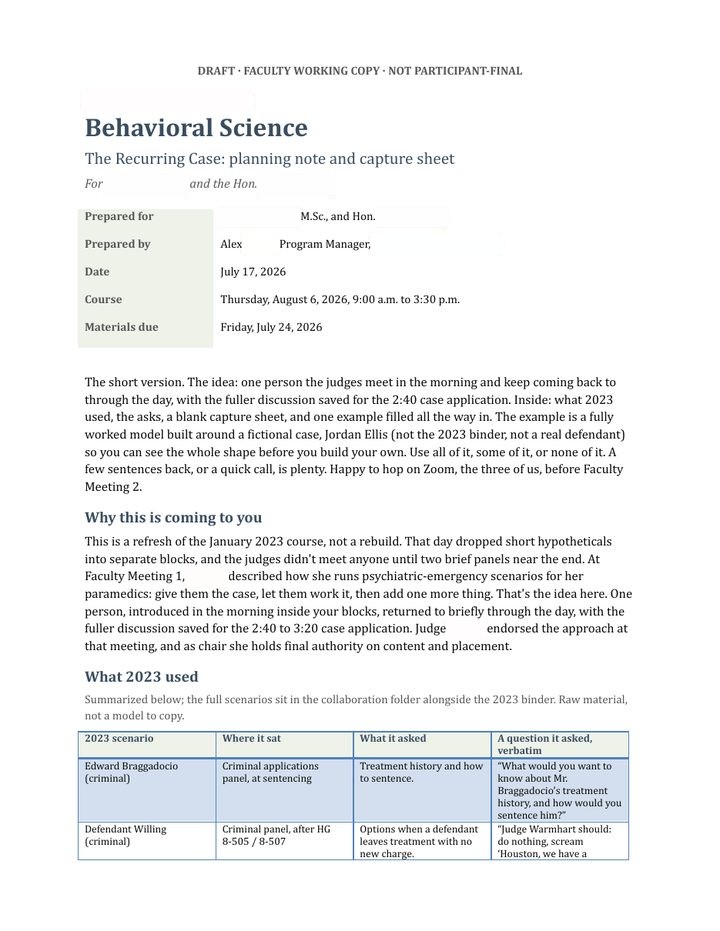
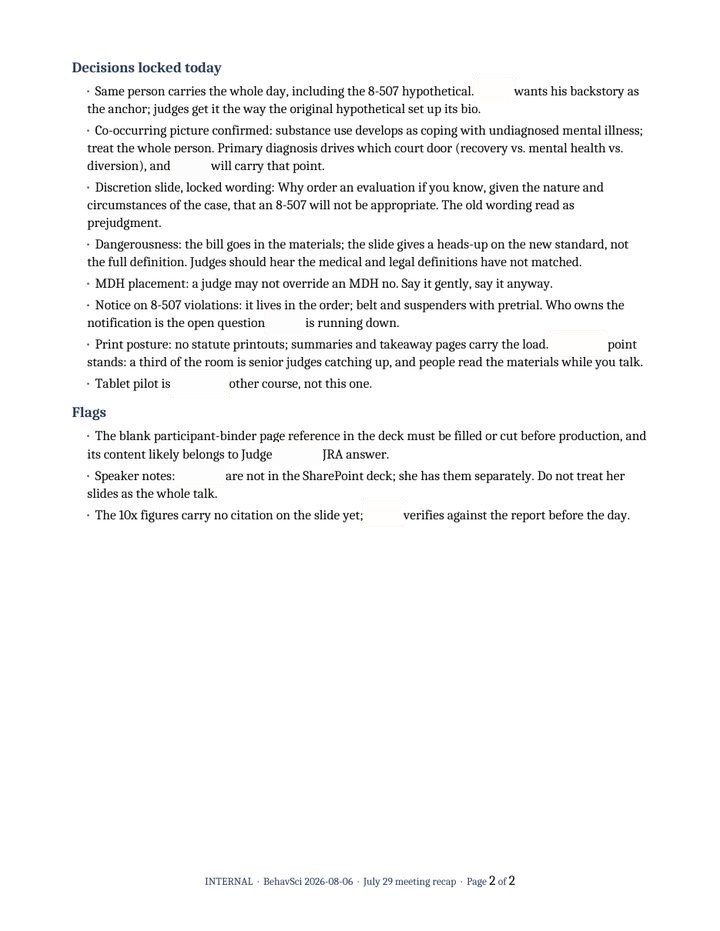
The recurring caseI replaced the two stand-alone scenarios with one fictional composite defendant, wrote the planning note and capture sheet with a fully worked example, and kept every fact proposed until the coordinator and the statutory judge approved it.
SlidesI built a template family for faculty to fill, recovered five slides whose text no tool could read, and held 256 slides to one visual system with nothing under 18 point. The rest of this page is that work.
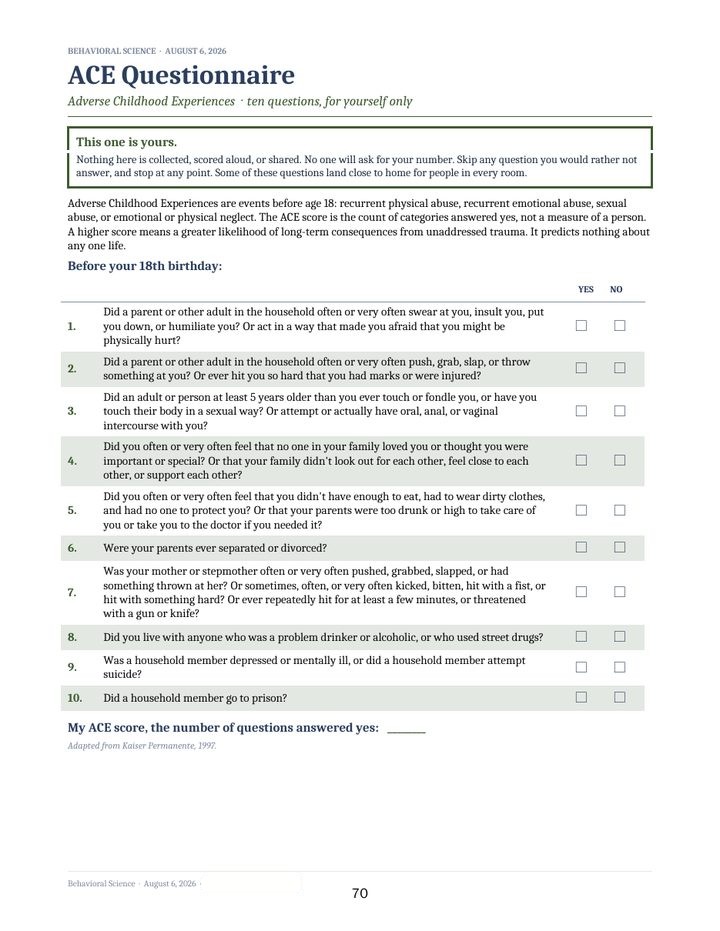
Binder and roomI rebuilt the participant binder with a linked contents page, redesigned the ACEs questionnaire at the clinician’s request and filed the room setup. I also wrote the run of show, which listed each session with its slide range, its faculty and the slide where Jordan returns.
ChecksI ran an AI-assisted check of faculty wording and every figure before the first send. It caught a statute cited with the wrong section number, a court participation figure that didn’t match its source, and a percentage with no source behind it.
Faculty reviewI built an individual review packet for each faculty member, an all-faculty crosswalk and a checklist to approve, validate or change every item in each block. The cover note I wrote for the 2023 slides offered three choices and pressed none: reuse them as they were, rebuild from them, or set them aside and build new.
On file
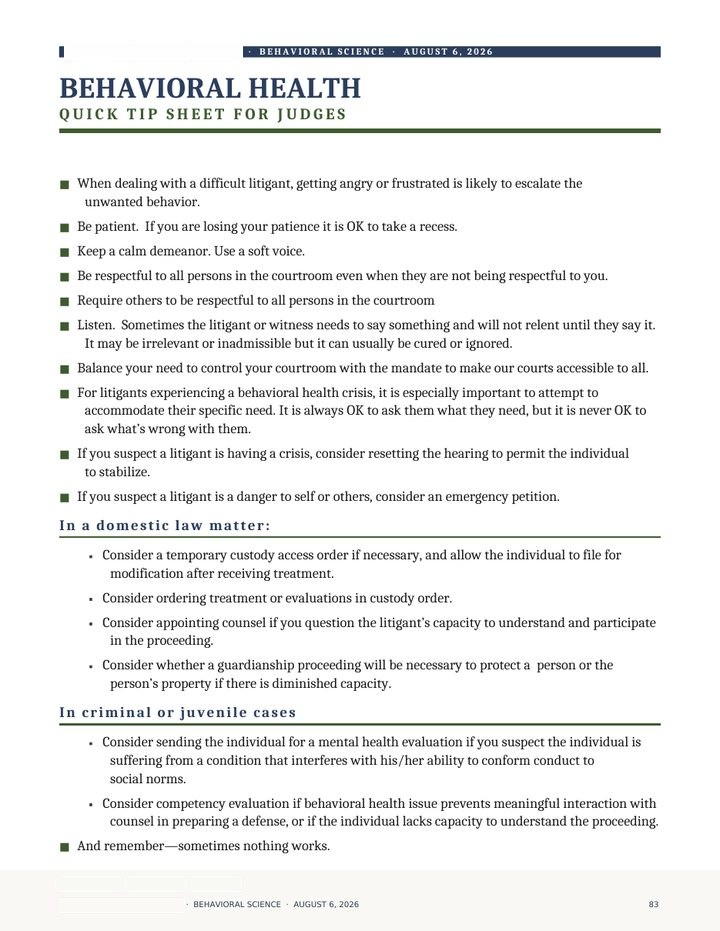
Same words
Checked against the source, word for word. A full slide becomes two.
18 point floor
A third of the room read from the back. Split, never shrink.
One master
Same title, same rule, same footer, every slide.
Faculty first
Preserve when preserving is right.
Four good reasons, beside a question mark.
The slide that tells judges why they are in the room. The reasons are the coordinator’s and they hold up. In 2023 they shared the slide with a grey box of clip art.
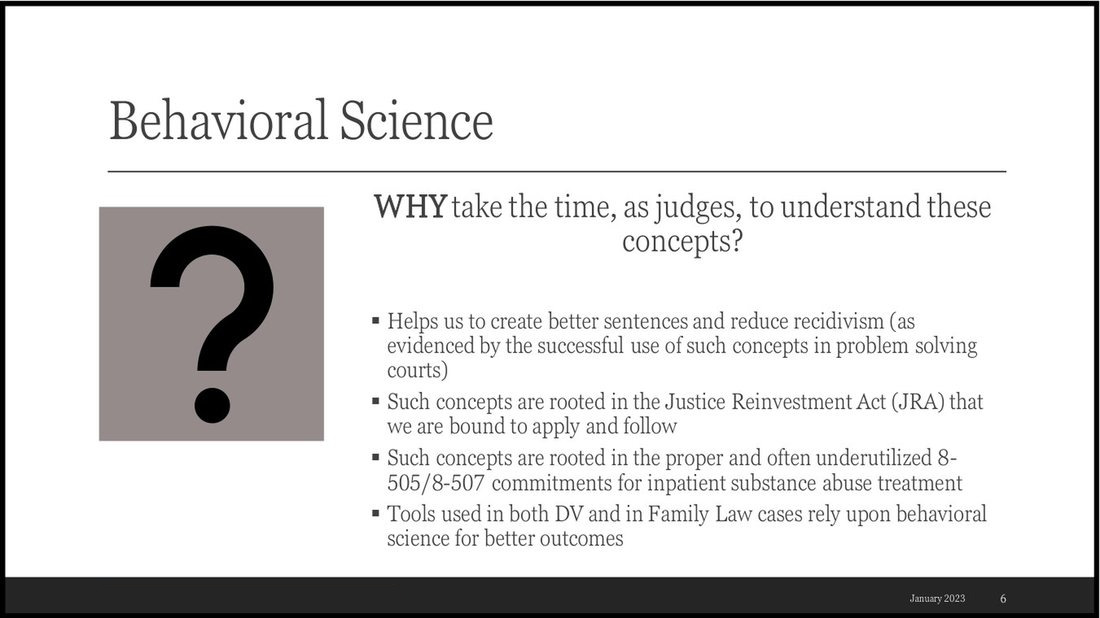
WHY carries the questionHer words in her order. The clip art is gone and the word itself does the work, in sage, at the head of the slide.
The bullets took the room the box hadBody type sits well above the 18 point floor, and each reason gets a line and a half instead of four.
The sentence was a diagram all along.
“Judicial Branch Commits to Executive Branch Pursuant to a Comprehensive Statutory Scheme” was the first item in a numbered list beside a clip-art book. It describes two parties and a direction, so the slide draws them.

One branch commits to the otherThe two branches are blocks; the commitment is a tiled bridge between them, and the statutory scheme runs underneath as a caption.
“But” is the hingeThe State’s duty sits on one side, the delegation that qualifies it on the other, and the slide’s one conjunction stands between them at title size.
One crowded slide, given room to breathe.
Health-General 8-505(a), all three clauses crammed onto one slide in orange SmartArt. Every text extractor I ran reported it as empty, because the words sat inside a diagram object. I recovered the text and gave the statute two slides.
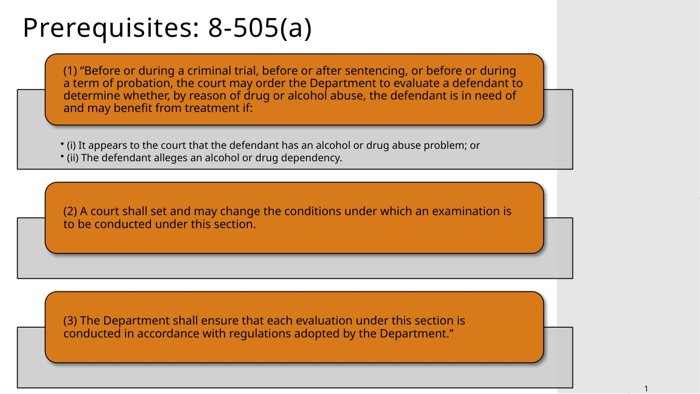
As delivered · two slides
One slide became twoFaculty had all three clauses on one slide. Clause (1) and its two tests now have a slide of their own; the two procedural clauses have the other, at a size the back row can read.
The choice is drawn as a choiceThe statute offers two alternative tests, so they sit side by side as equal fields with a single “or” between them.
Recovered, then set as live typeWording unchanged and editable, so faculty could still revise it the week of the course.
A stock photo of Scrabble tiles.
Three questions the faculty member wanted the room to sit with, beside a stock photo of Scrabble tiles spelling FAQ. The photo was doing nothing, and three equal boxes gave the lead question the same weight as its follow-ups.
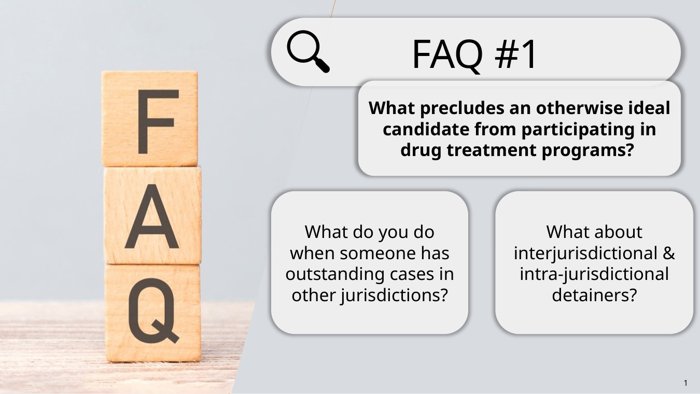
The Scrabble tiles became azulejo tilesStill Scrabble, point values and all, but glazed in the course motif and stacked down the full left edge, with the faculty member’s blessing.
The lead question got the wide panelThe two follow-ups sit below it, subordinate to it and equal to each other. The tile column carries all five FAQ slides.
One slide became three reading beats.
The faculty exercise, as drafted: facts, the court’s order and the defendant’s signed statement on a single slide, in 10-point type. Nothing could be cut, so it was split.
As delivered, three slides
From the faculty draft. This exercise was later replaced by the recurring case, below.
The rule the exercise was built to land.
After the exercise, the point the faculty wanted the room to leave with. In the draft it was a single bullet beside a stock photograph of an asteroid.


The only dark slide in the sectionSo the turn reads as a turn. The asteroid became a tiled porthole in the course’s own hand.
The rule is set first, in the serif“8-507 is not a freestanding sentence.” The explanation follows in the body type.
Two scenarios at the back, and the person who replaced them.
The spring draft still ran two stand-alone scenarios back to back. I proposed one fictional composite defendant who returns after each teaching block, so judges make another decision with the tools they have just been given.
At the first faculty meeting I brought the idea up, and the clinician jumped in right away: she does the same thing in her continuing medical education courses, where the group meets the same victim all day. One of the judges said she thought it was a great idea.
Before
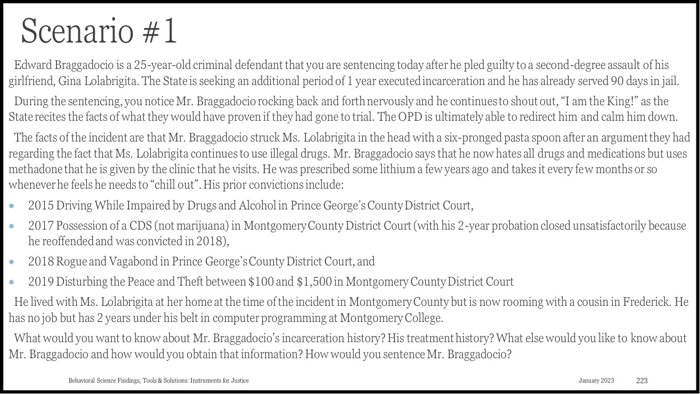
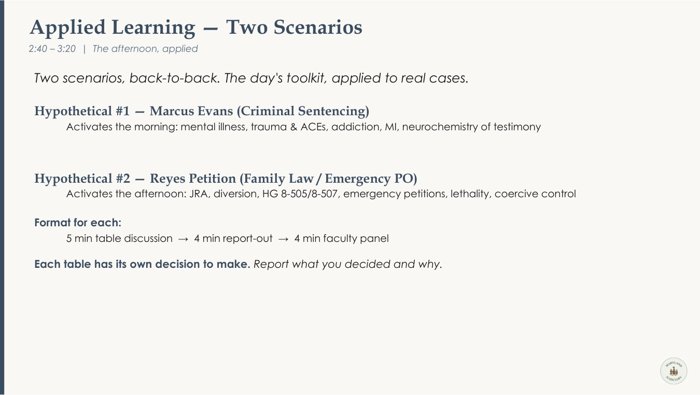
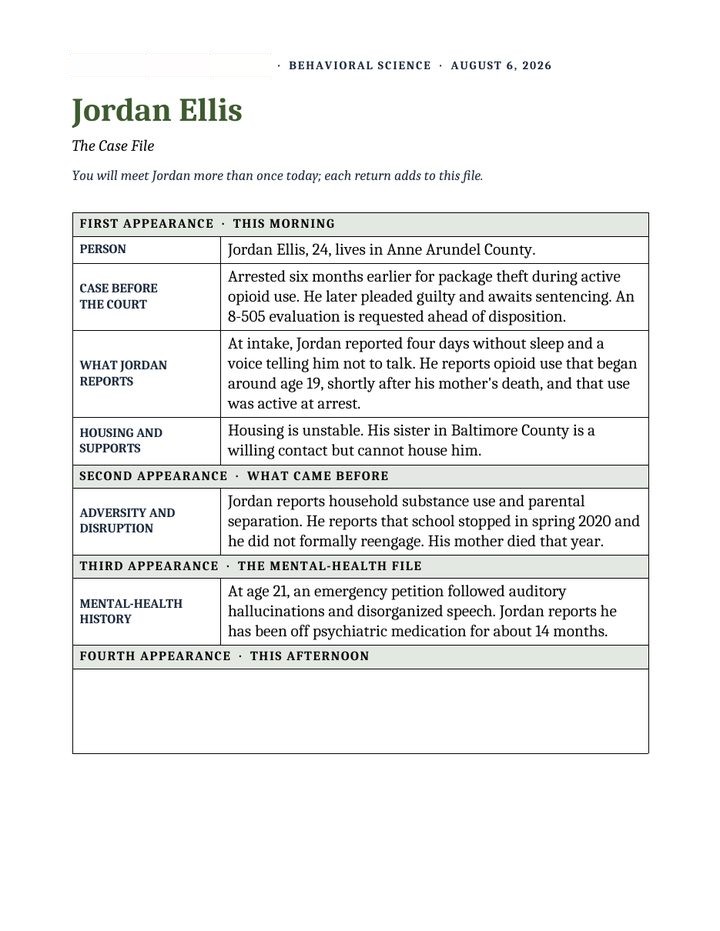
As delivered, first and second appearances
Every return carries the file so farA tinted band holds what is already established, so a judge who missed the morning can still decide in the afternoon.
No score anywhere on his fileAn ACE score is a population measure and predicts nothing about one person.
Why one case, four timesIn summer 2026 I commissioned a research brief on whether one defendant, met four times, would hold up better than a fresh hypothetical in every block. The brief is input for the design, not a literature review of mine. I used three of its arguments: a course can introduce a case and come back to it in more depth, adults learn around problems rather than subjects, and coming back to the same facts after a gap works better than one long stretch on them.
The printer failed on the morningSo the file moved onto the slides. That morning is the next section.
The printer broke. The day didn’t.
The plan was a one-page case file on every table, filled in at each of Jordan’s returns. On the morning of the course the printer failed, and the case file couldn’t be copied for every table.
A case file on every table
One printed page per table, filling in at each return.
The printer, that morning
No copies of the case file for the tables.
The room itself
The file so far on every return slide, and table discussion.
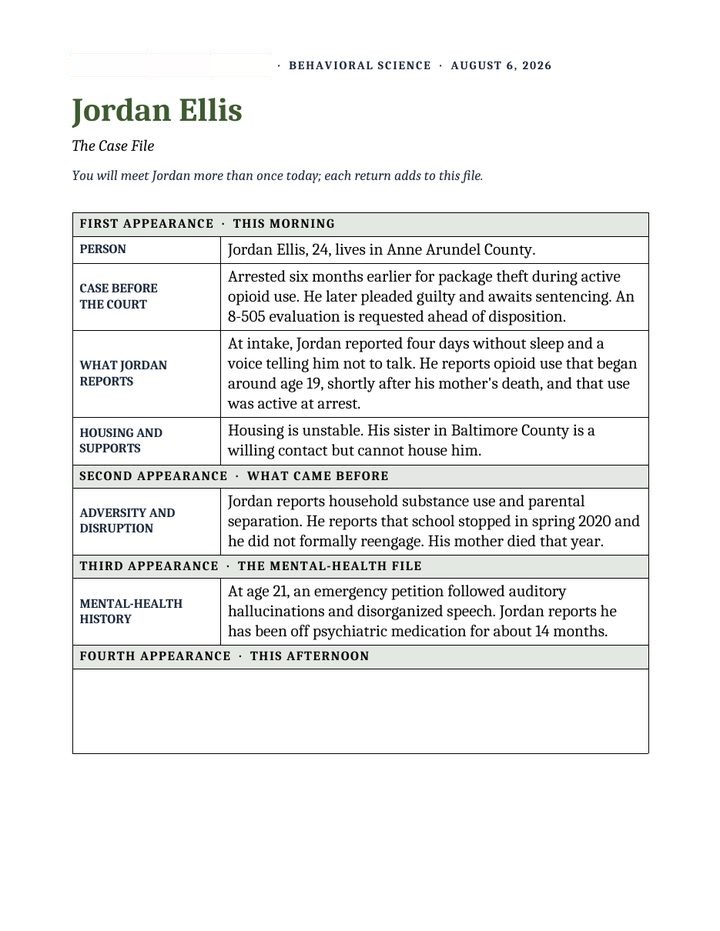
The file moved onto the slidesThat morning, the case file so far went onto each of Jordan’s return slides in place of the paper, so every table could still see what had already been established.
Slido came outLive polling was dropped for a show of hands. Faculty ran table discussion and casual polling from the front instead.
The closing round still ran at every tableWhat Jordan needs now, what the court still needs to know, and what the court can do today.
A teaching point worth keeping.
A judge’s 2023 quote slide, black and white, the attribution boxed in a hard rectangle. She uses it to open her section on listening to defendants. It needed a frame that did not fight it.
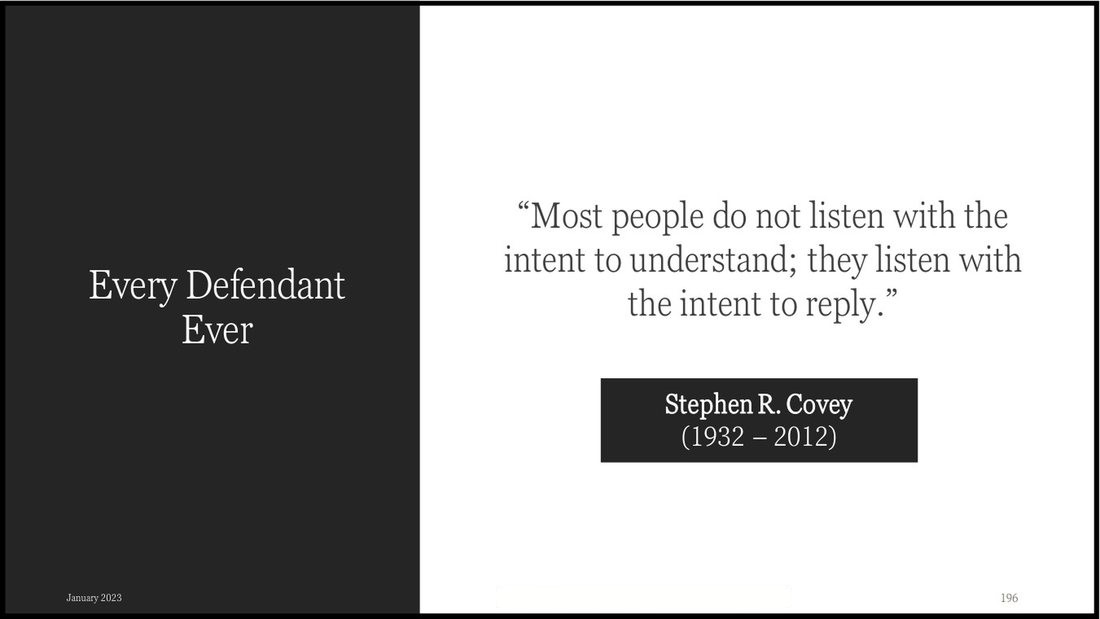
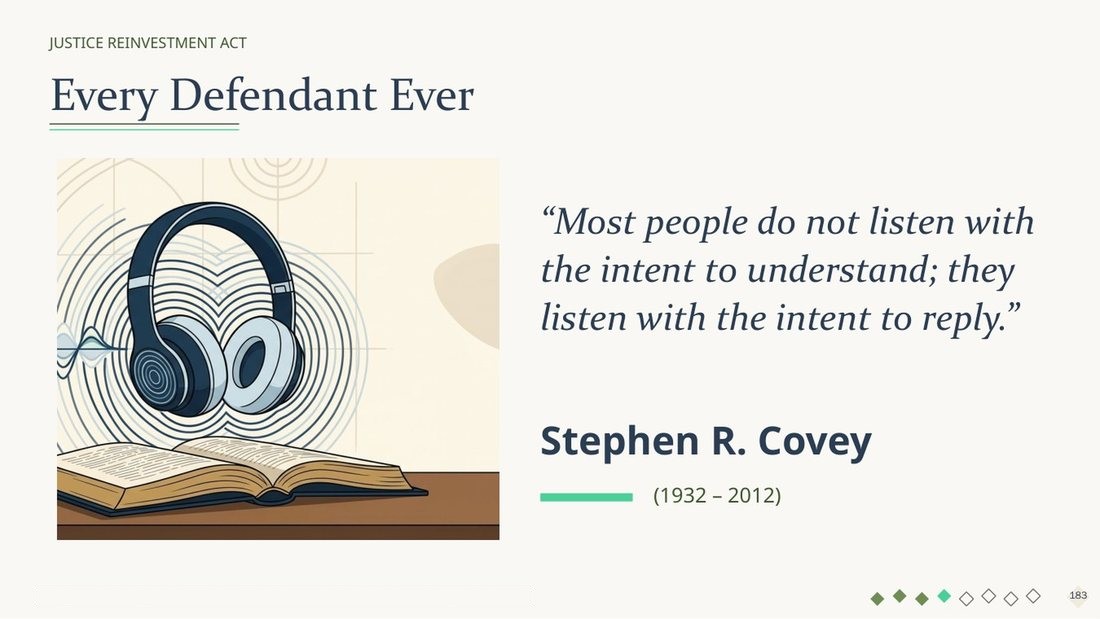
The quote gets half the slideIn italic at display size, beside new art in the course palette.
The attribution leaves the boxCovey’s name at title weight with a sage rule and his dates. Her section title moves to the eyebrow, so the quote reads as hers.
Three templates, so faculty could build their own.
Six faculty, six working styles, one day. Rather than restyle everyone’s slides at the end, I built three slides for faculty to fill, each with its rules written into the placeholder text. One judge built her entire section in them.
Everything’s in the same color palette, everything goes together, and it’s not just to make things look pretty. It’s super organized. I glance, I see that shade of green, this is behavioral health.
Ledger · points, with a side column for the record
Panels · points, with stat blocks and the swatch grid
Discussion · one question, three decisions, one show of hands
Preserved, not restyled
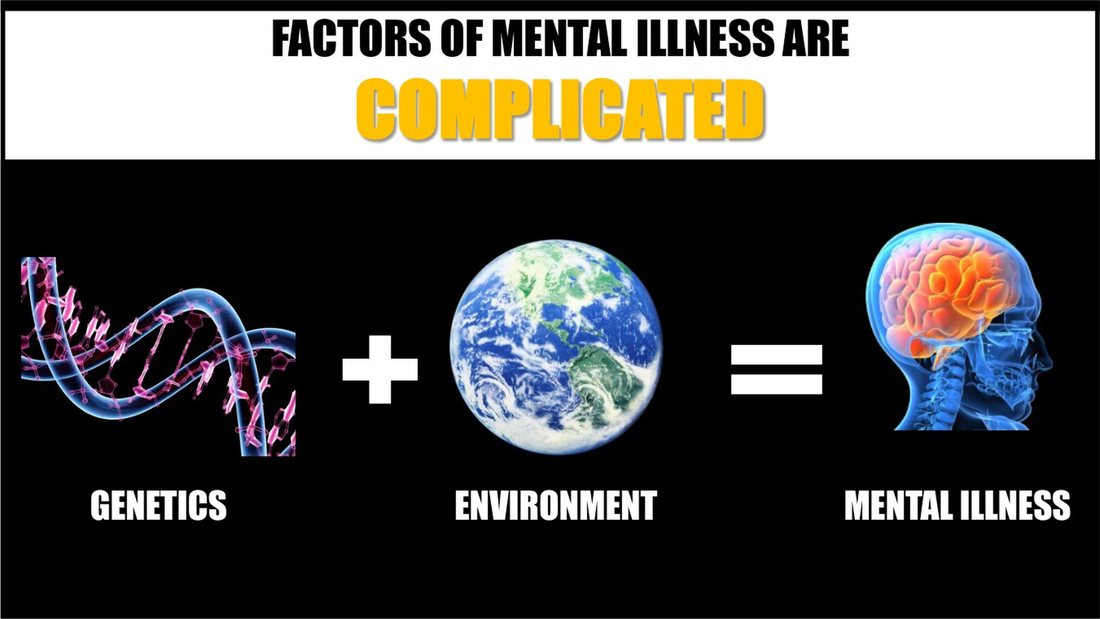
The rules live in the placeholders“Split the slide before shrinking the type” is the template’s own second bullet, so a judge filling it in reads the rule at the moment it applies.
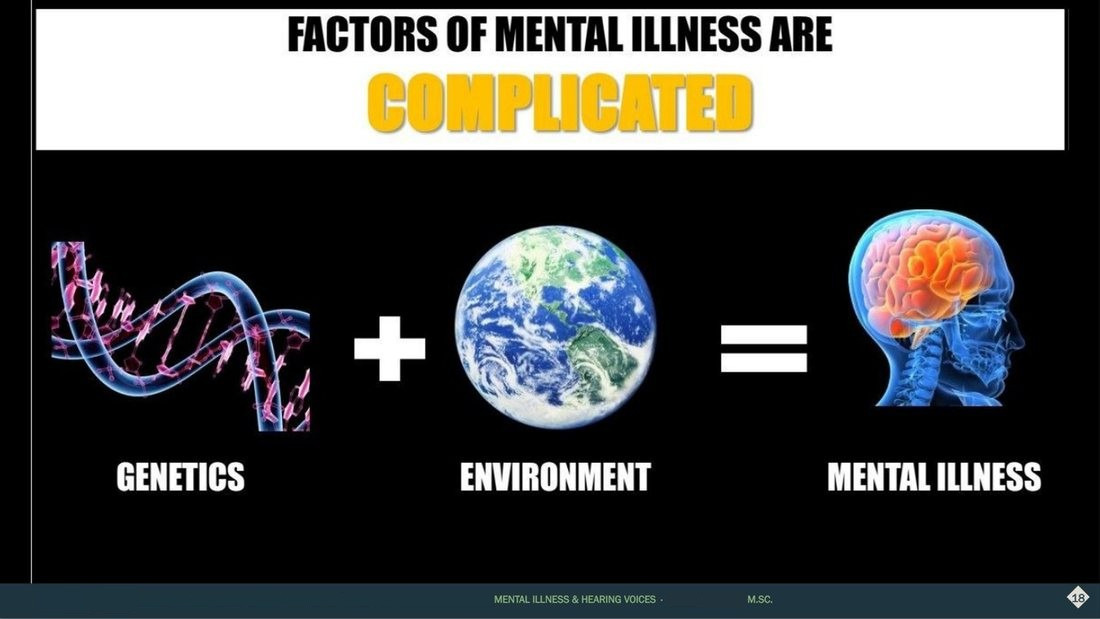
Knowing when not to restyle is part of the systemThe clinician’s 142 slides came in as pictures, exactly as she made them, with only the course footer added. Her design and her branding stayed hers.
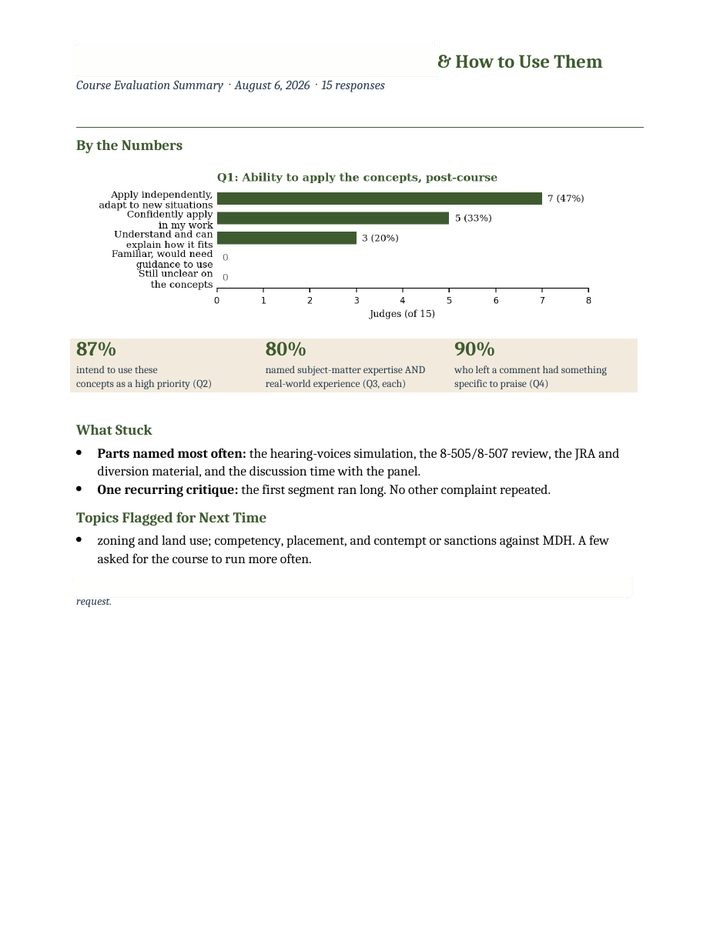
Fifteen judges answered afterward.
The answers were post-course self-reports, collected in late summer 2026.
12of 15
said they can confidently apply the concepts, or adapt them
13of 15
said they intend to use them as a high priority. The other two said their role doesn’t call for them.
0of 15
chose any negative statement about instruction
Answer choices shortened from the survey. Bars run from 0 to 15.
Judge, 2026 evaluation“They presented lots of complicated material in an economical but understandable fashion.”
Judge, 2026 evaluation“The slides and printed materials captured the essence of the presentations and made an excellent resource for future use.”
Judge, 2026 evaluation“More Judges should take this course.”
The evaluation drew four written critiques, quoted here in full.
“The first segment was probably too long.”
“Make the materials correlate to the presentation to allow notes on the handouts as we go along.”
“Maybe offer the course twice a year.”
“more classes to better explore subject material”
One judge asked for handouts that follow the slides in order, with room for notes. The fix is to print each session’s slides in presentation order with a notes column beside them.